
In 2024, the line between professional photography and casual snapshots has blurred like never before. High-end smartphones now feature triple-lens arrays, night modes that rival astrophotography setups, and AI-powered image processing that automatically enhances color, contrast, and focus. At the same time, entry-level DSLRs—once the go-to for aspiring photographers—are often priced higher and bulkier than their pocket-sized competitors. So, is carrying around a “real” camera still necessary? For many, the answer isn’t a simple yes or no—it depends on how you define \"need.\"
The truth is, while smartphones have democratized photography and made excellent image quality accessible to everyone, they still operate within physical and functional limits. A DSLR, even an entry-level one, offers control, flexibility, and optical capabilities that smartphones can't fully replicate. This article breaks down the real differences, weighs the pros and cons, and helps you decide whether investing in a dedicated camera still makes sense today.
Image Quality: Beyond Megapixels
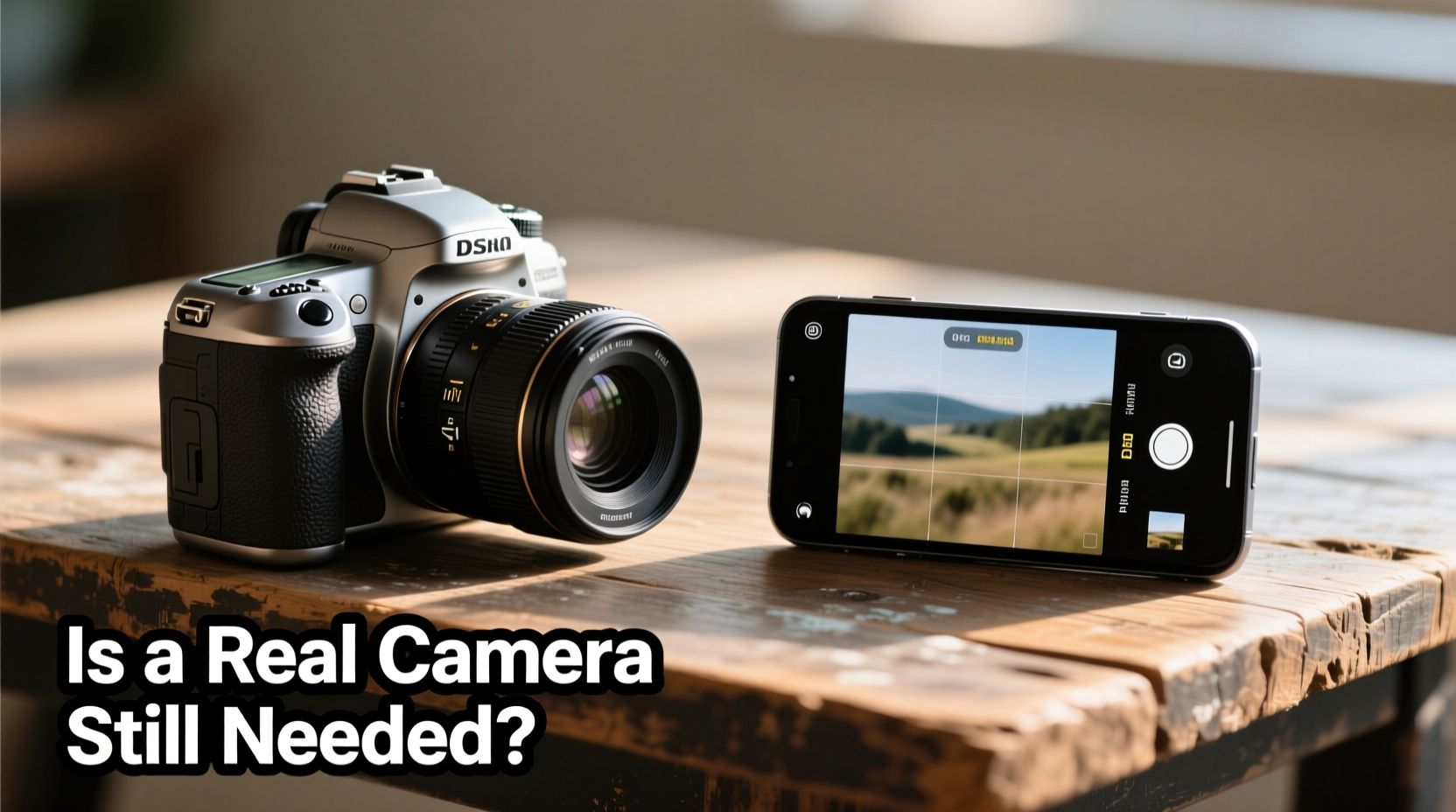
Megapixel counts on smartphones can be misleading. A modern flagship phone might advertise a 50MP main sensor, but those pixels are crammed into a tiny 1/1.3-inch chip. In contrast, even an entry-level DSLR like the Canon EOS Rebel T8i or Nikon D3500 uses an APS-C sized sensor—over 10 times larger in surface area. Sensor size directly impacts light capture, dynamic range, and noise performance, especially in low-light conditions.
Smartphones compensate with computational photography: stacking multiple exposures, sharpening edges artificially, and using HDR algorithms to balance shadows and highlights. The results often look impressive at first glance—bright, vivid, and optimized for social media—but upon closer inspection, details can appear over-processed, textures get smudged, and fine gradations in tone lose subtlety.
A DSLR captures more light per pixel, resulting in smoother tonal transitions, better highlight recovery, and richer shadow detail. It also allows shooting in RAW format—a digital negative that preserves all sensor data. This gives photographers far greater latitude during post-processing compared to a compressed JPEG (or HEIF) file from a smartphone.
Lens Flexibility and Optical Performance
One of the most significant advantages of a DSLR is lens interchangeability. An entry-level model typically comes with an 18-55mm kit lens, which already offers variable focal lengths impossible to match with a single smartphone lens. But beyond that, you can upgrade to wide-angle, macro, telephoto, or prime lenses with fixed apertures as your needs evolve.
Consider this scenario: you’re photographing a bird in flight from 50 meters away. Your smartphone’s 3x optical zoom maxes out quickly, forcing digital zoom—which degrades image quality. With a DSLR and a 70-300mm telephoto lens, you maintain full resolution and clarity. Similarly, for portrait work, a 50mm f/1.8 lens creates a shallow depth of field that separates subject from background in a way no dual-camera simulation can truly replicate.
Smartphone manufacturers use software tricks—depth mapping, edge detection, and artificial bokeh—to mimic this effect. But these methods often fail at complex edges (like hair or glasses), produce inconsistent results, and lack the organic blur of a real aperture.
“Optical physics hasn’t been canceled by AI. No amount of software can replace the light-gathering power of a large sensor and fast glass.” — Daniel Kim, Professional Photographer & Imaging Technologist
Control and Creative Freedom
DSLRs give manual control over shutter speed, aperture, ISO, white balance, focus points, and metering modes. This means you can freeze motion with a 1/4000s shutter, create motion blur with long exposures, or shoot star trails with bulb mode—all without relying on pre-programmed scene modes.
Smartphones have added “pro” or “manual” modes, but they remain limited. You can adjust ISO and exposure compensation, but shutter speed is often capped (e.g., no longer than 1 second), and aperture is fixed. Autofocus systems, while fast, rely heavily on contrast-detection and struggle in low-contrast scenes. DSLRs use phase-detection autofocus through the mirror system, offering faster and more accurate tracking—especially for moving subjects.
Beyond technical control, there’s a psychological difference. Using a DSLR encourages intentionality. You frame through a viewfinder, consider composition carefully, and take fewer, more deliberate shots. Smartphones promote rapid-fire snapping, often leading to hundreds of near-identical images with only a few keepers.
Comparison: Entry-Level DSLR vs High-End Smartphone
| Feature | Entry-Level DSLR (e.g., Nikon D3500) | High-End Smartphone (e.g., iPhone 15 Pro Max) |
|---|---|---|
| Sensor Size | APS-C (23.5 x 15.6 mm) | ~1/1.3\" (~9.6 x 7.2 mm) |
| RAW Support | Yes (NEF/CR2 formats) | Limited (ProRAW on select models) |
| Zoom Range | Optical: Varies by lens (up to 300mm+) | 3x optical, 10–15x digital (quality loss) |
| Manual Controls | Full (shutter, aperture, ISO, focus) | Limited (via app; restricted parameters) |
| Battery Life | 800–1200 shots per charge | Varies; heavy photo use drains in hours |
| Low-Light Performance | Superior due to larger pixels and less noise | Relies on multi-frame stacking; can look artificial |
| Ergonomics | Dedicated buttons, grip, viewfinder | Touchscreen-only; slippery when wet |
Real-World Example: Travel Photography in Morocco
Take Sarah, a travel blogger documenting a week-long trip through Marrakech and the Atlas Mountains. She owns both an iPhone 15 Pro Max and a Canon EOS 2000D with an 18-55mm and 50mm f/1.8 lens. During bustling souk visits, she used her phone for candid street shots—quick, discreet, and instantly shareable. But when visiting ancient riads or hiking at golden hour, she switched to the DSLR.
In dimly lit courtyards with intricate tilework, the DSLR’s ability to shoot at ISO 800 with minimal noise allowed her to capture rich textures without a flash. The 50mm lens created elegant portraits of local artisans with creamy backgrounds that her phone’s portrait mode struggled to emulate. On the final evening, she attempted astrophotography from a remote village. Even with Night Mode, the iPhone produced grainy, oversharpened stars. With the DSLR on a tripod and a 20-second exposure, she captured the Milky Way in stunning clarity.
Sarah concluded: “My phone handles 70% of my daily shots perfectly. But for the moments that matter—architecture, portraits, landscapes—I reach for the DSLR. It’s not about convenience. It’s about capturing the feeling, not just the scene.”
When a Smartphone Is Enough
For most people, a high-end smartphone is more than sufficient. Social media content, family photos, vacation snaps, food shots, and quick documentation don’t require professional gear. Modern phones excel in auto mode, offer instant sharing, and fit in your pocket. Features like LiDAR sensors, ultrawide lenses, and cinematic video stabilization make them versatile tools.
If your goals include:
- Sharing on Instagram, WhatsApp, or Facebook
- Taking occasional family portraits
- Capturing memories without post-processing
- Shooting short videos or vlogs
When a DSLR Still Matters
An entry-level DSLR becomes valuable when you start pushing creative boundaries. Consider upgrading if you:
- Want full control over exposure and focus
- Shoot in low light frequently (events, concerts, interiors)
- Print large-format images (posters, books, exhibitions)
- Photograph wildlife, sports, or fast-moving subjects
- Plan to learn photography fundamentals (exposure triangle, composition, lighting)
Step-by-Step: Choosing the Right Tool for You
- Define your purpose: Are you documenting life or creating art?
- Assess your environment: Do you often shoot indoors, at night, or in motion?
- Test current gear: Push your smartphone to its limits. Where does it fall short?
- Try before you buy: Rent or borrow a DSLR for a weekend project.
- Consider total cost: Factor in memory cards, batteries, bags, and editing software.
- Think long-term: Will you grow into the tool, or will it collect dust?
Checklist: Should You Buy an Entry-Level DSLR?
- ☐ I regularly wish I could zoom farther optically
- ☐ I struggle with blurry or noisy photos in dim light
- ☐ I want to learn photography beyond auto mode
- ☐ I edit photos and want more control over RAW files
- ☐ I shoot subjects that move quickly (kids, pets, sports)
- ☐ I value image quality over instant sharing
If three or more apply, a DSLR is worth considering. If none do, your smartphone is probably doing just fine.
Frequently Asked Questions
Can a smartphone replace a DSLR entirely?
For casual use, yes. But for professional work, artistic expression, or technical demands (like low-light or action photography), a DSLR—or mirrorless camera—still holds clear advantages in sensor size, lens options, and manual control.
Are DSLRs becoming obsolete?
They’re evolving. While mirrorless cameras dominate new development, entry-level DSLRs remain affordable gateways to serious photography. Used markets are full of reliable models at low prices, making them ideal for learners.
Is it worth learning DSLR photography if I mostly use my phone?
Absolutely. Skills like composition, lighting, and exposure translate across devices. Learning on a DSLR deepens your understanding, which improves your phone photography too.
Conclusion: Tools Serve Purpose
The question isn’t whether a real camera is “needed”—it’s whether it serves your purpose. Technology has advanced to the point where billions carry a capable camera everywhere they go. That’s revolutionary. But photography is more than convenience; it’s about vision, control, and the pursuit of quality.
A high-end smartphone is an incredible tool—one that suffices for most. Yet for those who seek more dynamic range, better optics, and deeper creative control, an entry-level DSLR remains a meaningful investment. It won’t upload to Instagram instantly, but it might help you capture something truer, richer, and more enduring.
If you’re curious, experiment. Try manual mode on your phone. Borrow a DSLR. Shoot the same scene with both. See what feels right. Because in the end, the best camera isn’t the one with the most features—it’s the one you use to see the world differently.




 浙公网安备
33010002000092号
浙公网安备
33010002000092号 浙B2-20120091-4
Comments
No comments yet. Why don't you start the discussion?