
The climactic moment between Eren Yeager and Zeke Yeager during the Battle of Fort Slava in Marley stands as one of the most pivotal—and tragic—scenes in *Attack on Titan*. What was meant to be a decisive union of wills, a physical and ideological handshake between two brothers with opposing philosophies, instead collapsed into chaos. The failed touch wasn’t just a tactical error; it was the culmination of deep psychological rifts, flawed assumptions, and irreversible character arcs. Understanding why this moment failed requires dissecting not only the immediate battlefield conditions but also the broader philosophical and emotional currents that defined both characters.
The Strategic Context: A Plan Built on Flawed Assumptions
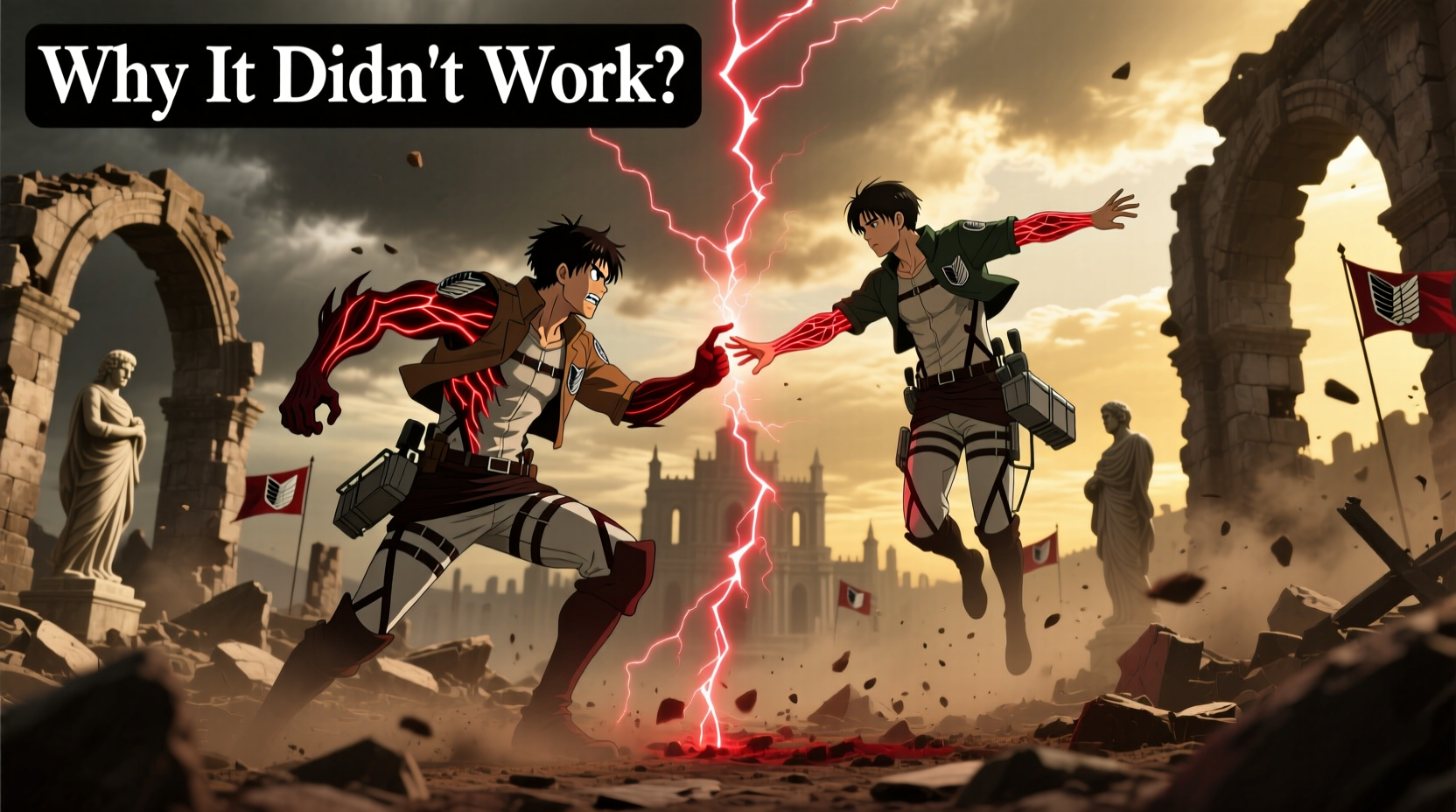
Eren and Zeke’s plan hinged on a precise sequence: Eren would transform into the Founding Titan near Zeke, allowing Zeke to initiate the royal bloodline contact necessary to activate coordinate-based powers. This would enable Zeke to use his Beast Titan’s scream to paralyze enemy forces while Eren initiated the Rumbling. However, the moment Eren charged toward Zeke, everything unraveled.
The first flaw lay in their assumption of control. Zeke believed he could manipulate Eren using familial bonds and shared trauma. He saw himself as the guiding elder brother, finally offering Eren a path to freedom through euthanasia—a world without suffering, achieved by sterilizing all Eldians. Eren, however, had long since rejected Zeke’s passive nihilism. His concept of freedom was not escape from life, but the right to fight for it, even if it meant destruction.
Emotional Disconnect: Two Brothers, Two Worlds
Their failed touch was symbolic of their emotional disconnect. Despite being half-brothers and both victims of Marley’s oppression, they processed trauma in fundamentally different ways. Zeke internalized his pain, retreating into fatalism and detachment. He viewed Eldians as a “diseased” race deserving extinction. Eren, conversely, weaponized his trauma. His rage fueled an unrelenting drive to break the cycle of hatred—even if it meant becoming the villain.
When Eren ran toward Zeke, he wasn’t approaching a savior or ally. To him, Zeke was a means to an end—a key to unlocking the Founding Titan’s power without Ymir Fritz’s consent. But Zeke expected reverence, recognition, perhaps even submission. Instead, he met defiance. The outstretched hand wasn’t for unity—it was for manipulation.
“Freedom is choosing your own chains.” — Levi Ackerman, reflecting on the cost of conviction
Tactical Breakdown: Why the Moment Failed Physically
Beyond ideology, the failure had concrete tactical causes. The battlefield at Fort Slava was chaotic. Allied Marleyan forces, Paradis soldiers, and shifting Titan transformations created constant interference. Armin and the Survey Corps actively disrupted Zeke’s positioning, knowing his role in enabling Eren’s transformation.
More critically, timing was off. Zeke needed uninterrupted contact with a Titan possessing royal blood. Eren’s transformation was rapid, unpredictable, and deliberately evasive. By the time Eren reached Zeke, he was already mid-shift—his human form dissolving into the armored titan structure. There was no stable window for skin-to-skin contact.
Additionally, Zeke’s own actions undermined the plan. His decision to reveal his euthanasia plot to Eren moments before the touch shattered any trust. Eren realized Zeke never intended to help him achieve true freedom—he wanted to erase the future entirely.
Timeline of the Failed Touch
- Zeke initiates the plan: Calls Eren using the Beast Titan’s roar, signaling readiness.
- Eren breaks formation: Charges toward Zeke against orders, drawing fire.
- Armin intervenes: Attempts to stop Eren, delaying the approach.
- Zeke reveals his true goal: Confesses the euthanasia plan, creating doubt.
- Eren transforms prematurely: Begins shifting before reaching Zeke.
- Contact fails: No viable hand-to-hand connection is made.
- Zeke is captured: Injured and exposed, he’s taken by Reiner and Armin.
Philosophical Misalignment: Freedom vs. Salvation
The core reason the touch failed lies in incompatible worldviews. Zeke sought salvation through annihilation—a quiet end to endless war. He believed peace could only come through the absence of desire, procreation, and conflict. His ideal world was still, emotionless, final.
Eren, shaped by Mikasa, Armin, and his childhood dreams beyond the walls, craved agency. Even if the world burned, he wanted the right to choose his fate. His freedom wasn’t about survival—it was about meaning forged through struggle. As he later says, “If we win, we live. If we lose, we die. That’s what makes it real.”
This fundamental clash rendered cooperation impossible. Zeke couldn’t comprehend Eren’s willingness to suffer for a future he wouldn’t see. Eren saw Zeke’s plan as cowardice disguised as mercy. Their hands may have nearly touched, but their souls had diverged long before.
Comparison: Eren vs. Zeke’s Endgame Vision
| Aspect | Eren Yeager | Zeke Yeager |
|---|---|---|
| End Goal | Freedom through conflict and self-determination | Peace through extinction and euthanasia |
| View of Eldians | Victims who must fight back | A \"diseased\" race needing culling |
| Role of Suffering | Necessary for growth and meaning | To be eliminated at all costs |
| Legacy Desire | To be remembered as a protector | To erase the Eldian lineage |
| Method | The Rumbling (global destruction) | Voluntary sterilization (quiet extinction) |
Mini Case Study: The Weight of a Single Second
Consider the split second when Eren’s hand extended toward Zeke. On paper, it was the fulfillment of years of planning. In reality, it was theater. Zeke reached out expecting surrender. Eren reached out planning betrayal. Both were acting, not connecting.
In that moment, Reiner Braun, torn between loyalty to Marley and guilt over past atrocities, made the decisive move. He intercepted Zeke, preventing contact—not out of strategy, but out of desperation to stop both brothers from unleashing apocalypse. It was a human intervention in a moment that had become mythic. The failure wasn’t just logistical; it was poetic. Two titans, shaped by pain and power, could not touch because they no longer spoke the same language.
Checklist: Conditions Needed for the Touch to Succeed
- ✅ Uninterrupted line of sight and movement between Eren and Zeke
- ✅ Eren remains in human form until contact is made
- ✅ Zeke maintains control of his position and avoids injury
- ✅ No external interference from allies or enemies
- ✅ Mutual agreement on the objective (coordination, not manipulation)
- ✅ Trust or at least aligned short-term goals
- ✅ Proper timing of transformation post-contact
Only one or two of these conditions were met. The rest were compromised by poor communication, last-minute revelations, and battlefield chaos.
Frequently Asked Questions
Could the touch have worked if Zeke hadn’t revealed his euthanasia plan?
Possibly. Had Zeke concealed his true intentions, Eren might have allowed the contact, believing Zeke was fully committed to Paradis’s survival. However, Eren was already leaning toward initiating the Rumbling independently. Deception might have delayed, but not prevented, the eventual rupture.
Was the failed touch foreshadowed earlier in the series?
Yes. From their first conversation in Liberio, tension simmered beneath the surface. Zeke called Eren “broken,” while Eren dismissed Zeke’s philosophy as defeatist. Their interactions lacked warmth or genuine collaboration, suggesting the alliance was always transactional, not heartfelt.
Did Eren ever intend for the touch to succeed?
Unlikely. Evidence suggests Eren had already accepted that he would need to force Ymir’s hand directly. His vision of the future included his own death and betrayal by Armin—indicating he never relied on Zeke’s cooperation as essential, only as a potential facilitator.
Conclusion: Why the Failure Mattered
The failed touch in Marley wasn’t a plot hole—it was the story’s emotional climax made manifest. It represented the impossibility of reconciliation between two versions of liberation: one born of surrender, the other of defiance. In that fractured moment, *Attack on Titan* reaffirmed its central theme: freedom is not given, nor is it clean. It is seized, stained, and often lost in the act of claiming it.
Eren and Zeke’s inability to connect physically mirrored their lifelong failure to understand each other. One sought to end the world to stop pain. The other sought to destroy it to preserve the right to feel. Neither was wholly right. Neither was wholly wrong. And in their collision, the truth of their world was revealed: some wounds don’t heal with a touch.




 浙公网安备
33010002000092号
浙公网安备
33010002000092号 浙B2-20120091-4
Comments
No comments yet. Why don't you start the discussion?