
Becoming an AI developer is no longer a niche ambition—it’s one of the most in-demand career paths in technology. But success in this field doesn’t come from simply knowing Python or having taken a single online course. It requires a blend of technical mastery, problem-solving intuition, and continuous learning. Whether you're transitioning from another tech role or starting fresh, building a strong foundation and following a structured path dramatically increases your chances of thriving in artificial intelligence.
Core Technical Skills Every AI Developer Must Master
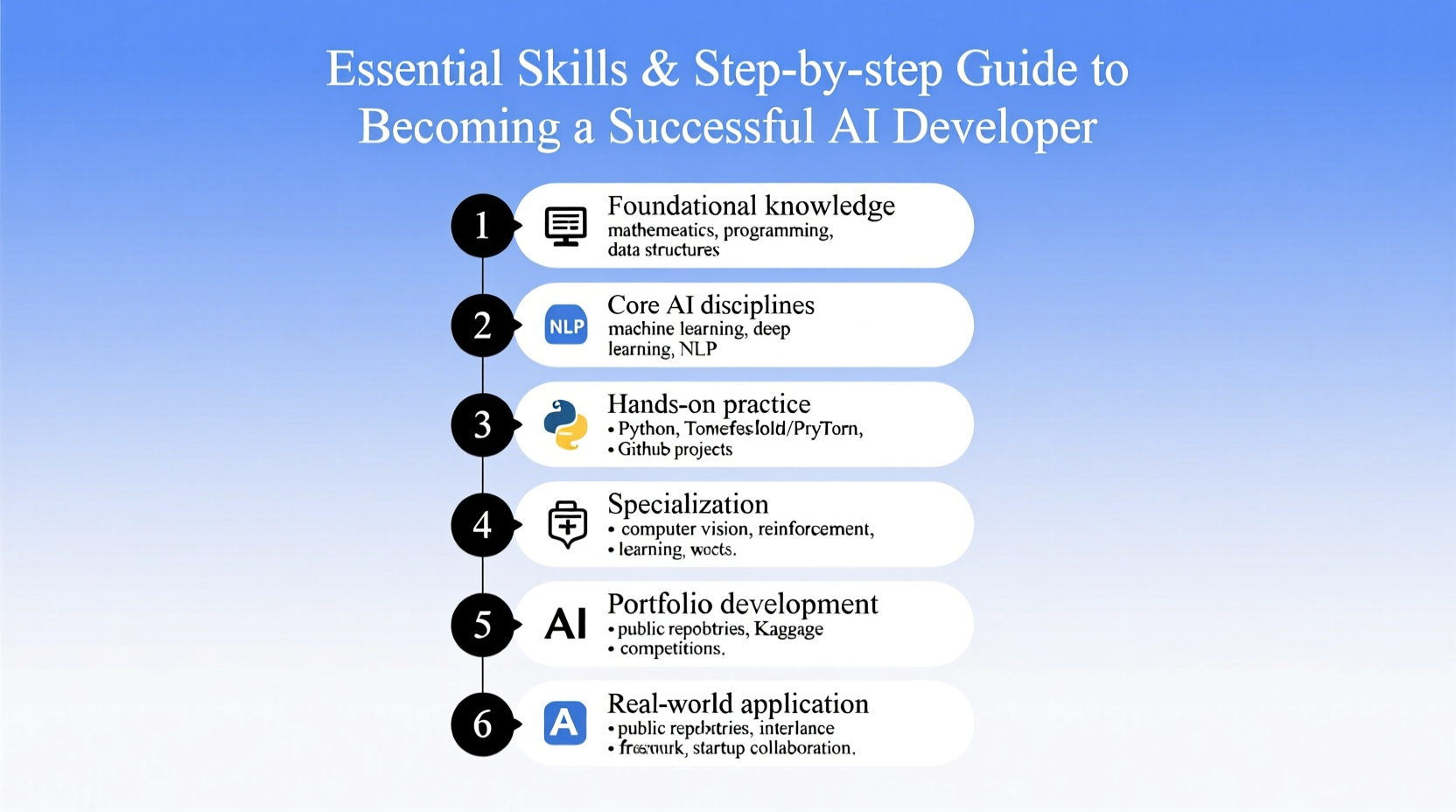
The backbone of any AI developer's toolkit lies in a solid understanding of programming, mathematics, and machine learning frameworks. Without these, even the most ambitious projects stall at the prototype stage.
- Programming Languages: Python dominates the AI landscape due to its simplicity and rich ecosystem. Libraries like NumPy, Pandas, and Scikit-learn are standard. R, Julia, and even JavaScript (via TensorFlow.js) have niche roles but are secondary to Python.
- Mathematics & Statistics: Linear algebra, calculus, probability, and statistical inference are not optional. These form the logic behind algorithms—from gradient descent to Bayesian networks.
- Machine Learning Frameworks: Proficiency in TensorFlow, PyTorch, or Keras is essential. Knowing how to build, train, and debug models using these tools separates hobbyists from professionals.
- Data Handling: Real-world data is messy. Skills in data preprocessing, cleaning, normalization, and augmentation are critical before any model can be trained effectively.
- Deep Learning Concepts: Understanding neural networks—CNNs for images, RNNs/LSTMs for sequences, and transformers for language—is non-negotiable for modern AI applications.
Soft Skills That Set Successful AI Developers Apart
Technical ability alone won't carry you far. The best AI developers combine analytical power with communication, collaboration, and ethical judgment.
- Problem-Solving Mindset: AI isn’t about applying models blindly—it’s about framing ambiguous problems, designing experiments, and iterating based on results.
- Communication: Explaining complex models to non-technical stakeholders is crucial. Whether writing documentation or presenting results, clarity is key.
- Curiosity & Adaptability: The field evolves rapidly. New architectures, tools, and research papers emerge weekly. Staying current requires genuine curiosity.
- Ethical Awareness: As AI impacts hiring, healthcare, and justice systems, developers must consider bias, fairness, transparency, and privacy in every project.
“AI is not just about building smart systems—it’s about building responsible ones. The best developers ask not only ‘can we do it?’ but ‘should we?’” — Dr. Fei-Fei Li, Professor of Computer Science, Stanford University
Step-by-Step Guide to Becoming a Successful AI Developer
Success doesn’t happen overnight. Follow this structured, realistic roadmap to build competence and credibility over time.
- Build Foundational Knowledge (Months 1–3)
Start with Python and basic data science concepts. Work through free resources like Coursera’s “Python for Everybody” or Khan Academy’s linear algebra courses. Practice daily coding on platforms like LeetCode or HackerRank. - Learn Core Machine Learning (Months 4–6)
Study supervised and unsupervised learning. Take Andrew Ng’s “Machine Learning” course on Coursera. Implement algorithms from scratch—linear regression, decision trees, k-means clustering—to understand their mechanics. - Master Deep Learning (Months 7–9)
Dive into neural networks using PyTorch or TensorFlow. Build image classifiers with CNNs, text generators with LSTMs, and explore transfer learning with pre-trained models like ResNet or BERT. - Work on Real Projects (Months 10–12)
Create a portfolio. Develop a chatbot, sentiment analyzer, or recommendation engine. Host code on GitHub. Participate in Kaggle competitions to test your skills against others. - Specialize and Gain Experience (Year 2+)
Pick a domain: computer vision, NLP, robotics, or reinforcement learning. Contribute to open-source projects, apply for internships, or publish blog posts explaining your work. Specialization makes you stand out.
Essential Tools and Resources
Using the right tools accelerates learning and professional output. Here’s a curated list of what works today.
| Category | Tool/Platform | Why It Matters |
|---|---|---|
| Development | Jupyter Notebooks | Ideal for experimentation and sharing code with visuals. |
| Cloud Computing | Google Colab / AWS SageMaker | Access GPUs for free or low cost to train large models. |
| Version Control | GitHub + Git | Track changes, collaborate, and showcase your work. |
| Model Deployment | FastAPI / Flask + Docker | Turn models into APIs that can be integrated into apps. |
| Learning Platforms | Coursera, Fast.ai, Hugging Face | Hands-on courses with real-world relevance. |
Mini Case Study: From Beginner to AI Engineer at a Health Tech Startup
Sophia, a former biology graduate, wanted to transition into AI. She started by taking online Python courses while working part-time. Over six months, she completed Andrew Ng’s ML course and built a simple pneumonia detector using chest X-rays from a public dataset. She documented her process on GitHub and wrote a Medium article explaining her approach.
Her project caught the attention of a health tech startup looking for junior AI engineers. Though she lacked formal credentials, her hands-on experience and clear communication made her a strong candidate. Within a year, she was leading a team developing diagnostic support tools using deep learning.
Sophia’s story isn’t unique—it reflects a growing trend: demonstrable skills often outweigh degrees in AI hiring.
Avoiding Common Pitfalls: Do’s and Don’ts
Many aspiring developers get stuck because they focus on the wrong things. This table highlights frequent mistakes and how to avoid them.
| Do’s | Don’ts |
|---|---|
| Build end-to-end projects (data → model → deployment) | Rely solely on tutorials without creating original work |
| Read research papers regularly (start with arXiv summaries) | Ignore math under the hood of models |
| Join AI communities (Reddit, Discord, LinkedIn groups) | Isolate yourself—collaboration speeds learning |
| Focus on reproducibility and clean code | Write unstructured scripts that others can’t run |
Frequently Asked Questions
Do I need a PhD to become an AI developer?
No. While advanced degrees help in research roles, many industry positions value practical skills and project experience. Building a strong portfolio can open doors without formal education.
How long does it take to become job-ready?
With consistent effort (15–20 hours per week), most people reach entry-level readiness in 12 to 18 months. Prior programming experience shortens this timeline significantly.
Can I specialize early in NLP or computer vision?
You can, but first master general machine learning principles. Specialization too early limits your adaptability. Build breadth first, then go deep.
Your AI Journey Starts Now
Becoming a successful AI developer isn’t about perfection—it’s about persistence. The field rewards those who build consistently, learn relentlessly, and solve real problems. You don’t need permission to start. Download a dataset, write your first model, break it, fix it, and do it again. The gap between where you are and where you want to be closes one line of code at a time.




 浙公网安备
33010002000092号
浙公网安备
33010002000092号 浙B2-20120091-4
Comments
No comments yet. Why don't you start the discussion?