
Snake earrings have surged in popularity, blending bold fashion with intricate design—especially when adorned with sparkling stones. But with rising demand comes an increase in imitation pieces. Many consumers unknowingly purchase jewelry labeled as “diamond-studded” only to discover later that the stones are cubic zirconia or glass. Distinguishing real diamonds from fakes isn’t just about value—it’s about authenticity, craftsmanship, and informed ownership. Understanding how to verify whether your snake earrings contain genuine diamonds empowers you to make smarter decisions, protect your investment, and appreciate your jewelry with confidence.
Understanding Diamond Characteristics
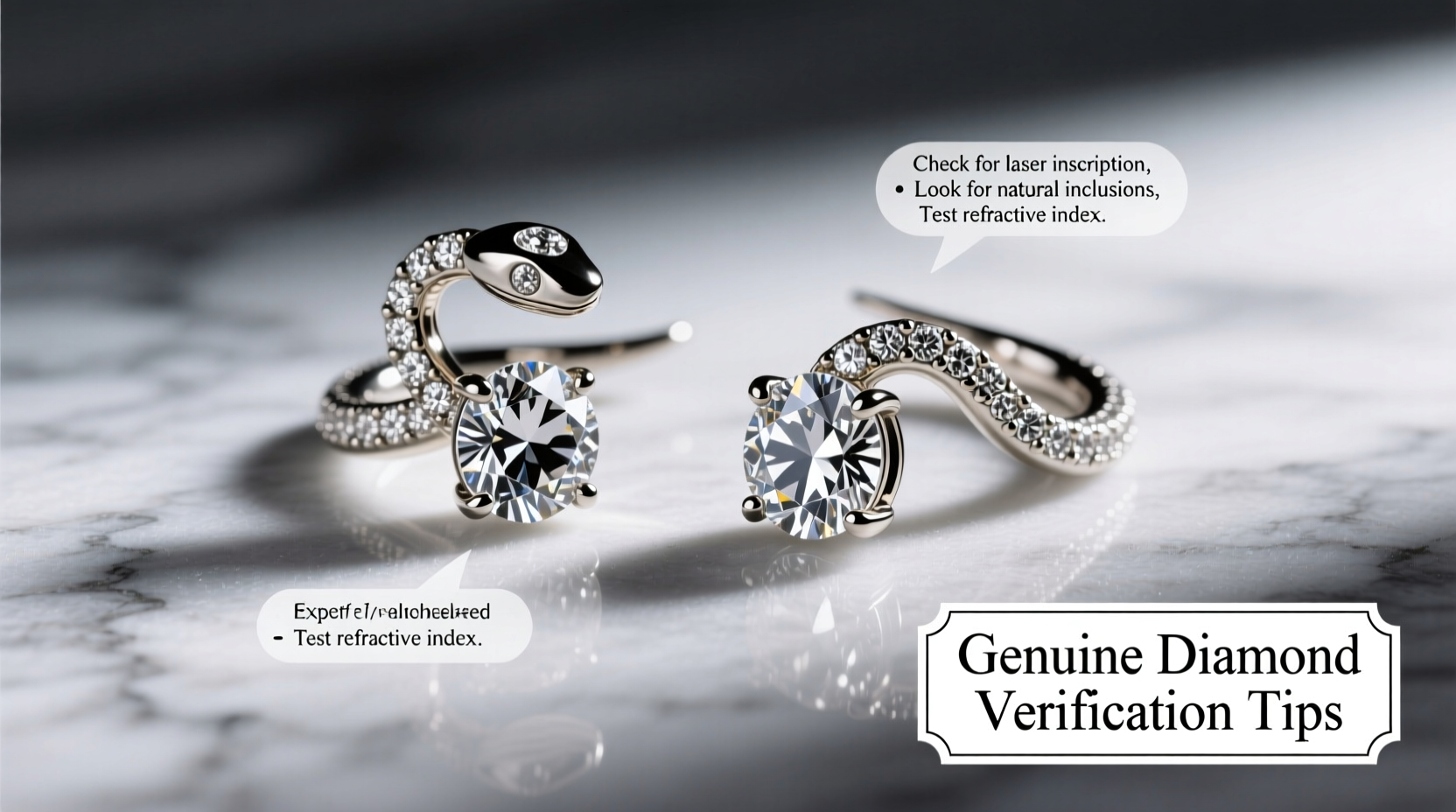
Diamonds possess unique physical and optical properties that set them apart from simulants. Recognizing these traits is the first step toward verification. Genuine diamonds are composed of pure carbon arranged in a crystal lattice, making them one of the hardest natural substances on Earth (ranking 10 on the Mohs scale). This hardness affects how they reflect light, resist scratching, and interact with heat.
Key characteristics include:
- Brilliance and fire: Real diamonds refract light sharply, producing intense sparkle and flashes of color.
- Dispersion: The ability to split white light into spectral colors—often seen as rainbow flashes.
- Thermal conductivity: Diamonds conduct heat exceptionally well, a trait most imitations lack.
- Inclusions: Natural microscopic imperfections visible under magnification; their absence may indicate lab-grown or synthetic stones.
Step-by-Step Guide to Verifying Diamond Authenticity
Verifying diamonds at home requires attention to detail and simple tools. While no DIY method replaces professional appraisal, these steps can help identify obvious fakes.
- Fog Test: Breathe on the stone as if fogging a mirror. A real diamond disperses heat instantly, so condensation vanishes within seconds. If the fog lingers, it's likely a simulant like cubic zirconia.
- Water Test: Drop the earring (if safe) into a glass of water. Due to high density, real diamonds sink. Lightweight materials such as glass or plastic float or remain suspended.
- Magnification Check: Use a 10x jeweler’s loupe or digital microscope. Look for internal flaws or inclusions—nearly all natural diamonds have them. Perfectly clear stones may be moissanite or CZ.
- Scratch Resistance: Attempt to gently scratch an unglazed ceramic tile with the stone’s edge. Only a diamond should leave a mark without damage. Caution: This test risks damaging both the stone and setting—use sparingly and carefully.
- Light Performance Test: Hold the earring under direct sunlight or LED light. Observe sharp contrast between bright and dark areas (called \"sparkle pattern\"). Fakes often show uniform, overly flashy rainbows.
“Diamonds don’t glitter uniformly—they dance with contrast. That interplay of fire and shadow is hard to replicate convincingly.” — Dr. Lena Torres, Gemologist, GIA Alumna
Do’s and Don’ts When Evaluating Diamond Jewelry
| Do | Don’t |
|---|---|
| Inspect under natural daylight whenever possible | Rely solely on fluorescent lighting, which distorts color perception |
| Clean the earrings before testing (dirt masks brilliance) | Evaluate dirty or oily stones—residue mimics poor clarity |
| Use a jeweler’s loupe or microscope for inclusion checks | Assume perfection equals quality—flawless stones are rare and expensive |
| Consult a certified gemologist for confirmation | Perform aggressive tests that could damage delicate settings |
| Request a grading report if purchasing new | Accept vague terms like “natural-looking” or “diamond-like” |
When to Seek Professional Verification
While at-home techniques offer preliminary insights, definitive authentication requires expert evaluation. Reputable jewelers use advanced tools such as microscopes, spectrometers, and thermal probes to distinguish diamonds from look-alikes like moissanite, white sapphire, or strontium titanate.
A professional assessment typically includes:
- Determining whether the stone is natural, lab-grown, or synthetic
- Grading cut, clarity, color, and carat weight (the 4Cs)
- Checking for laser inscriptions on the girdle (common with GIA-certified stones)
- Verifying metal purity via acid test or XRF analysis
If your snake earrings were inherited, gifted, or purchased secondhand, formal appraisal adds significant value—not only monetarily but also emotionally. It confirms what you own and ensures proper insurance coverage.
Mini Case Study: The Hidden Truth Behind “Luxury” Earrings
Sophia bought a pair of gold-plated snake earrings online, marketed as “featuring real diamonds.” Priced at $180, they seemed like a steal. Excited, she showed them to her sister, a jewelry designer. After a quick fog test and loupe inspection, her sister noticed two red flags: the stones stayed fogged for over five seconds, and under 10x magnification, they displayed perfect symmetry with no inclusions.
Sophia took them to a local gem lab. The result? All stones were cubic zirconia. Though well-cut and visually convincing, they lacked thermal conductivity and dispersion patterns of true diamonds. She received a full report and used it to file a dispute with the retailer. Her experience underscores the importance of skepticism and verification—even when shopping from seemingly reputable sites.
Checklist: How to Confirm Your Snake Earrings Have Real Diamonds
- ✅ Perform the fog test: Does condensation disappear immediately?
- ✅ Examine sparkle under natural light: Is there sharp contrast and controlled fire?
- ✅ Inspect with a loupe: Are there internal inclusions or surface blemishes?
- ✅ Check for professional markings: Look for stamps like “14K,” “585,” or “DWT”
- ✅ Verify seller credentials: Did they provide a certificate from a recognized lab?
- ✅ Schedule a third-party appraisal: Get an unbiased expert opinion
- ✅ Review return policy: Ensure recourse if authenticity claims are false
Frequently Asked Questions
Can lab-grown diamonds be considered “real”?
Yes. Lab-grown diamonds share the same chemical composition, crystal structure, and physical properties as mined diamonds. They are graded using the same 4C system and are indistinguishable from natural diamonds without specialized equipment. However, they typically cost 20–40% less.
Are snake earrings with small diamonds still valuable?
Value depends on total carat weight, diamond quality, metal type, and craftsmanship. Even small genuine diamonds in 14k or 18k gold settings hold intrinsic value. For example, a pair with 0.50ct total weight in VS clarity and G color can retail between $800–$1,500 depending on brand and design.
What’s the difference between moissanite and diamond?
Moissanite is a silicon carbide gemstone often mistaken for diamond due to its brilliance. However, it has higher refractive index and double refraction (visible as doubled facet lines under magnification). It also conducts electricity—unlike diamonds—which allows testers to differentiate them easily.
Take Action Today
Your jewelry tells a story—one of taste, identity, and sometimes, legacy. Ensuring that your snake earrings truly feature genuine diamonds preserves both their aesthetic and financial worth. Whether you’re wearing them daily or storing them for special occasions, knowing their authenticity transforms passive ownership into informed appreciation. Don’t assume. Verify. Appraise. Protect.




 浙公网安备
33010002000092号
浙公网安备
33010002000092号 浙B2-20120091-4
Comments
No comments yet. Why don't you start the discussion?