
In Clash of Clans, a well-designed base isn't just about aesthetics—it's a strategic necessity. Whether you're farming resources or pushing through the leaderboards, your layout determines how effectively you can withstand enemy attacks. The difference between losing 50% of your loot and keeping it all often comes down to wall placement, building hierarchy, and trap synergy. With constant updates from Supercell introducing new troops and balancing changes, static layouts quickly become obsolete. To stay ahead, players must adopt dynamic, intelligent base designs that prioritize protection, misdirection, and layered defense.
Understanding Core Defense Principles
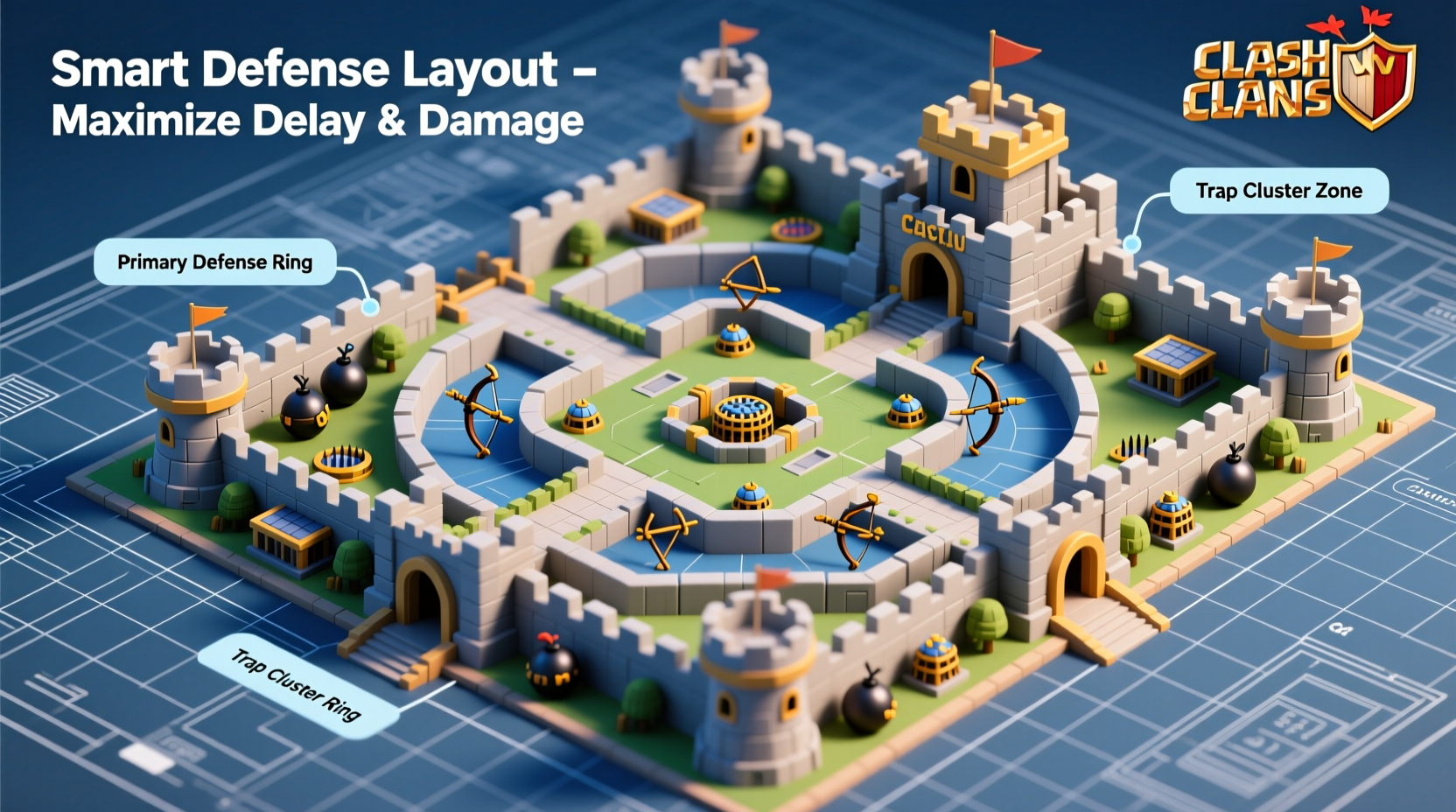
A strong base in Clash of Clans operates on three foundational principles: compartmentalization, centralization of key defenses, and psychological manipulation of attacker behavior. Compartmentalization involves dividing your base into walled-off sections, forcing attackers to spend more time and resources breaking in. This slows down even high-damage compositions like GoWiPe or LavaLoon.
The most critical buildings—such as the Town Hall, Eagle Artillery, and Inferno Towers—should always be placed at the center, surrounded by multiple layers of walls and decoy structures. This forces attackers to commit deep before reaching their primary objectives. Additionally, placing less important buildings like collectors and storages near the edges creates an illusion of vulnerability, luring opponents into funneling toward traps or dead zones.
“Defense isn’t about making your base unbreakable—it’s about making it not worth the effort.” — Marcus Lin, Clash of Clans Community Strategist
Top 5 Layout Types for Different Play Styles
No single layout fits all players. Your ideal design depends on your goals: resource farming, trophy pushing, war defense, or hybrid play. Below are five proven layout styles tailored to specific strategies.
| Layout Type | Best For | Key Features | Weaknesses |
|---|---|---|---|
| Farming Base | Protecting Elixir & Gold Storages | Storages centralized; few offensive defenses exposed | Poor performance in wars due to low DPS exposure |
| Trophy-Pushing Base | Climbing leaderboards | Maximized defense synergy; traps optimized for common attack patterns | Vulnerable to niche strategies if over-optimized |
| War Base | Clan Wars & Friendly Challenges | Symmetric design; air and ground defense balance | Can be predictable if reused too often |
| Hybrid Base | Balanced gameplay | Combines farming security with moderate trophy resilience | Less effective than specialized bases in extreme scenarios |
| Anti-3-Star Base | Minimizing full destructions | Decoy Town Hall; staggered X-Bows; hidden traps | Requires frequent reconfiguration |
Designing for Trap Synergy
Traps are often underestimated but can turn the tide of an attack when placed correctly. Spring Traps should sit just inside outer walls to launch Giants or Miners into open areas. Giant Bombs work best near Clan Castle troops or Wizard damage clusters. Seeking Air Mines are crucial against balloon or dragon rushes and should be spaced apart to avoid chain detonations.
Step-by-Step Guide to Building a Smart Defensive Layout
Creating an effective base doesn’t happen overnight. Follow this methodical approach to refine your design over time.
- Assess Your Current Weaknesses: Review recent replays. Did attackers break in easily? Were key defenses bypassed?
- Identify Priority Targets: Decide whether to protect Town Hall level, resource storage, or defensive uptime.
- Choose a Base Template: Start with a symmetrical or asymmetrical core structure based on your play style.
- Place Key Defenses First: Position your Archer Queen, Grand Warden, Eagle Artillery, and Inferno Towers in the center ring.
- Add Layered Walls: Use wall segments of varying lengths to create chokepoints and delay troop movement.
- Integrate Traps Strategically: Align bombs with funnel paths and spring traps near likely breach points.
- Test Against Common Attacks: Use friendly challenges or simulate attacks using strategy tools.
- Iterate Weekly: Adjust layout every 7–10 days to counter evolving meta strategies.
Real Example: Turning Around a High-Loot Loss Rate
Javier, a TH12 player focused on farming, was losing over 60% of his elixir daily despite having max-level defenses. His original base had storages scattered along the perimeter, making them easy targets for Hog Rider raids. After analyzing 15 attack replays, he redesigned his layout using a compact, circular farming shell with storages grouped in the second ring, protected by Wizard Towers and Bomb Towers.
He added two Giant Bombs between the outer and middle walls—zones commonly used by Jump Spell users. Within one week, his average loot loss dropped by 78%. More importantly, attackers began receiving only one star, reducing overall incentives to target him.
Checklist: Pre-Deployment Base Audit
Before finalizing any layout, run through this checklist to ensure optimal defense readiness:
- ✅ Is the Town Hall fully enclosed within walls?
- ✅ Are Clan Castle and Hero Altars centrally located?
- ✅ Do walls form at least two defensive rings?
- ✅ Are X-Bows and Multi-Archer Towers angled to cover multiple directions?
- ✅ Are traps positioned to trigger during mid-to-late game phases?
- ✅ Does the design discourage funneling toward core defenses?
- ✅ Have you tested against both ground and air attacks?
- ✅ Is there visual misdirection (e.g., fake gaps, decoy compartments)?
Frequently Asked Questions
How often should I change my base layout?
For maximum effectiveness, update your layout every 7 to 10 days. Frequent changes prevent attackers from memorizing weak spots and exploiting repeated patterns. If you’re being raided heavily, consider changing immediately after observing successful attack routes.
Should I use the same base for war and regular gameplay?
No. War bases benefit from predictability and symmetry to coordinate with clanmates, while everyday bases should prioritize deception and loot protection. Always customize your war base separately and optimize it for the current season’s attack trends.
Are symmetrical bases better than asymmetrical ones?
Symmetry offers balanced coverage and is easier to master, especially in wars. However, asymmetrical bases introduce uncertainty, making it harder for attackers to plan. A hybrid approach—using near-symmetry with one intentionally weak side—can bait attackers into traps while maintaining overall stability.
Maintaining Long-Term Defensive Success
A great layout is only as good as its maintenance. Beyond physical design, smart defense includes behavioral habits: regularly watching replays, tracking loot theft patterns, and adjusting trap placements post-upgrade. Players who treat their base as a living system—not a one-time build—consistently outperform those relying solely on maxed-out gear.
Additionally, joining an active clan provides access to diverse attack perspectives. Observing how others attack can reveal blind spots in your own logic. Use clan chat to request feedback on your latest layout; many seasoned players are happy to offer quick critiques.
“Your base should evolve as much as your army composition. Static thinking leads to predictable losses.” — Lena Park, Top 1000 Global Player (TH13)
Conclusion
Mastering Clash of Clans defense goes beyond copying popular templates. It requires understanding attacker psychology, leveraging terrain and trap mechanics, and adapting to the ever-shifting meta. By implementing smart layout strategies—from compartmentalized farming shells to anti-3-star war configurations—you gain control over how and when enemies succeed. The strongest bases don’t just resist attacks; they manipulate them.




 浙公网安备
33010002000092号
浙公网安备
33010002000092号 浙B2-20120091-4
Comments
No comments yet. Why don't you start the discussion?