
In an age of constant digital stimulation and rising anxiety levels, many people turn to tactile tools to manage stress and sharpen focus. Two of the most popular options—fidget spinners and Pop Its—have flooded classrooms, offices, and therapy rooms. But despite their viral popularity, a critical question remains: do they actually help with focus, or are they just distractions disguised as solutions?
This article examines the science, user experiences, and practical applications behind fidget spinners and Pop Its. We’ll explore how each tool affects attention, emotional regulation, and productivity, helping you determine which—if either—is truly effective for improving concentration.
The Science Behind Fidgeting and Focus
Fidgeting isn’t just a nervous habit—it can be a cognitive strategy. Research in neuroscience and psychology suggests that small, repetitive movements can stimulate the brain’s arousal system, particularly in individuals with ADHD or anxiety. The theory is simple: when under-stimulated, the brain seeks input. Purposeful fidgeting provides low-level sensory feedback that helps maintain alertness without overwhelming cognitive resources.
Dr. Julie Schweitzer, a professor of psychiatry and behavioral sciences at UC Davis, explains:
“Motor activity can enhance attention by increasing dopamine and norepinephrine levels in the prefrontal cortex—the area responsible for executive function.” — Dr. Julie Schweitzer, ADHD Research Specialist
This means that movement-based tools like fidget spinners or Pop Its may not just soothe anxiety—they could potentially support working memory and task persistence. However, not all fidgeting is created equal. The key lies in whether the action is purposeful or distracting.
Fidget Spinners: Design, Use, and Cognitive Impact
Fidget spinners burst into global popularity around 2017, marketed as tools to reduce anxiety and improve concentration. Typically made of metal or plastic with ball bearings at the center, they rotate smoothly when spun between the fingers.
Proponents argue that the smooth, predictable motion creates a meditative rhythm. The visual component—watching the spinner whirl—can induce a mild trance-like state, similar to staring at a lava lamp or flame. This effect may help calm racing thoughts.
However, studies on fidget spinners have been mixed. A 2018 study published in the Journal of Abnormal Child Psychology found that while children with ADHD showed improved attention during tasks involving physical movement, the use of spinners specifically led to decreased performance when the device became the focus of attention rather than a background stimulant.
In other words, if you’re watching the spinner more than your work, it’s counterproductive.
Pros and Cons of Fidget Spinners
| Aspect | Advantages | Drawbacks |
|---|---|---|
| Sensory Input | Provides rhythmic tactile and proprioceptive feedback | Can become visually distracting |
| Portability | Small, quiet, easy to carry | Limited variety in interaction |
| Durability | Metal models last years with proper care | Plastic versions wear out quickly |
| Focus Support | May help regulate arousal in under-stimulated brains | Risk of over-engagement and distraction |
Pop Its: Sensory Satisfaction and Mental Regulation
Pop Its, originally designed as baby toys, gained mainstream traction during the pandemic. These silicone sheets feature bubble-like domes that “pop” when pressed from one side to the other. Their satisfying tactile feedback made them instant favorites among teens and adults alike.
Unlike fidget spinners, Pop Its offer no moving parts—just a binary action: press and flip. This simplicity may be their strength. The act of popping bubbles mimics the satisfaction of cracking knuckles or peeling stickers, triggering what psychologists call “autonomous sensory meridian response” (ASMR)—a calming, tingling sensation linked to focused attention and relaxation.
A 2021 survey conducted by the Anxiety and Depression Association of America found that 68% of respondents reported reduced anxiety after using tactile fidget tools, with Pop Its ranking highest in user-reported satisfaction due to their ease of use and immediate sensory payoff.
Because Pop Its don’t require visual attention, they’re less likely to pull focus away from reading or writing tasks. Instead, users often keep them under the desk or beside the keyboard, engaging in subconscious tapping while concentrating on cognitive work.
Real-World Example: Sarah’s Study Routine
Sarah, a college student diagnosed with generalized anxiety disorder, struggled to focus during long study sessions. She tried fidget spinners but found herself mesmerized by the spinning motion, often losing track of time. After switching to a small 3x3 inch Pop It, she noticed a significant improvement.
“I don’t even realize I’m using it,” she said. “My hand just moves over it while I read. It keeps my hands busy without pulling my mind away. I retain more and feel calmer.”
Her experience aligns with occupational therapy principles: successful fidget tools should operate in the periphery of awareness, not dominate it.
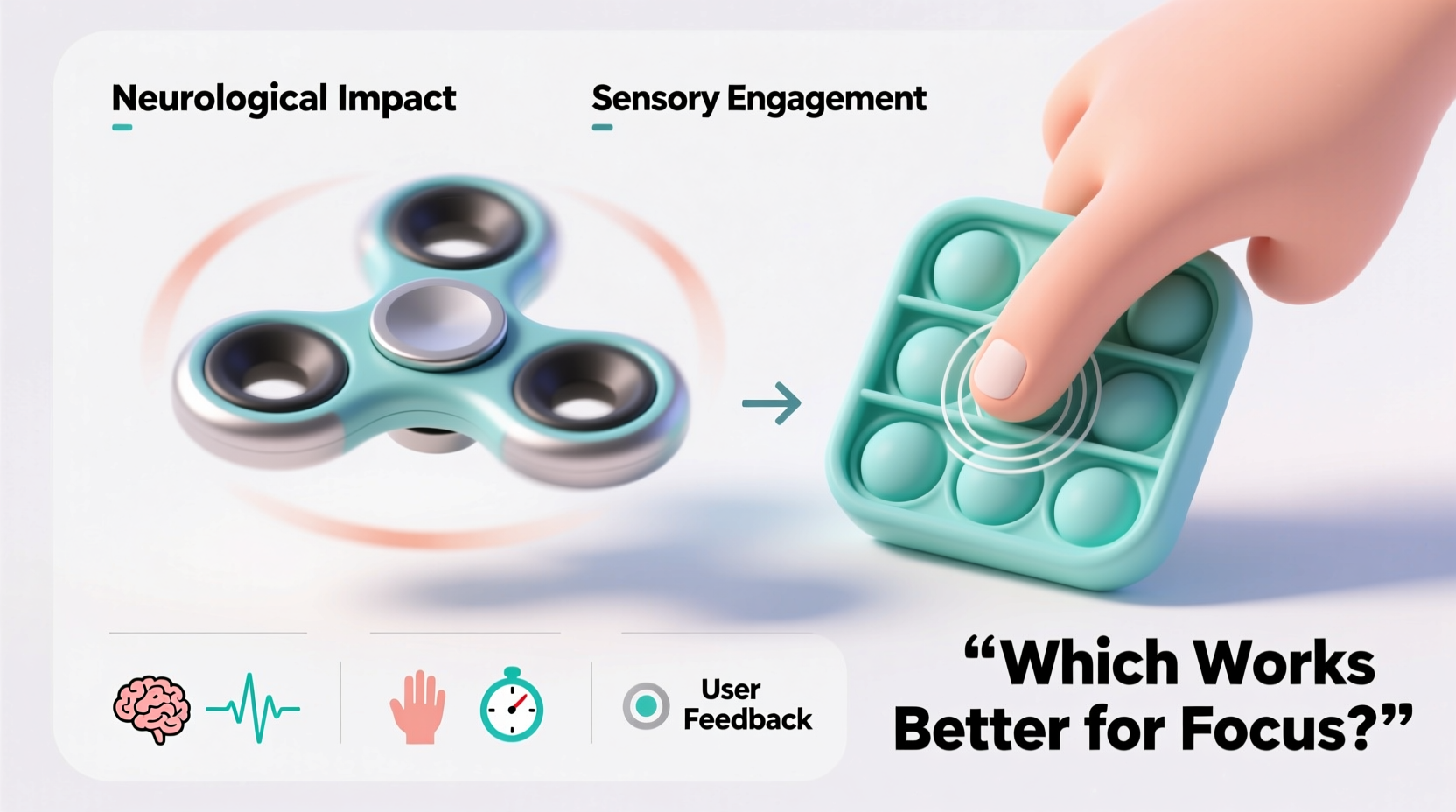
Comparative Effectiveness: What Works Best for Focus?
To determine which tool supports focus more effectively, we evaluated four key criteria: sensory engagement, distraction level, usability in shared spaces, and long-term utility.
- Sensory Engagement: Pop Its win here. The dual-sided popping action offers varied tactile input, whereas spinners provide consistent but monotonous feedback.
- Distraction Level: Fidget spinners are more visually engaging, making them riskier for attention diversion. Pop Its, being flat and static, are easier to use without drawing visual focus.
- Usability in Classrooms/Offices: Pop Its are quieter and less conspicuous. Spinners can wobble, make noise, or require two hands, disrupting workflow.
- Long-Term Utility: While both can lose novelty, Pop Its tend to remain useful longer because their action is self-contained and repeatable without setup. Spinners require re-spinning, interrupting flow.
Which Should You Choose?
- Choose a fidget spinner if: You need rhythmic motion to calm hyperactivity, enjoy kinesthetic feedback, and can resist watching it spin.
- Choose a Pop It if: You want subtle, silent stimulation; struggle with anxiety-induced restlessness; or work in environments where discretion matters.
Expert Recommendations and Therapeutic Use
Occupational therapists frequently incorporate fidget tools into sensory integration programs. According to Rachel Schwartz, OTR/L, a pediatric therapist specializing in school-based interventions:
“The best fidget is the one that meets the individual’s sensory needs without becoming the main event. For most students, Pop Its provide just enough input to stay regulated without hijacking attention.” — Rachel Schwartz, Occupational Therapist
She emphasizes that effectiveness depends on customization. Some clients benefit from weighted spinners, while others prefer textured Pop Its with raised patterns for enhanced tactile feedback.
Therapists also warn against treating these tools as universal fixes. “They’re not magic,” Schwartz adds. “They work best when paired with mindfulness, breathing techniques, and structured routines.”
Step-by-Step Guide to Using Fidget Tools for Maximum Focus
To get the most out of any fidget device, follow this evidence-based routine:
- Assess Your Sensory Needs: Are you seeking pressure, vibration, motion, or texture? Match the tool to your preference.
- Test in Low-Stakes Settings: Try the fidget during casual reading or listening to a podcast before using it in high-focus scenarios.
- Set Boundaries: Limit use to specific times (e.g., during reading or phone calls) to prevent dependency.
- Monitor Distraction Levels: If you catch yourself focusing on the fidget more than the task, switch to a less stimulating option.
- Combine with Breathing: Pair fidget use with slow, deep breaths (4 seconds in, 6 seconds out) to enhance calming effects.
- Rotate Tools Weekly: Prevent habituation by alternating between different types of fidgets.
Common Mistakes That Undermine Effectiveness
Even well-intentioned fidget use can backfire. Avoid these pitfalls:
- Using flashy or noisy models: LED spinners or loud Pop Its draw attention and disrupt others.
- Overusing the tool: Constant engagement prevents the brain from learning self-regulation.
- Choosing based on trends: Just because a fidget is popular doesn’t mean it suits your sensory profile.
- Ignoring context: A classroom or meeting requires subtler tools than private study time.
FAQ: Your Top Questions Answered
Do fidget tools really help with ADHD focus?
Yes, for many individuals with ADHD, fidget tools can improve focus by providing the extra sensory input their brains crave. However, effectiveness depends on the type of fidget and how it’s used. Tools that allow subconscious movement without visual engagement—like small Pop Its—are generally more effective than visually stimulating ones like spinners.
Can fidget spinners worsen anxiety?
In some cases, yes. If the spinner becomes a source of performance pressure (“How long can I keep it spinning?”) or causes frustration due to imbalance, it may increase anxiety. Additionally, public criticism or confiscation in schools can create negative associations.
Are Pop Its appropriate for adults in professional settings?
Discreet models—small, muted colors, silent operation—are perfectly acceptable. Many professionals use them during calls or while writing. The key is subtlety: keep it off the table during meetings and avoid exaggerated motions.
Final Verdict: Which Stress Reliever Wins for Focus?
After evaluating scientific research, expert insights, and real-world usage, the evidence leans clearly toward Pop Its as the superior tool for enhancing focus. Their design supports continuous, low-effort engagement without demanding visual attention. They’re adaptable, durable, and widely accessible, making them ideal for students, remote workers, and anyone managing anxiety-driven restlessness.
Fidget spinners aren’t without merit—they can help certain individuals regulate through rhythmic motion—but their potential for distraction makes them less reliable for sustained concentration. Unless carefully used, they risk becoming toys rather than tools.
Ultimately, the best choice depends on personal sensory preferences and environment. But if you're looking for a stress reliever that quietly supports focus without stealing attention, a simple Pop It is likely your best bet.




 浙公网安备
33010002000092号
浙公网安备
33010002000092号 浙B2-20120091-4
Comments
No comments yet. Why don't you start the discussion?