
For urban dwellers, small-space homeowners, renters with strict decor policies, or anyone seeking a refined, modern holiday aesthetic, the traditional floor-standing Christmas tree often presents practical challenges: it consumes precious square footage, risks tipping in high-traffic areas, demands ceiling clearance, and can clash with minimalist or contemporary interiors. Enter the floating shelf Christmas display—a design-forward, functional, and surprisingly versatile alternative that transforms vertical wall space into a curated holiday focal point. Unlike makeshift mantel arrangements or cluttered side tables, a thoughtfully engineered floating shelf display delivers visual impact without sacrificing utility, safety, or style. This approach isn’t about downsizing the spirit of the season—it’s about reimagining it with intention, craftsmanship, and spatial intelligence.
Why Floating Shelves Outperform Floor Trees in Modern Living Spaces
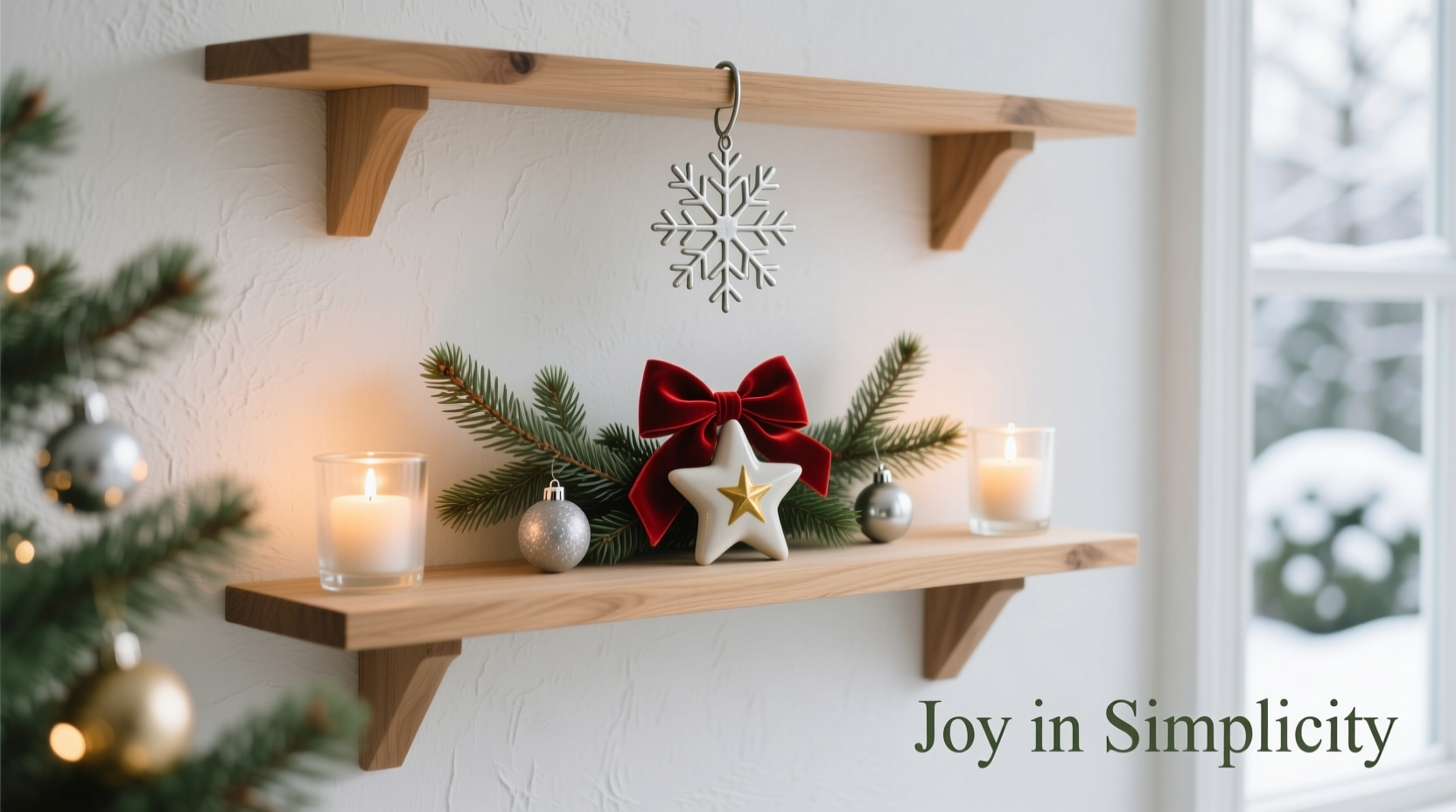
Floor trees remain beloved for their tradition and presence—but they’re increasingly at odds with evolving residential realities. Over 68% of U.S. households now live in spaces under 1,500 square feet (U.S. Census Bureau, 2023), and apartment leases frequently prohibit drilling into walls *or* anchoring heavy freestanding objects near windows and exits. Meanwhile, interior designers report rising client demand for “holiday architecture”—decor that integrates seamlessly with year-round design rather than temporarily overwhelming it. Floating shelves meet this need precisely because they are permanent yet adaptable, architectural yet festive, grounded in structure but visually weightless.
Structurally, well-installed floating shelves distribute load across wall studs, offering superior stability compared to floor trees anchored only by water-filled bases or weighted stands. Aesthetically, they invite curation over accumulation: instead of hiding ornaments behind dense branches, every element is intentionally placed and fully visible. Psychologically, they reduce visual noise—no tangled lights, no fallen needles tracked across hardwood—and elevate the ritual of decorating into an act of mindful composition.
Engineering Safety: Load Limits, Anchoring, and Wall Integrity
A floating shelf Christmas display is only as safe as its installation. Unlike decorative wall hooks or picture rails, floating shelves bear concentrated, static loads—and holiday decor adds unexpected weight: glass ornaments (up to 0.5 lbs each), ceramic figurines (1–3 lbs), battery-operated LED string lights (0.3–0.7 lbs per 10 ft), and fresh or faux garlands (1.5–4 lbs per linear foot). A single 36-inch shelf supporting three tiers of decor can easily carry 12–18 lbs—not including the shelf’s own weight.
Professional installers emphasize two non-negotiables: first, mounting exclusively into wall studs (not drywall anchors alone); second, using continuous metal support brackets rated for *at least double* the anticipated load. For example, if your planned display weighs 15 lbs, use brackets rated for 30+ lbs per bracket. Avoid hollow-wall toggle bolts for anything over 5 lbs—these degrade under sustained vibration (e.g., from nearby HVAC systems or foot traffic).
| Shelf Length | Minimum Stud Spacing | Recommended Bracket Type | Max Safe Decor Load |
|---|---|---|---|
| 24 inches | 16 inches on center (standard) | Continuous steel L-bracket, ⅜\" thick | 12 lbs |
| 36 inches | Two studs minimum (32\" span) | Dual heavy-duty concealed bracket, ½\" steel | 20 lbs |
| 48 inches | Three studs required | Reinforced ledger board + concealed brackets | 28 lbs |
| 60+ inches | Consult structural engineer | Custom steel cantilever system | Engineer-specified only |
Always verify wall type before drilling: plaster-and-lath walls require masonry bits and specialized anchors; concrete or CMU walls demand hammer-drill anchors rated for overhead shear loads. When in doubt, hire a licensed contractor—especially for multi-shelf installations above seating or walkways. As interior architect Lena Torres explains: “A floating shelf isn’t just furniture—it’s a built-in architectural gesture. Its integrity must match that of the wall itself. Cutting corners here doesn’t save time; it creates liability.”
“Floating shelves succeed when they disappear—when the eye sees only the beauty of the display, not the engineering holding it up. That invisibility requires precision, not improvisation.” — Lena Torres, FAIA, Principal at Studio Lumina Interiors
Design Principles for Cohesive, Three-Dimensional Displays
A successful floating shelf Christmas display operates on three spatial planes: foreground (closest to viewer), midground (the shelf surface itself), and background (the wall behind). Mastery lies in orchestrating rhythm, scale, and contrast across all three.
Start with the background: paint the wall behind the shelf in a deep, matte tone—navy, charcoal, or forest green—to create a rich, uncluttered canvas. Avoid glossy finishes, which reflect light unevenly and distract from decor. Then establish a vertical anchor: a slender, upright element like a tapered birch branch, a brushed-brass taper holder, or a slim pillar candle (battery-operated for safety) draws the eye upward and implies height where physical height isn’t possible.
On the shelf surface, apply the “rule of threes” in staggered heights: one tall item (e.g., 12\" mercury-glass ornament), one medium (e.g., 6\" ceramic star), one low (e.g., 2\" pinecone cluster). Repeat this triad across the shelf, varying materials—wood, metal, glass, ceramic—to avoid monotony. Use felt pads or museum putty beneath heavier items to prevent sliding and micro-scratches.
In the foreground, extend the display outward with purposeful layering: drape a hand-rolled eucalyptus garland over the shelf’s front edge, letting 4–6 inches cascade downward. Tuck miniature ornaments or dried orange slices into the folds. Add subtle motion with a single strand of warm-white micro-LEDs woven through the greenery—not wrapped tightly, but loosely coiled for organic texture.
Real-World Implementation: A Brooklyn Loft Transformation
When Maya Chen, a graphic designer living in a 650-square-foot Brooklyn loft, faced her third consecutive holiday season with a 6' pre-lit tree that blocked her only entryway and triggered her partner’s allergies, she decided to redesign her entire holiday approach. Her constraints were clear: no floor obstructions, no real pine (allergy-safe requirement), no drilling beyond existing stud locations, and a budget under $300.
She installed two 36-inch blackened-steel floating shelves—spaced 24 inches apart—anchored into three studs using reinforced concealed brackets rated for 35 lbs each. She painted the wall between them in Farrow & Ball’s “Hague Blue,” then styled the upper shelf with a 10\" brass taper holder flanked by two matte-black ceramic geodes and a looped wool-felt garland. The lower shelf held a 14\" mercury-glass orb, a stack of three vintage-inspired hardcover books bound in red cloth, and a cluster of cinnamon-stick bundles tied with jute twine. Micro-LED string lights ran vertically along the wall between shelves, mimicking falling snow. Total assembly time: 3.5 hours. Total cost: $287. Her neighbors began asking for installation referrals—and her landlord approved the setup as “architecturally integrated seasonal enhancement.”
Step-by-Step Installation & Styling Timeline
Build your display in five deliberate phases—allowing time for drying, testing, and refinement:
- Week 3 Before Christmas: Locate and mark wall studs using a digital stud finder. Confirm spacing matches shelf bracket requirements. Purchase brackets, screws, and shelf material (solid wood or steel recommended—avoid particleboard).
- Week 2 Before Christmas: Mount brackets and shelves. Allow 48 hours for any wall patching or touch-up painting to cure fully. Test load capacity with sandbags equal to projected decor weight.
- Week 1 Before Christmas: Style background wall (paint, wallpaper accent, or textured panel). Select and gather decor elements—prioritize items with flat, stable bases and consistent color temperature (all warm-white LEDs, no cool-white mixing).
- 3 Days Before Christmas: Begin layering: place tallest anchor items first, then mid-height pieces, then low-profile textures. Photograph each arrangement from eye level and adjust spacing until negative space feels intentional—not empty.
- Day Before Christmas: Install lighting last. Secure all cords with adhesive cord clips painted to match the wall. Do a final stability check: gently press downward on each decor item. If any wobble exceeds 1mm, reposition or add museum putty.
Do’s and Don’ts: Critical Guidelines for Longevity and Impact
- Do use battery-operated or UL-listed low-voltage LED lights only—never plug-in strings near wooden shelves without thermal shielding.
- Do rotate decor seasonally: swap out heavy ornaments for lightweight paper stars or origami in January to reduce year-round load stress.
- Do clean shelves quarterly with a microfiber cloth and pH-neutral wood cleaner (for wood) or stainless steel polish (for metal)—dust buildup accelerates wear on finish and hardware.
- Don’t hang shelves directly above sofas, beds, or desks—fall risk remains even with secure mounting, especially with children or pets present.
- Don’t mix ornament finishes haphazardly (e.g., shiny gold next to matte black next to rustic copper)—choose one dominant metal tone and one complementary accent.
- Don’t exceed 70% shelf surface coverage—leave breathing room for visual rest and to highlight individual pieces.
FAQ
Can I use fresh greenery on floating shelves?
Yes—with precautions. Fresh eucalyptus, rosemary, or cedar sprigs last 7–10 days when misted lightly every other day and kept away from direct heat sources (radiators, vents, sunlight). Avoid pine boughs—they shed excessively and increase fire risk near electrical components. Always remove fresh greenery after 10 days to prevent mold or pest attraction.
How do I secure ornaments so they don’t slide off narrow shelves?
Use museum putty (reusable, non-damaging) for glass and ceramic ornaments. For wood or metal pieces, attach thin, clear acrylic risers (1/4\" tall) with archival PVA glue—these lift items slightly while adding grip. Never rely solely on gravity on shelves narrower than 8 inches.
Will this look “too minimal” compared to a traditional tree?
Not if designed with intention. A floating shelf display trades volume for significance: one exceptional hand-blown glass ornament carries more emotional resonance than twenty mass-produced ones. Its power lies in editing—selecting only what truly matters to you, your family, and your space. Many clients report it feels *more* personal, not less.
Conclusion
The floating shelf Christmas display is more than a space-saving workaround—it’s a declaration of values: respect for your home’s architecture, mindfulness in consumption, and confidence in simplicity as a form of abundance. It invites you to slow down, choose deliberately, and celebrate not just the holiday season, but the quiet dignity of your everyday environment. You don’t need a towering evergreen to feel the warmth of tradition—you need only a steady shelf, a few meaningful objects, and the willingness to see your walls not as boundaries, but as canvases.
Start small: select one shelf in your living area or entryway. Measure twice. Anchor once. Then build—not with haste, but with care. Your display won’t just hold ornaments. It will hold attention. It will hold memory. It will hold space for what truly matters.




 浙公网安备
33010002000092号
浙公网安备
33010002000092号 浙B2-20120091-4
Comments
No comments yet. Why don't you start the discussion?