
When Samsung releases a new mid-range phone like the Galaxy A25, it's natural to wonder: does the latest model outshine an older flagship like the Galaxy S20? On paper, newer doesn’t always mean better—especially when comparing today’s budget-friendly devices against yesterday’s premium flagships. The Galaxy S20, launched in early 2020, set the standard for Android performance and camera quality at its time. Fast forward to 2024, and the Galaxy A25 arrives with updated software, longer software support, and modern design cues. But does that make it a smarter buy than the S20, even if you can now get the older phone at a steep discount?
The answer depends on what you value most: raw performance and future-proofing, or long-term usability and everyday functionality. Let’s break down both phones across key categories to help you decide which one truly offers better value in 2024.
Performance: Flagship Power vs Modern Efficiency
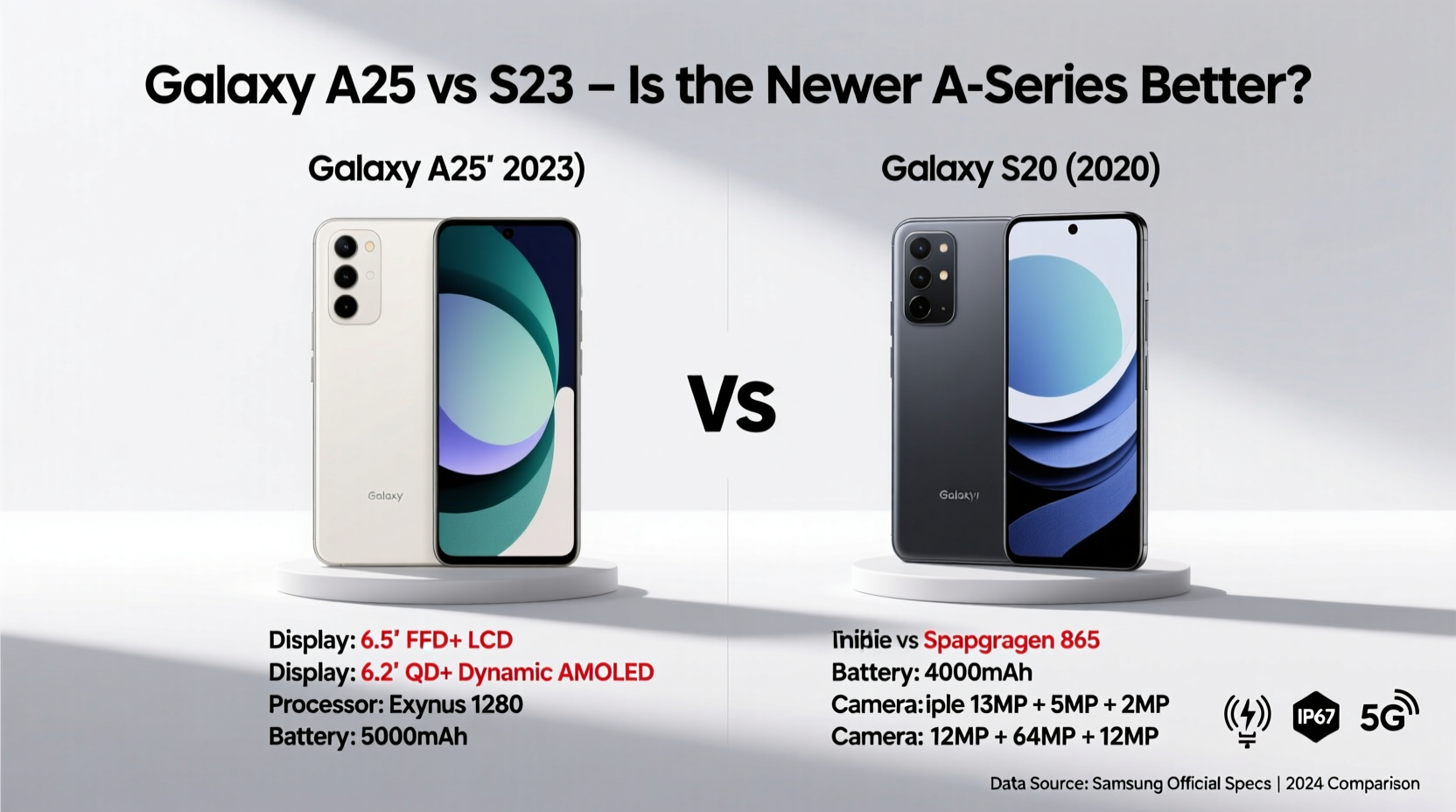
The Galaxy S20 was powered by the Qualcomm Snapdragon 865 (or Exynos 990 in some regions), a top-tier chipset at launch. Even today, this processor handles multitasking, gaming, and intensive apps with ease. It was built for high-refresh-rate displays, 5G connectivity, and AI-driven photography—all cutting-edge features back in 2020.
In contrast, the Galaxy A25 runs on the MediaTek Dimensity 1530, a capable but mid-range chip designed for efficiency over brute power. While it supports smooth 120Hz display operation and handles social media, streaming, and light gaming well, it can struggle under sustained loads. Games like Genshin Impact or Call of Duty Mobile run at lower settings, and app switching isn’t as seamless as on the S20.
RAM also plays a role: the S20 launched with 8GB or 12GB options, while the A25 comes with 6GB or 8GB. More RAM means better background app retention and smoother navigation. Though the A25 benefits from slightly newer software optimization, the S20’s hardware advantage remains significant.
“Even four years later, the Snapdragon 865 holds up remarkably well in daily use. For users who want longevity, older flagships often outperform newer mid-rangers.” — David Lin, Mobile Hardware Analyst at TechPulse
Display and Design: Refresh Rate vs Brightness
Both phones feature 6.5-inch Super AMOLED displays with 120Hz refresh rates—an impressive spec for fluid scrolling and responsive touch. However, there are subtle but important differences.
The S20 uses a Dynamic AMOLED 2X panel with HDR10+ support and peak brightness around 1300 nits. This makes it far more usable outdoors and gives richer contrast. The A25’s display, while vibrant and sharp, peaks at about 1000 nits and lacks HDR certification. In direct sunlight, the S20 clearly wins.
Design-wise, the A25 feels more current. Its flat edge design, slim bezels, and matte finish align with 2024 aesthetics. The S20 has a curved display and a bulkier profile, which some may find outdated. However, the S20 is IP68-rated for dust and water resistance—a feature missing on the A25. If you frequently use your phone near water or in unpredictable environments, this is a major drawback for the newer model.
Camera Comparison: Consistency vs Versatility
The Galaxy S20 launched with a triple rear setup: 12MP main, 64MP telephoto (3x hybrid zoom), and 12MP ultra-wide. Its camera system was praised for balanced color science, excellent dynamic range, and reliable low-light performance. Video recording goes up to 8K at 24fps, a feature few mid-range phones offer even today.
The Galaxy A25 features a 50MP main sensor, 5MP ultrawide, 2MP macro, and 2MP depth sensor. On paper, this looks competitive, but real-world results tell a different story. The A25 struggles with noise in dim lighting, inconsistent white balance, and oversharpened images. The inclusion of macro and depth sensors adds little practical value—they’re mostly marketing tools.
While the A25 benefits from newer AI enhancements and improved night mode algorithms, the S20’s larger pixels and superior image processing pipeline produce more natural, detailed photos. Unless you're shooting in ideal daylight, the S20 consistently delivers better results.
“The S20’s camera may be older, but its hardware foundation—larger sensors, optical-quality lenses—is something many 2024 mid-rangers still can’t match.” — Lena Cho, Mobile Photography Reviewer
Battery Life and Charging: Endurance vs Longevity
The Galaxy A25 packs a 5000mAh battery, significantly larger than the S20’s 4000mAh unit. In practice, this translates to about 1.5 days of moderate use on the A25 versus a full day on the S20. That said, battery health matters: after four years, even a well-maintained S20 likely has degraded capacity, possibly below 80%. If buying used, check battery health via service menus or third-party apps.
Charging speed favors the A25 too—it supports 25W fast charging, while the S20 maxes out at 15W (unless using proprietary chargers). Neither supports wireless charging, though the S20 originally did. Software updates also affect battery management; the A25 ships with Android 13 and promises four OS upgrades, meaning it could stay supported until 2027. The S20 stopped receiving major updates after Android 12, limiting its long-term security and feature access.
Key Battery & Software Differences
| Feature | Galaxy A25 | Galaxy S20 |
|---|---|---|
| Battery Capacity | 5000 mAh | 4000 mAh |
| Fast Charging | 25W | 15W |
| Wireless Charging | No | Yes (original models) |
| OS Support Until | ~2027 (Android 17) | 2023 (Android 12) |
| Current OS Version | Android 13 (One UI 5.1) | Android 12 (One UI 4.1) |
Real-World Example: Choosing Based on Use Case
Consider Maria, a freelance photographer and traveler who needed a reliable second phone. She considered both the A25 and a refurbished S20. Her priorities were camera quality, outdoor visibility, and durability.
She tested both devices side-by-side in Morocco—shooting landscapes, navigating cities, and enduring desert heat. The S20’s brighter screen made maps easier to read under the sun. Its superior low-light performance captured vibrant night markets without grain. Despite shorter battery life, she carried a portable charger. Most importantly, the S20’s IP68 rating gave her peace of mind during sudden rainstorms.
Maria ultimately chose the refurbished S20 for $220, prioritizing camera and build quality over software longevity. For her, the A25’s newer release date didn’t justify its compromises in core areas she used daily.
Checklist: Which Phone Should You Buy?
- Choose the Galaxy A25 if:
- You want longer software support (until 2027)
- Battery life is your top priority
- You prefer a lighter, flatter design
- You’re on a tight budget ($250–$300 range)
- Choose the Galaxy S20 if:
- You value camera quality and dynamic range
- You need a brighter, HDR-capable display
- You want IP68 water resistance
- You can find a well-maintained used/refurbished unit under $250
Frequently Asked Questions
Can the Galaxy A25 replace a flagship phone?
For casual users who stream, browse, and message, yes. But power users, gamers, or photographers will notice limitations in performance, camera, and durability compared to true flagships—even older ones like the S20.
Is the Galaxy S20 still secure to use in 2024?
It no longer receives major OS updates or monthly security patches from Samsung. While it can still function safely for basic tasks, it’s not recommended for handling sensitive data or banking if unpatched vulnerabilities exist.
Does the A25 have better software than the S20?
Yes, in terms of update frequency and future support. The A25 runs a newer version of One UI with enhanced customization and privacy tools. However, the S20’s interface was cleaner and less bloated in its prime.
Final Verdict: Newer Isn’t Always Better
The Galaxy A25 is a solid mid-range phone with strong battery life and modern software support. But calling it “better” than the Galaxy S20 oversimplifies what makes a phone valuable. The S20 still outperforms it in critical areas: processing power, display quality, camera consistency, and build protection.
If you're shopping in 2024, consider your priorities. For long-term software updates and dependable daily use, the A25 makes sense. But if you want a device that performs like a flagship—especially if you find a well-preserved S20 at a discount—the older phone remains a compelling choice.




 浙公网安备
33010002000092号
浙公网安备
33010002000092号 浙B2-20120091-4
Comments
No comments yet. Why don't you start the discussion?