
The Samsung Galaxy A51 was once a benchmark for mid-range smartphones—offering a sleek design, solid camera system, and dependable performance at an accessible price. But with newer models like the Galaxy A15 5G entering the market, many users are asking: Is it time to move on? Or does the A51 still hold its ground in 2024?
This isn’t just about specs on paper. It’s about real-world usability, longevity, and whether spending extra on a new device brings meaningful improvements. Let’s break down the differences and see what makes sense for your needs.
Design and Display: Subtle Shifts, Same Philosophy
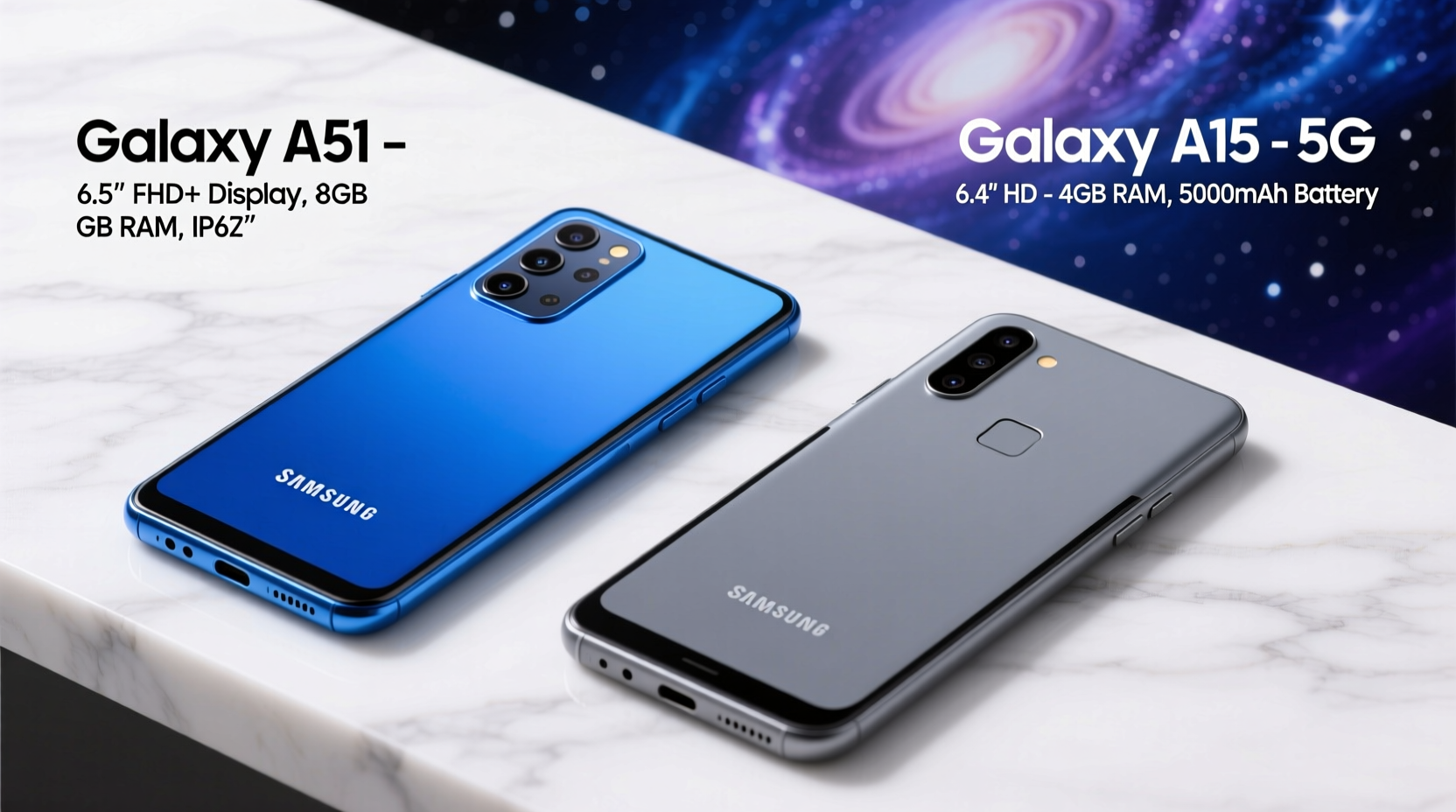
Both phones follow Samsung’s minimalist aesthetic with glossy finishes and centered punch-hole cameras. The A51 features a 6.5-inch Super AMOLED display with a resolution of 1080 x 2400 pixels—still impressive for media consumption and text clarity. Colors pop, blacks are deep, and viewing angles remain excellent.
The A15 5G steps slightly backward by switching to a 6.5-inch Full HD+ PLS LCD panel. While it matches the resolution, PLS LCD can’t match the contrast or vibrancy of AMOLED. For everyday use, this may not be glaring, but in direct sunlight or dark rooms, the difference becomes noticeable.
Physically, both devices are similar in size and weight, but the A15 5G feels slightly more rugged with a textured back panel that resists fingerprints better. Neither is water-resistant, so caution around moisture is essential.
Performance and Software: Generational Gaps Matter
Under the hood, the shift from the A51 to the A15 5G reveals a strategic pivot. The A51 runs on Samsung’s Exynos 9611—a 10nm chip with an octa-core CPU and Mali-G72 MP3 GPU. It handled multitasking well in its prime and supported smooth navigation across apps.
The A15 5G swaps in MediaTek’s Dimensity 6100+—a modern 6nm chipset built specifically for 5G efficiency. Despite being newer, benchmarks show mixed results: single-core performance is improved, but sustained multitasking and gaming can expose thermal throttling due to lower cooling capacity.
RAM configurations also differ. The A51 launched with up to 8GB RAM, while the A15 5G caps at 8GB only in select regions—many variants offer just 4GB or 6GB, which impacts long-term usability as apps grow heavier.
“Mid-range processors today prioritize connectivity over raw power. Users upgrading purely for 5G should evaluate whether their carrier coverage and usage justify the trade-offs.” — David Lin, Mobile Hardware Analyst
Software support is another key factor. The A51 received three major Android OS updates (up to Android 13) and four years of security patches, ending in 2024. The A15 5G, released in early 2024, promises four OS upgrades and five years of security updates—meaning it will likely stay supported through 2028.
Camera Comparison: More Megapixels ≠ Better Photos
The A51 introduced a versatile quad-camera setup: 48MP main, 12MP ultra-wide, 5MP macro, and 5MP depth sensor. In good lighting, photos were sharp and detailed, though low-light performance lagged behind flagships.
The A15 5G reduces the main sensor to 50MP but uses pixel binning to produce 12.5MP images. The ultra-wide drops to 5MP (from 12MP), and the macro and depth sensors remain unchanged. Video recording stays limited to 1080p at 30fps on both devices.
In practice, the A15 5G offers marginally better dynamic range and faster autofocus thanks to its newer image signal processor, but the overall improvement is subtle. The A51’s larger ultra-wide sensor still captures more detail in landscape shots.
| Feature | Galaxy A51 | Galaxy A15 5G |
|---|---|---|
| Main Camera | 48MP (f/2.0) | 50MP (f/1.8) |
| Ultra-Wide | 12MP (f/2.2) | 5MP (f/2.2) |
| Front Camera | 32MP (f/2.2) | 13MP (f/2.0) |
| Video Recording | 1080p @ 30fps | 1080p @ 30fps |
| Night Mode | Yes | Yes |
The front camera takes a significant step down—from a crisp 32MP shooter on the A51 to a basic 13MP lens on the A15 5G. Selfie enthusiasts will notice reduced detail and weaker digital zoom capabilities.
Battery and Charging: Endurance vs Efficiency
The A51 packs a 4000mAh battery, sufficient for a full day of moderate use. It supports 15W fast charging, reaching 50% in about 30 minutes. However, Samsung included a 15W charger in-box at launch—an advantage no longer guaranteed with newer models.
The A15 5G increases capacity to 5000mAh, aligning with current trends favoring endurance over speed. It supports 25W fast charging (though often sold without the adapter). Real-world testing shows the A15 5G lasts 15–20% longer under identical conditions, especially when using 5G networks.
Real-World Example: Maria’s Upgrade Dilemma
Maria has used her Galaxy A51 since 2020. It still works—calls are clear, apps open without freezing, and the screen looks great. But she’s noticed slower app launches recently, especially after updating WhatsApp and Instagram. Her biggest frustration? The phone no longer receives security updates, making her hesitant to bank online.
She considered the A15 5G primarily for 5G access and longer software support. After testing one in-store, she appreciated the longer battery life but was disappointed by the selfie camera and less vibrant screen. Ultimately, she decided to wait for a refurbished Galaxy A34 5G, which offered AMOLED, better cameras, and ongoing updates—all at a similar price point.
Maria’s story highlights a crucial truth: upgrading isn’t automatic. Value depends on individual priorities—whether it’s future-proofing, photography, or display quality.
Should You Upgrade? A Practical Checklist
Before making a decision, ask yourself the following:
- Is your A51 experiencing performance slowdowns or frequent crashes?
- Are you no longer receiving security updates?
- Do you live in an area with strong 5G coverage and want faster downloads?
- Do you need longer battery life for work or travel?
- Are you frustrated with low-light photos or poor selfie quality?
- Is your budget under $250?
If most answers are “yes,” the A15 5G makes sense. But if your A51 still performs reliably and you don’t need 5G, extending its life with a battery replacement or protective case might be smarter.
Frequently Asked Questions
Can the Galaxy A51 still run modern apps smoothly?
Yes, for basic tasks like messaging, browsing, and video streaming. However, heavy multitasking or newer games may cause lag. Clearing cache and disabling unused apps can help maintain performance.
Is 5G worth it on a budget phone like the A15 5G?
Only if you have consistent 5G coverage and use data-intensive services like cloud gaming or HD video conferencing. Otherwise, the battery drain and minimal speed gains may not justify the feature.
Does the A15 5G support expandable storage?
Yes, both phones support microSD cards up to 1TB via a dedicated slot—ideal for storing photos, music, or offline videos.
Final Verdict: Is the A51 Still Good or Should You Move On?
The Galaxy A51 remains a competent device in 2024—if it still functions well. Its AMOLED display, capable main camera, and clean software experience hold up remarkably. For casual users, students, or secondary-device owners, it’s far from obsolete.
The Galaxy A15 5G brings tangible benefits: 5G connectivity, longer battery, and extended software support. But these come with compromises—especially in display quality and front camera performance. At similar price points, alternatives like the Galaxy A24 or refurbished A34 offer better balance.
Upgrading should solve a specific problem, not follow a trend. If your A51 meets your needs, keep using it. If you’re hitting limits in speed, security, or battery, then yes—the A15 5G is a reasonable step forward, provided you accept its trade-offs.




 浙公网安备
33010002000092号
浙公网安备
33010002000092号 浙B2-20120091-4
Comments
No comments yet. Why don't you start the discussion?