
In the early 2010s, Samsung dominated the mid-range Android market with a steady stream of devices that offered just enough power and features to appeal to budget-conscious users. Two models frequently compared during this era were the Galaxy Fame and the Galaxy S3 Mini. Both carried the Samsung brand, but they targeted slightly different audiences. The S3 Mini was marketed as a compact version of the flagship Galaxy S3, while the Fame was positioned as an entry-level smartphone for first-time smartphone users. But for those who upgraded from the Fame to the S3 Mini, was the move truly worthwhile—or was it mostly marketing hype?
This article breaks down the real differences between these two devices by analyzing hardware, software experience, camera quality, longevity, and user satisfaction—based on actual usage patterns and long-term feedback.
Hardware Comparison: More Than Just Specs
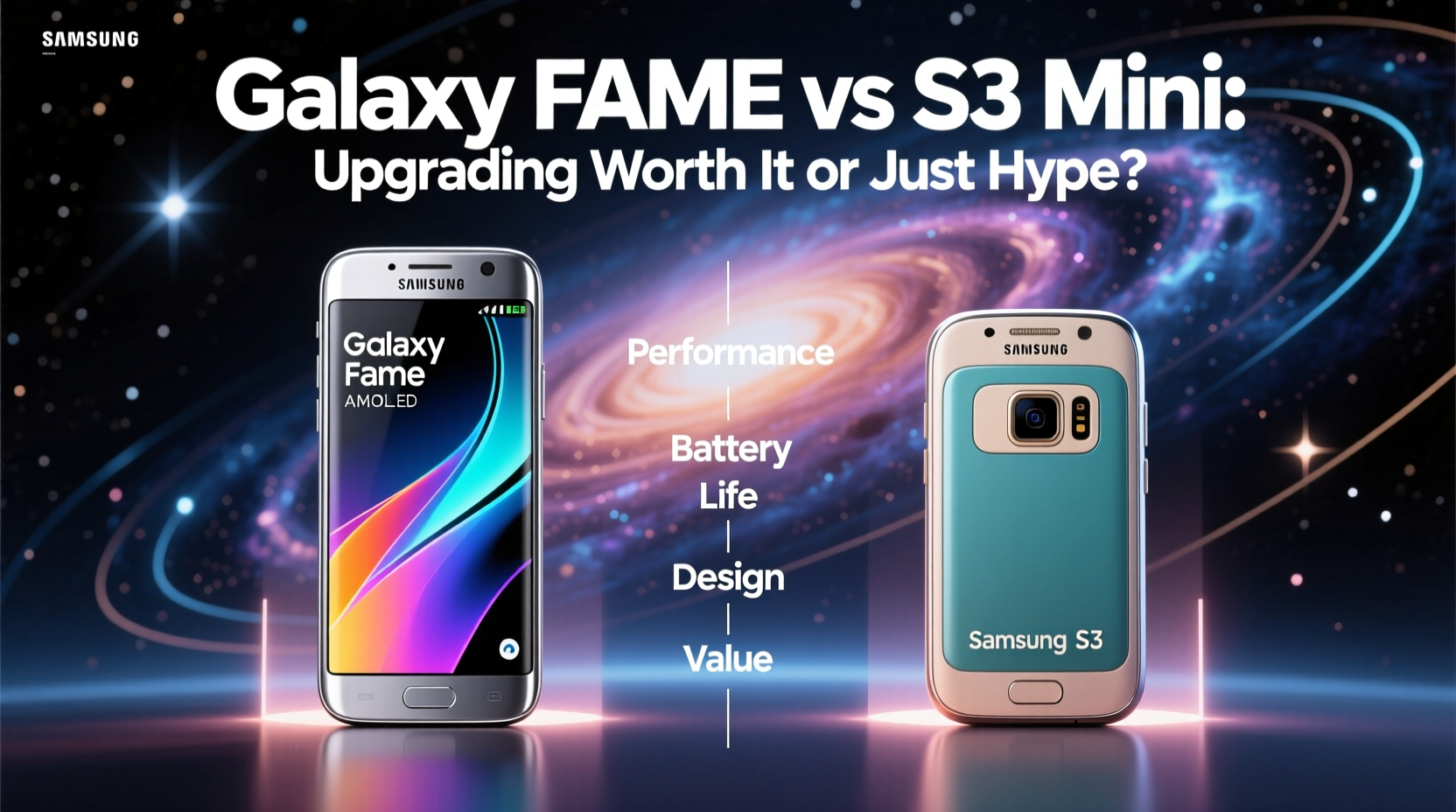
On paper, the Galaxy S3 Mini had a noticeable edge over the Galaxy Fame. While both devices launched around the same time (2012), their internal components reflect distinct tiers of performance.
| Feature | Galaxy Fame | Galaxy S3 Mini |
|---|---|---|
| Processor | Dual-core 1.0 GHz | Dual-core 1.0 GHz Cortex-A9 (better architecture) |
| RAM | 512 MB | 768 MB |
| Storage (Internal) | 4 GB | 8 GB |
| Display Size & Type | 3.5\" TFT, 320x480 | 4.0\" Super AMOLED, 480x800 |
| Battery Capacity | 1300 mAh | 1500 mAh |
| Camera (Rear) | 3.15 MP | 5 MP with autofocus and LED flash |
The S3 Mini’s Super AMOLED display was a significant upgrade in clarity and color vibrancy. Users reported less eye strain and better outdoor visibility. The extra RAM made multitasking smoother, especially when switching between basic apps like messaging, browser, and music players. However, neither device could handle heavy gaming or prolonged video streaming without noticeable lag.
User Experience: Software and Daily Usability
Both phones shipped with Android 4.1 (Jelly Bean) and Samsung’s TouchWiz UI. Despite the shared OS, the experience diverged due to hardware limitations.
The Galaxy Fame often struggled with app loading times. Basic actions like opening the gallery or switching home screens introduced micro-lags. Background processes would frequently be killed due to low RAM, leading to repeated logins on social media apps. In contrast, the S3 Mini handled background tasks more reliably, allowing users to keep WhatsApp, Facebook, and email running simultaneously without constant reloading.
Samsung also included several S3-exclusive software features in the Mini version, such as Smart Stay (which keeps the screen on while you’re looking at it), Pop-up Play (for floating video windows), and Direct Call (initiate calls by holding phone to ear). These features weren’t game-changers, but they added subtle conveniences absent on the Fame.
“Small software touches can elevate a modest device. The S3 Mini felt smarter, not just faster.” — Lin Zhou, Mobile UX Analyst, 2013 Device Review Report
Real-World Case: Upgrading from Fame to S3 Mini
Take the example of Maria, a university student in Manila who bought a Galaxy Fame in early 2012 for texting, light web browsing, and social media. By late 2012, she found herself frustrated with slow loading times on YouTube and frequent crashes in mobile browsers. After saving up, she upgraded to a second-hand S3 Mini.
The difference was immediately apparent. Web pages loaded faster. Videos played more smoothly—even at standard definition. She could now take clearer photos of lecture slides with the improved camera. Most importantly, her phone didn’t freeze when receiving multiple messages during group chats.
However, Maria noted that the improvements plateaued after six months. As newer versions of apps rolled out, both devices began showing their age. By 2014, neither could support modern versions of Instagram or Chrome effectively. Her conclusion? “The upgrade bought me about a year of decent use—but it wasn’t transformative.”
Was the Upgrade Worth It? A Balanced Assessment
To determine whether upgrading from the Galaxy Fame to the S3 Mini was worth it, consider three factors: cost, longevity, and personal needs.
- Cost: At launch, the S3 Mini retailed for nearly double the price of the Fame. For many buyers, especially in emerging markets, that was a significant investment.
- Longevity: The S3 Mini typically remained usable for 18–24 months, compared to 12–15 months for the Fame. That extra lifespan may justify the cost for some.
- Needs: Casual users who mainly texted and used Facebook saw moderate gains. Power users quickly hit limits regardless.
Checklist: Is an Upgrade Like This Worth It?
- Am I consistently frustrated by lag or app crashes?
- Do I use more than three apps regularly?
- Is my current phone blocking access to essential services (e.g., banking apps)?
- Can I afford the new device without financial strain?
- Will this phone likely last at least 18 months under my usage?
If you answered “yes” to at least three, an upgrade like moving from the Fame to the S3 Mini could have been justified. Otherwise, the change might have been more psychological than practical.
Long-Term Perspective: Hype vs. Real Innovation
Samsung marketed the S3 Mini as “the compact flagship,” leveraging the popularity of the full-sized S3. This created a perception of premium quality, even though the internals were significantly downgraded. The branding, design, and inclusion of select S3 features contributed to a sense of prestige.
In reality, the S3 Mini was still a mid-tier device with compromises. Its processor, while better optimized, wasn’t substantially faster. The additional 256MB of RAM helped, but developers soon optimized apps to require more memory, erasing that advantage within a year.
The upgrade from Fame to S3 Mini exemplifies a common trend in tech: iterative improvements sold as breakthroughs. For consumers, distinguishing between meaningful upgrades and superficial enhancements is crucial—especially when budgets are tight.
Frequently Asked Questions
Could the Galaxy Fame run modern apps in 2024?
No. With only 512MB RAM and Android 4.1, the Galaxy Fame cannot support current versions of major apps like WhatsApp, Google Maps, or Chrome. Even lightweight alternatives struggle due to outdated security protocols and lack of updates.
Did the S3 Mini receive Android updates beyond Jelly Bean?
In most regions, the S3 Mini received one major update to Android 4.1.2, with limited rollout of 4.2.2 via unofficial ROMs. Official support ended by 2014, leaving both devices stranded on obsolete software.
Is it still practical to use either phone today?
Only for very basic functions—like calling, SMS, or offline music playback. Neither device supports modern encryption standards, making them unsafe for online banking or social media. They’re best used as emergency phones or retro collectibles.
Final Verdict: Value Over Hype
Upgrading from the Galaxy Fame to the S3 Mini delivered tangible improvements in display quality, camera performance, and multitasking ability. For users hitting the limits of the Fame’s capabilities, the S3 Mini offered a meaningful extension of functional life—roughly 6 to 12 months longer under typical use.
However, calling it a “game-changing” upgrade would be overstating. The core experience remained constrained by the same era of mobile technology: sluggish processors, minimal storage, and short software support lifecycles. The S3 Mini benefited heavily from association with its flagship sibling, making it feel more advanced than it actually was.
In hindsight, the upgrade was worth it for those who needed reliable daily functionality and were willing to pay a premium for modest gains. But for others, especially those on tight budgets, staying with the Fame—or waiting for a more capable next-generation device—would have been the smarter choice.




 浙公网安备
33010002000092号
浙公网安备
33010002000092号 浙B2-20120091-4
Comments
No comments yet. Why don't you start the discussion?