
As we move further into 2024, many Galaxy S10 owners are questioning whether it’s time to upgrade—especially to a device like the Galaxy S20, which once represented Samsung’s leap into the 5G era and high-refresh-rate displays. The S10 was a flagship powerhouse in its day, but technology evolves fast. With newer models on the market, is stepping up to the S20 still a meaningful upgrade—or should you skip straight to something more current?
This deep dive compares the Galaxy S20 and S10 across key categories: performance, display, camera, battery life, software support, and real-world usability in 2024. We’ll help you determine if the S20 remains a viable step up or if holding onto your S10 (or targeting a newer model) makes more sense.
Performance: A Noticeable Leap in Speed and Efficiency
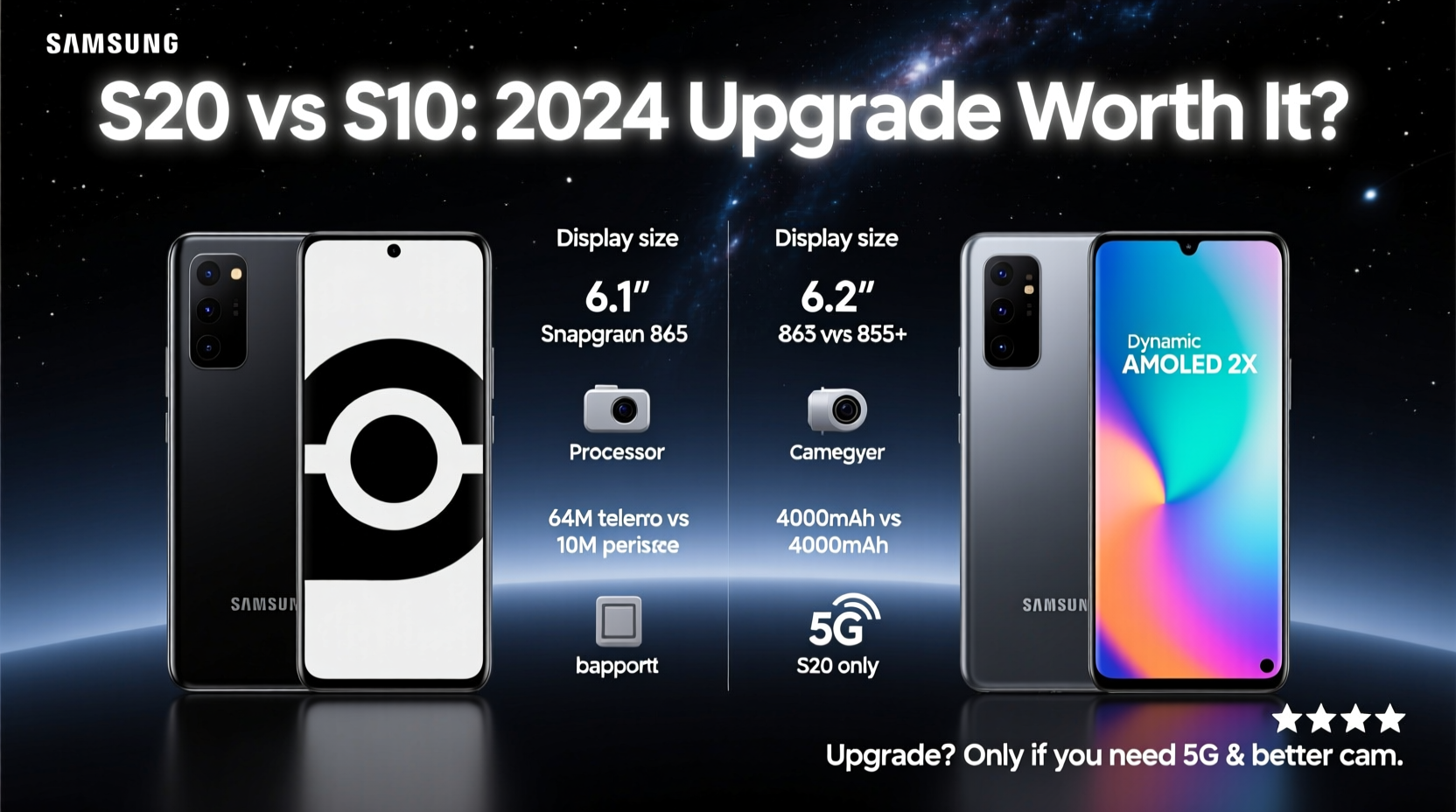
The Galaxy S10 launched in 2019 with the Qualcomm Snapdragon 855 (or Exynos 9820 in some regions), while the S20 arrived just a year later with the Snapdragon 865 or Exynos 990. Though this may seem like a minor generational jump, the difference in real-world responsiveness is tangible.
The S20’s processor, paired with faster UFS 3.0 storage and LPDDR5 RAM, delivers smoother multitasking, quicker app launches, and better sustained performance during gaming or video editing. Apps that may stutter slightly on an aging S10 run fluidly on the S20—even in 2024.
However, for basic tasks—messaging, browsing, social media—the S10 still holds up well. The real bottleneck isn’t raw power but software optimization over time. As Android updates roll out, older devices like the S10 experience slower adaptation, making the S20 feel more “current” even four years later.
Display and Design: From Good to Future-Ready
One of the most significant upgrades from the S10 to the S20 is the display. The S10 features a 6.1-inch Dynamic AMOLED panel with a 60Hz refresh rate. It was excellent in 2019, offering vibrant colors and deep blacks. But the S20 introduced a 6.2-inch QHD+ Dynamic AMOLED 2X display with a 120Hz adaptive refresh rate—a game-changer for smooth scrolling and responsive touch input.
In 2024, high refresh rates are standard, and returning to 60Hz after using 120Hz feels jarring. The S20’s screen automatically adjusts between 60Hz and 120Hz based on content, balancing smoothness and battery efficiency.
| Feature | Galaxy S10 | Galaxy S20 |
|---|---|---|
| Display Size | 6.1 inches | 6.2 inches |
| Resolution | 3040 x 1440 (QHD) | 3200 x 1440 (QHD+) |
| Refresh Rate | 60Hz | 120Hz (adaptive) |
| Material | Dynamic AMOLED | Dynamic AMOLED 2X |
| 5G Support | No (except S10 5G) | Yes (on 5G models) |
The S20 also adopted a punch-hole front camera centered at the top, replacing the S10’s curved cutout. This small change improved symmetry and usability, especially when watching videos or playing games.
Camera Comparison: Evolution Over Revolution
Both phones feature strong camera systems, but the S20 refines the formula. The S10 has a triple rear setup: 12MP main, 12MP telephoto, and 16MP ultra-wide. The S20 keeps the same resolution but improves sensor quality and adds enhanced software processing.
- Low-light photography: The S20’s Night Mode is noticeably better, capturing brighter images with less noise.
- Zoom capabilities: : The S20 supports 3x hybrid zoom and up to 30x digital zoom via Space Zoom, whereas the S10 maxes out at 2x optical and 10x digital.
- Video recording: The S20 can record 8K at 24fps, a headline feature in 2020. While few users need 8K, the ability reflects stronger image stabilization and processing power.
Front cameras are nearly identical—both 10MP with autofocus—but the S20 benefits from improved HDR and AI scene optimization.
“Even incremental improvements in camera processing can significantly impact photo consistency, especially in mixed lighting.” — David Lin, Mobile Imaging Analyst at DXOMARK
For casual photographers, the difference may not justify an upgrade. But for enthusiasts who shoot in varied conditions or want better zoom, the S20 offers measurable gains.
Battery Life and Charging: Practical Trade-offs
The S10 packs a 3,400mAh battery, while the S20 steps up to 4,000mAh—a 17% increase. Despite the larger battery and more power-hungry 120Hz display, the S20 typically lasts a full day under moderate use, matching or slightly exceeding the S10’s endurance.
Charging speeds are identical: 25W wired, 12W wireless, and reverse wireless charging. Neither supports ultra-fast 45W charging found in later flagships. However, the S20’s larger battery provides more headroom as battery health degrades over time.
Software Support and Longevity in 2024
This is where the decision becomes clearer. Samsung promised four years of major Android OS updates for the S20 series, meaning it received updates up to Android 14. The S10, despite being popular, only got three generations (up to Android 13).
As of 2024, the S10 no longer receives major OS updates and is limited to security patches, which may become less frequent. The S20, depending on region and carrier, may still receive quarterly security updates, extending its secure usability.
If you value up-to-date software, privacy features, and compatibility with modern apps, the S20 has a clear edge. Newer banking apps, messaging platforms, and productivity tools increasingly require recent Android versions, putting older devices at risk of obsolescence.
Mini Case Study: Sarah’s Upgrade Dilemma
Sarah has used her Galaxy S10 since 2019. By late 2023, she noticed apps taking longer to load, occasional crashes in Chrome, and her bank app warning that her OS version was unsupported. She considered buying a used S20 for $180, seeing it as a budget-friendly way to regain stability.
After switching, she immediately noticed smoother navigation, fewer app freezes, and the joy of a 120Hz screen. Her phone now runs Android 14, and she expects it to remain functional through 2025. For her, the upgrade wasn’t about cutting-edge features—it was about regaining reliability.
Upgrade Checklist: Is the S20 Right for You?
Before making the move, consider these factors:
- Are you experiencing slowdowns or app incompatibility on your S10?
- Do you want a high-refresh-rate display for a smoother experience?
- Is 5G access important for your connectivity needs?
- Do you value having one more year of software support?
- Are you on a tight budget and considering a used S20 instead of a newer model?
If you answered yes to three or more, the S20 upgrade is likely worthwhile. But if you're already thinking beyond 2025, you might be better off investing in an S21 FE, S23, or newer model with longer support.
Frequently Asked Questions
Can the Galaxy S10 still handle daily use in 2024?
Yes, for basic tasks like calls, messaging, email, and light browsing. However, performance may lag with newer apps, and lack of Android 14 means missing security and feature updates.
Is the Galaxy S20 5G compatible?
Yes, all global variants of the S20 (excluding the base S20 in some early markets) support 5G. The S10 only has a separate 5G model, which was rare and expensive at launch.
Should I upgrade to the S20 or wait for a newer model?
If you’re on a tight budget and want a noticeable improvement over the S10, the used S20 market offers good value. But if you can stretch your budget, an S22 or S23 provides better long-term support, improved efficiency, and stronger resale value.
Final Verdict: A Calculated Step Forward
Upgrading from the Galaxy S10 to the S20 in 2024 isn’t about chasing the latest tech—it’s about reclaiming performance, modern software, and a display that meets current standards. The S20 delivers on all three, making it a sensible mid-tier upgrade for S10 users facing slowdowns or software limitations.
While newer phones offer better cameras, longer warranties, and more future-proof hardware, the S20 strikes a sweet spot between cost and capability. At typical used prices of $150–$220, it extends smartphone usability without breaking the bank.




 浙公网安备
33010002000092号
浙公网安备
33010002000092号 浙B2-20120091-4
Comments
No comments yet. Why don't you start the discussion?