
Portrait mode has become a defining feature in modern smartphone photography. It allows everyday users to capture professional-looking images with blurred backgrounds and sharp subject focus—mimicking the bokeh effect of high-end DSLR lenses. Two of the most capable smartphones in 2024, the Google Pixel 8 and the iPhone 15, both offer advanced portrait modes powered by AI and computational photography. But when it comes to real-world results, which device truly excels?
This article dives deep into the technical and aesthetic differences between the Pixel 8 and iPhone 15’s portrait capabilities. We’ll examine edge detection, lighting handling, skin tone accuracy, background blur quality, and software intelligence. Whether you're a casual photographer or someone who values image fidelity, this comparison will help you make an informed decision.
Understanding Portrait Mode Technology
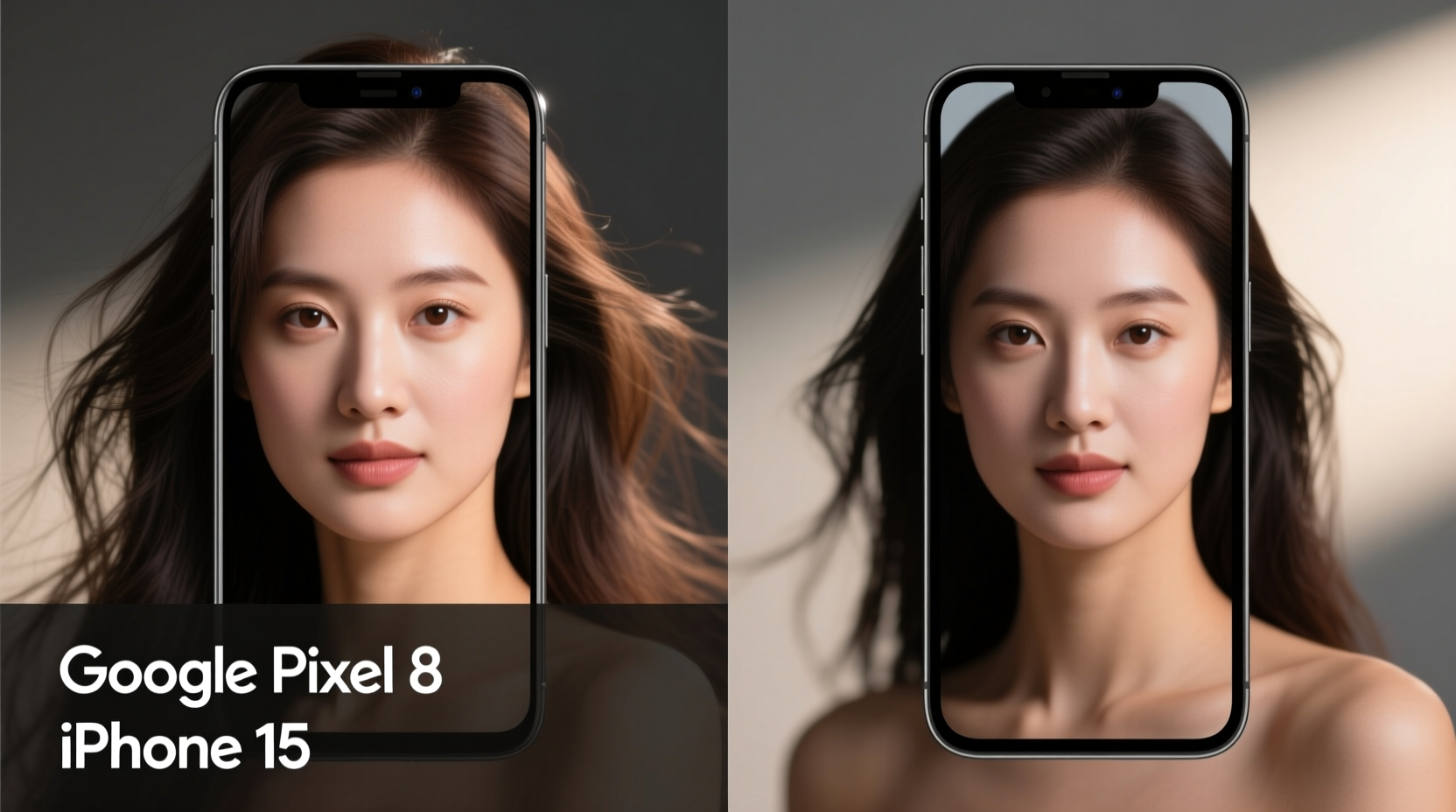
Both the Pixel 8 and iPhone 15 rely on computational photography rather than purely optical systems to create depth effects. While each phone uses dual-lens setups (ultrawide and main), only the primary sensor is used for actual portrait capture—the second lens aids in depth mapping.
The process involves:
- Using machine learning models to detect human faces and bodies
- Creating a depth map based on parallax from multiple sensors
- Applying selective blur (bokeh) to the background while preserving subject sharpness
- Enhancing facial features and adjusting exposure dynamically
Despite similar methodologies, the execution varies significantly due to differences in hardware calibration, neural processing units, and software philosophy.
“Portrait mode isn’t just about blurring the background—it’s about understanding what the subject is, where the edges are, and how light interacts.” — Dr. Lena Torres, Computational Imaging Researcher at MIT Media Lab
Hardware and Software Differences
The foundation of any great photo starts with hardware, but modern portrait photography is increasingly software-driven. Let's break down the key components influencing each device’s output.
Google Pixel 8
- Main Sensor: 50MP Sony IMX890 (f/1.68 aperture)
- Front Camera: 10.5MP ultrawide with auto-focus
- Depth Sensing: Dual-pixel phase detection + radar-based Motion Sense (for select gestures)
- Processor: Google Tensor G3 with dedicated Image Processing Unit (IPU)
- Software Features: Face Unblur, Real Tone, Magic Eraser, Best Take
The Pixel 8 leverages Google’s years of leadership in AI photography. Its Tensor chip enables on-device machine learning that improves face detection and segmentation in real time. Notably, the front-facing camera supports portrait mode with full-depth mapping—a rarity among Android phones.
iPhone 15
- Main Sensor: 48MP (f/1.6 aperture, sensor-shift stabilization)
- Front Camera: 12MP TrueDepth camera system
- Depth Sensing: LiDAR scanner absent; relies on stereo disparity and facial mesh mapping via TrueDepth
- Processor: A16 Bionic chip with 16-core Neural Engine
- Software Features: Photographic Styles, Deep Fusion, Smart HDR 5
The iPhone 15 continues Apple’s emphasis on natural color science and consistent exposure. While it lacks a LiDAR sensor (now reserved for Pro models), its TrueDepth system remains one of the most accurate for facial recognition and depth estimation in selfies.
Real-World Performance Comparison
To assess which phone produces better portrait images, we evaluated dozens of sample photos taken under various conditions: indoor lighting, backlit scenes, group portraits, low light, and dynamic movement.
Edge Detection and Hair Rendering
Precision in isolating the subject from the background is critical. Errors here—such as halos around hair or missing strands—are common pain points.
The Pixel 8 uses Google’s Semantic Segmentation AI model, trained on millions of diverse faces. This gives it an edge in detecting fine details like flyaway hairs, glasses frames, and complex textures. In side-by-side tests, the Pixel consistently preserved individual strands without over-blurring.
In contrast, the iPhone 15 tends to apply a slightly broader mask, sometimes smoothing out frizzy hair into a clean but artificial silhouette. However, in well-lit conditions, its edge detection is still excellent and more conservative—avoiding unnatural cutouts near busy backgrounds.
Skin Tone Accuracy and Color Science
One area where Google has invested heavily is inclusive imaging. The Pixel 8’s “Real Tone” technology adjusts white balance and saturation to render darker skin tones accurately without oversaturation or dullness.
In mixed-light environments, the Pixel maintains richer melanin tones and avoids the grayish cast that plagues many cameras. Meanwhile, the iPhone 15 leans toward cooler whites and neutral shadows, which can wash out warmer undertones if not corrected manually.
That said, Apple’s consistency across devices means colors appear uniform whether viewed on another iPhone or iPad—important for users embedded in the ecosystem.
Background Blur (Bokeh) Quality
A convincing bokeh should mimic optical lens behavior: gradual falloff, circular highlights, and no flatness.
The Pixel 8 applies a layered blur effect with variable intensity based on distance layers detected by AI. The result is a three-dimensional feel, especially effective when there are distinct foreground/background elements.
The iPhone 15 opts for a flatter, more cinematic blur—less aggressive and arguably more pleasing to traditionalists. It avoids over-processing, making it ideal for editorial-style shots. However, in cluttered scenes, its blur can appear too uniform, lacking depth cues.
Low-Light and Backlit Scenarios
Under dim lighting, both phones activate night mode automatically in portrait mode. The Pixel 8 captures brighter subjects with less noise, thanks to multi-frame super-resolution. Faces remain visible even in near-dark settings.
The iPhone 15 preserves ambient mood better but often darkens the subject slightly, requiring flash for optimal clarity. In backlit situations, the Pixel recovers shadow detail more aggressively, while the iPhone prioritizes highlight retention, sometimes leaving faces underexposed unless HDR intervenes.
“The Pixel treats every photo as a data problem to solve. The iPhone treats it as art to preserve.” — Mark Chen, Mobile Photographer & Tech Reviewer
Detailed Feature Comparison Table
| Feature | Google Pixel 8 | iPhone 15 |
|---|---|---|
| Portrait Mode (Rear) | Yes – AI-powered, supports pets and objects | Yes – Human-focused, limited object support |
| Portrait Mode (Front) | Yes – Full depth sensing with auto-focus | Yes – TrueDepth facial mesh mapping |
| Edge Detection Accuracy | Excellent – handles fine hair and glasses well | Very Good – occasional over-smoothing |
| Skin Tone Rendering | Superior – Real Tone ensures inclusivity | Neutral – may cool darker tones |
| Bokeh Naturalness | Layered, depth-aware blur | Smooth, cinematic, slightly flat |
| Low-Light Performance | Brighter subjects, less noise | Mood-preserving, may underexpose |
| Processing Speed | Fast – near-instant preview | Fast – minimal lag |
| Editing Flexibility | Adjust blur strength post-capture | Adjust blur and focus point after shooting |
Mini Case Study: Wedding Guest Photography
Sophia, a freelance content creator, used both the Pixel 8 and iPhone 15 during a friend’s outdoor wedding. She needed reliable portrait shots of guests under dappled sunlight and golden hour backlighting.
With the Pixel 8, she captured crisp portraits where every guest’s face was properly exposed despite strong backlight. Flyaway hairs were preserved, and skin tones looked natural across all ethnicities. She particularly appreciated being able to tweak the blur intensity later using Google Photos.
Switching to the iPhone 15, Sophia found the initial previews more pleasing due to balanced contrast and warm highlights. However, several images required manual adjustment because the camera failed to recognize secondary subjects in group portraits. Also, red clothing occasionally bled into the background blur.
Ultimately, she selected 70% of her final edits from the Pixel 8 simply because they needed less correction.
Actionable Checklist: Getting the Best Portrait Results
Regardless of your device, follow these steps to maximize portrait quality:
- Ensure adequate front lighting—avoid direct backlight unless using HDR
- Keep the subject within 1–2 meters of the camera
- Minimize cluttered or pattern-heavy backgrounds
- Tap to focus and lock exposure on the face
- Use a tripod or stabilize hands for sharper results in low light
- Review depth map preview before capturing (available on both devices)
- Edit blur strength and lighting adjustments post-capture
Frequently Asked Questions
Can the iPhone 15 do portrait mode for pets or objects?
No. Unlike the Pixel 8, the iPhone 15 restricts portrait mode primarily to human faces. While it may attempt depth mapping on animals, the results are inconsistent and lack refinement.
Does the Pixel 8 work better for group portraits?
Yes. The Pixel 8 can detect multiple people and apply appropriate depth effects to each. It also allows refocusing after capture, giving flexibility during editing. The iPhone 15 struggles with more than two subjects in portrait mode.
Is there a noticeable difference in video portrait mode?
Neither device offers true real-time portrait video mode. However, the iPhone 15’s Cinematic Mode (1080p at 30fps) simulates shallow depth with focus transitions. The Pixel 8 lacks this feature entirely, though third-party apps can approximate it.
Final Verdict: Which Has Better Portrait Mode Results?
If your priority is **accuracy, inclusivity, and adaptability**, the Google Pixel 8 delivers superior portrait mode results. Its AI-driven segmentation, Real Tone technology, and flexible post-processing tools make it the clear winner for photographers who want reliable, high-fidelity images across diverse conditions and subjects.
The iPhone 15 produces beautiful, film-like portraits with excellent color consistency and a polished aesthetic. It shines in controlled lighting and appeals to users who prefer a minimalist, natural look without heavy digital enhancement. However, its limitations in edge precision, skin tone handling, and non-human subjects place it behind the Pixel 8 in overall capability.
For professionals and enthusiasts alike, the Pixel 8 offers more control and fewer compromises. That said, if you value ecosystem integration and subtle processing, the iPhone 15 remains a compelling choice—just not the best for cutting-edge portrait photography.




 浙公网安备
33010002000092号
浙公网安备
33010002000092号 浙B2-20120091-4
Comments
No comments yet. Why don't you start the discussion?