
Travel photography has evolved dramatically in the last decade. What once required bulky DSLRs or dedicated camcorders can now be done with a smartphone pulled from your pocket. Apple’s iPhone Action Mode, introduced with the iPhone 14 series, promises stabilized, cinematic video that rivals professional gear. Meanwhile, GoPro continues to dominate the action camera market with rugged designs, wide-angle lenses, and advanced stabilization. But when it comes to capturing your adventures — hiking trails, snorkeling reefs, or biking through cities — do you actually need a GoPro if you already own a modern iPhone?
The short answer: it depends on how you travel and what kind of content you want to create. The long answer requires a deeper look at image quality, environmental resilience, ease of use, and creative flexibility.
Image Quality and Stabilization: A Side-by-Side Look
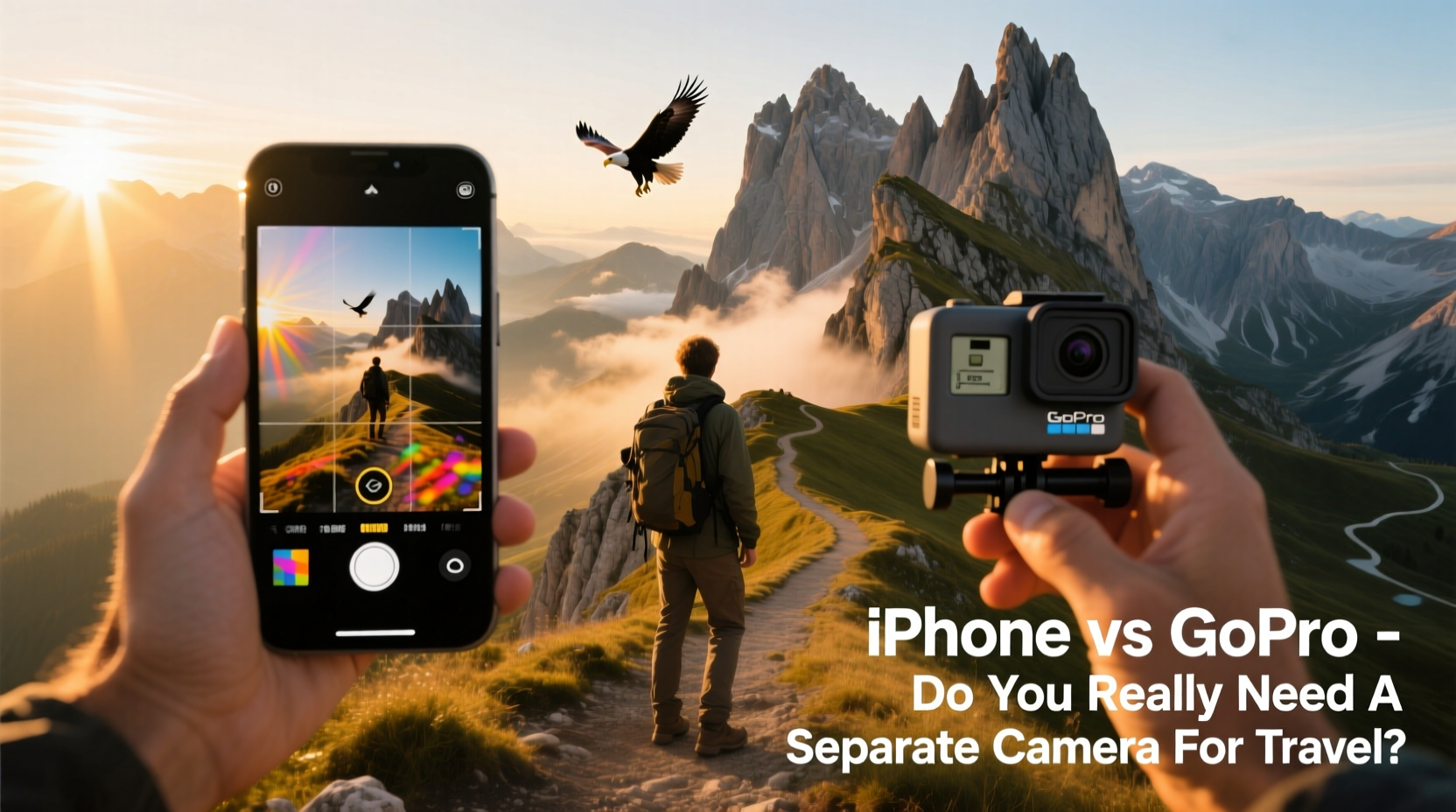
At first glance, the iPhone's Action Mode appears to close the gap between smartphones and action cameras. It uses sensor-shift stabilization, software algorithms, and cropping to deliver smooth footage even during high-motion activities like running or mountain biking. In ideal lighting, the results are impressive — sharp detail, accurate colors, and minimal shake.
GoPro, however, builds its entire platform around motion capture. Models like the GoPro Hero12 Black feature HyperSmooth 6.0 stabilization, horizon leveling up to 360°, and native support for high-bitrate video formats (up to 5.3K60). These aren’t just marketing terms; they translate into usable footage when mounted on helmets, handlebars, or drone arms — scenarios where even minor wobble ruins a shot.
In low light, the difference becomes more pronounced. While iPhones have excellent computational photography, their small sensors struggle in dim conditions. GoPros, though not class-leading in night performance, maintain better dynamic range and noise control in challenging environments thanks to purpose-built tuning for outdoor extremes.
Durability and Environmental Resistance
This is where GoPro still holds a commanding lead. Every current GoPro model is waterproof up to 33 feet (10 meters) without a case. You can jump off a dock, film underwater, or ride through rainstorms without hesitation. The housing adds further protection and enables deeper dives — up to 197 feet with optional mods.
iPhones, while improved in water resistance (IP68 rated), are not designed for repeated submersion. Apple explicitly warns against using the phone underwater, even though it may survive brief exposure. Sand, saltwater, and pressure changes increase the risk of damage. One misstep near a waterfall could mean a $1,200 repair bill.
Additionally, GoPros are built to withstand drops, vibrations, and temperature swings. Their compact size and rubberized bodies absorb impact far better than glass-backed smartphones. If you're climbing, kayaking, or skiing, this peace of mind matters.
“Durability isn’t just about surviving accidents — it’s about enabling spontaneous creativity.” — Lena Torres, Adventure Filmmaker & NatGeo Contributor
Mounting and Hands-Free Flexibility
One of the biggest advantages of a GoPro is its ecosystem. From suction cups to chest harnesses, pole mounts to adhesive pads, GoPro accessories let you capture unique perspectives effortlessly. Want a POV shot of your paragliding descent? Clip it to your helmet. Document a cooking class from above? Use a flexible arm mount on the counter.
While you *can* mount an iPhone, doing so is clunky and risky. Most mounts require bulky cases, increasing weight and reducing access to controls. Battery drain during extended recording also limits usability — something GoPros manage much more efficiently due to optimized hardware.
Beyond convenience, mounting opens creative doors. First-person footage creates immersion. Overhead angles add production value. With a GoPro, these options become routine rather than exceptions.
Comparison Table: Key Features at a Glance
| Feature | iPhone (14/15 Pro) | GoPro Hero12 Black |
|---|---|---|
| Video Resolution | 4K60 (Action Mode: 2.8K60 cropped) | 5.3K60, 4K120, 2.7K240 |
| Stabilization | Action Mode (digital crop + software) | HyperSmooth 6.0 + Horizon Lock 360° |
| Water Resistance | IP68 (up to 6m for 30 min; not for submersion) | 10m without case; up to 60m with Super Suit |
| Battery Life (video) | ~1.5–2 hours (varies by usage) | ~2–3 hours (extendable with Enduro battery) |
| Mounting Options | Limited, requires third-party gear | Extensive official ecosystem |
| Low Light Performance | Good (Night mode photo only) | Moderate (improved with Night Lapse modes) |
| Price (USD) | N/A (included with phone) | $370–$450 |
Real-World Example: A Week in Bali
Consider Sarah, a solo traveler documenting her week in Bali. She starts with sunrise yoga — she props her iPhone on a mat, but the angle cuts off half her body. With a GoPro mounted overhead via a mini tripod, she captures full frames effortlessly.
Next, she snorkels at Nusa Penida. Her iPhone stays ashore. Her GoPro, clipped to a floaty wrist strap, records manta rays gliding beneath her. Afterward, she surfs — an activity too dynamic for safe iPhone handling. Mounted on her board leash, the GoPro captures wipeouts and rides alike.
Back on land, she films a street food tour. Using her iPhone’s Action Mode while walking, the footage is stable but narrow due to aggressive cropping. The GoPro, worn on a lanyard mount, provides a wider field of view and longer battery life across multiple stalls.
By trip’s end, Sarah realizes her iPhone was great for quick clips and social posts, but the GoPro delivered the bulk of her cinematic content — especially in wet, active, or hands-free situations.
When the iPhone Wins (And When It Doesn’t)
The iPhone excels in accessibility and integration. You always have it. It shoots excellent photos, supports instant editing apps, and uploads directly to Instagram or YouTube. Its microphone system is superior for voiceovers, and its screen makes framing easy.
But limitations emerge under stress. Heat warnings interrupt long recordings. Storage fills quickly with 4K video. And because it’s your primary device, risking it for a cool shot feels unwise.
If your travels involve mostly urban exploration, cultural sites, or casual vlogging, the iPhone — especially with Action Mode — may be all you need. But if you’re engaging in water sports, extreme terrain, or multi-day expeditions, a GoPro reduces risk and expands creative potential.
Step-by-Step: Choosing the Right Tool for Your Trip
- Assess your itinerary. Will you swim, hike, cycle, or ski? High-motion or wet environments favor GoPro.
- Evaluate your existing gear. Do you already own a protective case or gimbal? Can your iPhone handle the workload?
- Determine your output goals. Are you making a highlight reel for YouTube, or just sharing moments on Stories?
- Test both devices beforehand. Record sample footage in similar conditions — walking, panning, low light.
- Decide based on risk tolerance. Is losing or damaging your phone acceptable for one shot?
Checklist: Do You Need a Separate Action Camera?
- ✅ Traveling to aquatic destinations (beaches, lakes, pools)
- ✅ Engaging in adventure sports (skiing, mountain biking, rock climbing)
- ✅ Planning hands-free or POV filming
- ✅ Creating professional-grade content for platforms
- ✅ Visiting remote areas where phone repair isn’t feasible
- ✅ Frequently recording in dusty, sandy, or humid environments
If three or more apply, a GoPro is worth the investment.
Frequently Asked Questions
Can I use my iPhone instead of a GoPro for travel videos?
Yes, especially if your trips are low-risk and urban-focused. Modern iPhones produce high-quality video, and Action Mode helps with stabilization. However, avoid submerging it, and be cautious in extreme conditions.
Is GoPro video noticeably better than iPhone?
In most daylight scenarios, the difference is subtle. But in motion-heavy, wet, or mounted situations, GoPro consistently delivers smoother, wider, and more reliable footage. Its horizon leveling and color profiles (like GoPro Flat) also give editors more flexibility.
Do I need both an iPhone and a GoPro?
Many travelers do — and for good reason. The iPhone handles photos, communication, navigation, and casual clips. The GoPro specializes in durable, immersive action capture. Together, they cover nearly every scenario without compromise.
Expert Insight: Why Hybrid Setups Are Rising
“The best travel kits now include both devices: the iPhone for storytelling and connectivity, the GoPro for fearless documentation.” — Mark Chen, Digital Nomad & Video Producer
Professionals increasingly adopt this dual-device strategy. They use the iPhone for interviews, B-roll, and social media posting, while relying on the GoPro for sequences too risky or dynamic for a smartphone. This hybrid approach maximizes safety, quality, and workflow efficiency.
Final Verdict: Convenience vs. Capability
The iPhone’s Action Mode is a game-changer — no doubt. It brings pro-level stabilization to billions of users overnight. For many travelers, it eliminates the need for a second camera entirely.
But “need” doesn’t always equal “optimal.” Just because you can film a mountain trail run on your iPhone doesn’t mean you should. Risk of damage, limited mounting, shorter battery life, and narrower stabilization margins make it less ideal for true adventure scenarios.
A GoPro isn’t essential for every traveler. But for those who push boundaries, embrace spontaneity, or value high-quality documentation, it remains unmatched. Think of it not as a replacement, but as a specialized tool — like bringing hiking boots instead of sneakers.
Conclusion: Capture More, Worry Less
You don’t *need* a GoPro to document your travels — not anymore. But you’ll likely *want* one once you experience the freedom of worry-free filming. Whether you’re diving into turquoise waters or racing down a dirt path, having a camera built for the elements lets you focus on the moment, not the mechanics.
If your adventures lean toward the ordinary, your iPhone is enough. But if you chase waves, peaks, or hidden trails, consider adding a GoPro to your pack. Not because your phone failed you — but because your experiences deserve to be captured without limits.




 浙公网安备
33010002000092号
浙公网安备
33010002000092号 浙B2-20120091-4
Comments
No comments yet. Why don't you start the discussion?