
In a world dominated by stress, distractions, and digital overload, the simple act of writing down what you're grateful for might seem like little more than a feel-good ritual. Yet, a growing body of scientific research suggests that gratitude journaling is far from superficial—it can fundamentally alter the way your brain functions. This isn’t just about optimism or positive thinking; it’s about measurable neurobiological shifts that influence mood, resilience, and long-term mental health.
The practice is straightforward: each day, write down three to five things you’re grateful for. But beneath this simplicity lies a powerful mechanism capable of reshaping neural pathways, enhancing emotional regulation, and improving overall psychological well-being. The real question isn’t whether gratitude journaling works—but how, exactly, does putting pen to paper rewire your brain?
The Neuroscience of Gratitude
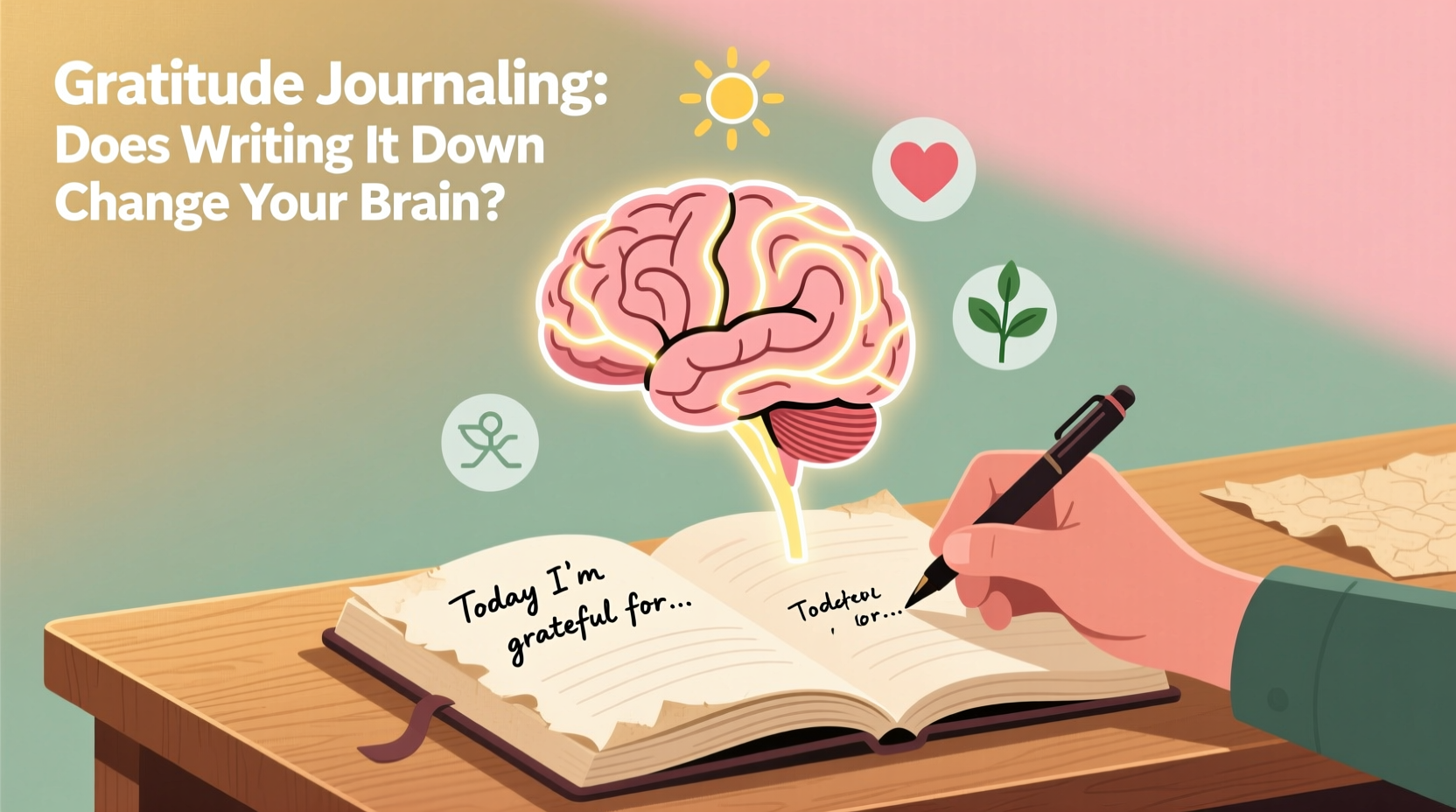
Gratitude isn’t merely an emotion; it’s a cognitive process with deep roots in brain function. Functional MRI (fMRI) studies have shown that expressing gratitude activates key regions involved in moral cognition, reward processing, and emotional regulation. When participants reflect on people or experiences they appreciate, researchers observe increased activity in the prefrontal cortex—the area responsible for decision-making, self-control, and social behavior.
One landmark study conducted at Indiana University found that individuals who wrote gratitude letters over a three-week period showed significantly greater neural sensitivity in the medial prefrontal cortex when later exposed to acts of kindness—even months after the intervention ended. This suggests that gratitude journaling doesn’t just produce temporary mood boosts—it may create lasting changes in how the brain responds to positive stimuli.
“Gratitude rewires the brain to focus on abundance rather than lack. Over time, this shift reduces baseline levels of anxiety and enhances emotional resilience.” — Dr. Alex Korb, Neuroscientist and Author of *The Upward Spiral*
The brain operates on the principle of neuroplasticity—its ability to reorganize itself by forming new neural connections throughout life. Every thought, habit, and repeated behavior strengthens certain pathways while weakening others. By consistently directing attention toward positive experiences through journaling, individuals reinforce circuits associated with well-being, making them more dominant over time.
How Writing It Down Amplifies the Effect
Why does the physical act of writing matter? Why not just think about what you’re grateful for? Research indicates that expressive writing engages deeper cognitive processing than passive reflection. The moment you translate abstract feelings into concrete language, multiple brain systems activate: motor control for handwriting, linguistic centers for word selection, and memory networks for recall.
This multi-system engagement increases emotional salience—the brain treats written thoughts as more significant than fleeting mental notes. A 2018 study published in Psychotherapy Research demonstrated that participants who journaled their gratitude reported higher levels of subjective well-being compared to those who mentally noted their appreciations. The researchers concluded that externalizing gratitude through writing solidifies its impact on self-perception and emotional tone.
A Step-by-Step Guide to Effective Gratitude Journaling
To harness the full neurological benefits, structure matters. Random or rushed entries are less likely to trigger meaningful brain changes. Follow this science-backed sequence to maximize results:
- Choose a consistent time – Ideally, journal daily at the same time (morning or evening). Consistency reinforces habit formation via the basal ganglia, a brain region central to routines.
- Write 3–5 specific items – Avoid vague statements like “I’m grateful for my family.” Instead, write, “I’m grateful my sister called me today—it made me feel supported.” Specificity increases emotional resonance.
- Include the ‘why’ – For each item, briefly explain why it mattered. This deepens cognitive processing and strengthens memory encoding.
- Reflect on small moments – Don’t wait for major events. Appreciate a warm cup of coffee, a stranger’s smile, or sunlight through the window. Training the brain to notice micro-positives builds sustained positivity bias.
- Re-read past entries weekly – Reviewing previous journal entries reignites positive emotions and consolidates neural gains, similar to how spaced repetition improves learning.
Commit to at least 21 days. While some report mood improvements within a week, structural brain changes typically emerge after sustained practice. Like building muscle, neuroplastic transformation requires repetition and effort.
Do’s and Don’ts of Gratitude Journaling
| Do | Don’t |
|---|---|
| Be specific and detailed | Use generic phrases like “I’m grateful for everything” |
| Write by hand when possible | Rely solely on voice memos or apps without reflection |
| Focus on people and relationships | Only list material possessions |
| Acknowledge challenges with gratitude (“I’m grateful I handled that meeting calmly despite stress”) | Ignore negative emotions—gratitude should coexist with honesty |
| Review old entries monthly | Toss or delete journals after finishing them |
Real Impact: A Mini Case Study
Sarah, a 34-year-old project manager, began gratitude journaling after being diagnosed with mild anxiety. Initially skeptical, she committed to writing three things each night before bed. Her first entries were basic: “I’m grateful for dinner,” “My dog greeted me happily.”
After two weeks, she noticed a subtle shift. She started catching herself appreciating small wins during the workday—a colleague’s helpful comment, a productive meeting. By week six, her sleep improved, and she reported feeling “less reactive” under pressure. At her three-month follow-up with her therapist, Sarah shared that journaling had become a non-negotiable part of her routine. fMRI scans taken as part of a university wellness study showed increased connectivity between her prefrontal cortex and limbic system—indicating better emotional regulation.
Sarah’s experience isn’t unique. Thousands of individuals report similar outcomes, supported increasingly by objective data. The cumulative effect of daily reflection trains the brain to default to appreciation rather than threat detection—a crucial advantage in our hyper-vigilant modern environment.
Long-Term Brain Benefits Backed by Science
Gratitude journaling doesn’t just improve mood in the short term; it contributes to enduring brain health. Longitudinal studies show that regular practitioners experience:
- Reduced amygdala reactivity – The amygdala, which processes fear and stress, shows decreased activation in response to negative stimuli among those who journal gratitude.
- Increased gray matter density in the anterior cingulate cortex and medial prefrontal cortex—areas linked to empathy, decision-making, and emotional intelligence.
- Improved serotonin and dopamine regulation – Gratitude stimulates the production of these neurotransmitters, producing natural antidepressant effects comparable to low-dose medication in some cases.
- Lower cortisol levels – Chronic stress hormone reduction has been documented in participants after just eight weeks of consistent journaling.
These changes aren’t limited to emotionally vulnerable populations. Even psychologically healthy individuals show measurable improvements in attention, patience, and social connection after adopting the practice. In essence, gratitude journaling functions as preventive mental healthcare—fortifying the brain against future stressors.
Common Misconceptions About Gratitude Journaling
Despite its benefits, several myths persist:
- Myth: It’s just toxic positivity. Truth: Authentic gratitude acknowledges hardship while choosing to spotlight moments of good. It complements, rather than replaces, emotional processing.
- Myth: You need to feel thankful to write. Truth: Action often precedes emotion. Writing gratitude can induce the feeling, even when starting from a neutral or negative state.
- Myth: More entries equal better results. Truth: Quality trumps quantity. One deeply reflective sentence can be more impactful than ten shallow lines.
FAQ
Can gratitude journaling help with depression?
While not a substitute for clinical treatment, gratitude journaling is recognized as an effective complementary tool. Multiple randomized controlled trials show it reduces depressive symptoms by shifting attention away from rumination and fostering a sense of meaning. However, individuals with moderate to severe depression should combine it with professional care.
What if I miss a day—or a week?
Missed days don’t erase progress. The brain retains plastic changes even during lapses. Simply resume without self-judgment. In fact, forgiving yourself for missing a session is itself an act of emotional maturity supported by the practice.
Is digital journaling as effective as handwriting?
Handwriting generally produces stronger cognitive and emotional engagement due to slower processing and sensory feedback. However, digital journaling is still beneficial—especially for those more likely to stick with it using apps or voice-to-text. The key is consistency, not medium.
Your Brain on Gratitude: A Checklist for Lasting Change
Build a sustainable gratitude practice with this checklist:
- ✅ Choose a quiet time each day for journaling
- ✅ Use a physical notebook for enhanced mindfulness
- ✅ Write 3–5 specific, meaningful items daily
- ✅ Include the reason why each item matters
- ✅ Reflect on both big and small positives
- ✅ Revisit past entries once a week
- ✅ Be patient—neural changes take 4–8 weeks to stabilize
- ✅ Pair journaling with deep breathing for added calm
Conclusion: Rewire Your Mind, One Sentence at a Time
Gratitude journaling is not magic—it’s neuroscience in action. By deliberately focusing on what’s going well, you train your brain to scan the world for safety, connection, and opportunity instead of threats and deficits. Over time, this recalibrates your internal operating system, leading to greater emotional resilience, improved relationships, and a quieter mind.
The evidence is clear: writing it down doesn’t just record your thoughts—it transforms them. And in transforming your thoughts, you transform your brain. You don’t need hours or special tools. Just a pen, a few minutes, and the willingness to notice what’s already good.




 浙公网安备
33010002000092号
浙公网安备
33010002000092号 浙B2-20120091-4
Comments
No comments yet. Why don't you start the discussion?