
The iPhone 8 remains a surprisingly relevant device years after its release, especially for users seeking a compact iOS experience or a reliable backup phone. But if you're buying one secondhand or importing from another region, you might encounter two versions: GSM and Global. On the surface, they look identical. So what’s the real difference—and more importantly, does it still affect your connectivity and usability in today’s mobile landscape?
This isn’t just a technical curiosity. Choosing the wrong model could mean limited LTE bands, no VoLTE support on your carrier, or even a lack of future software updates. Let’s clarify the distinctions, assess their relevance in 2024, and help you make an informed decision.
Understanding GSM and Global iPhone Models
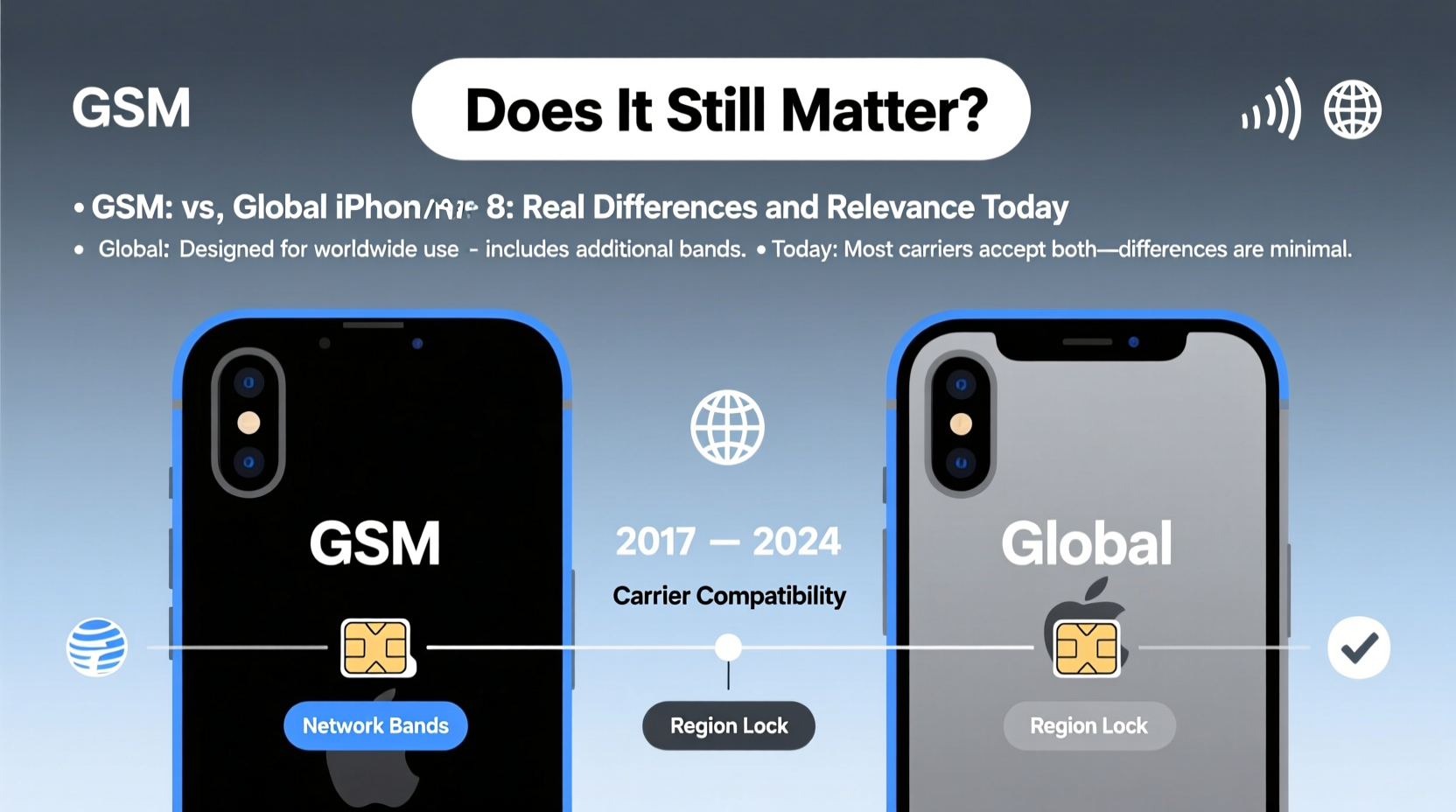
Apple has historically released multiple hardware variants of its iPhones to accommodate different regional network standards. The iPhone 8 was no exception. Two primary models were sold:
- iPhone 8 (Model A1863) – Marketed as the \"GSM\" version, primarily intended for carriers like AT&T and T-Mobile in the United States.
- iPhone 8 (Model A1905) – Known as the \"Global\" version, compatible with both GSM and CDMA networks, including Verizon and Sprint.
The key distinction lies in cellular radio support. While both phones use GSM technology for 2G/3G, the Global model includes additional CDMA radios and broader LTE band coverage, making it more versatile across North American carriers and certain international networks.
“Carrier-specific hardware decisions from 2017 still echo in today’s used smartphone market—especially when cross-carrier compatibility matters.” — Lena Torres, Senior Mobile Analyst at TechSignal Insights
Hardware Differences: What’s Inside Each Model?
Beyond the model numbers, the internal differences are subtle but impactful. Here's a breakdown of the core disparities:
| Feature | GSM (A1863) | Global (A1905) |
|---|---|---|
| CDMA Support | No | Yes (Band Class 0, 1, 3, 10) |
| LTE Bands | Bands 2, 4, 5, 7, 12, 13, 17, 25, 26, 29, 30, 66 | Bands 2, 3, 4, 5, 7, 8, 12, 13, 17, 18, 19, 20, 25, 26, 28, 29, 30, 66 |
| Primary Markets | AT&T, T-Mobile (USA), Canada, Latin America | Verizon, Sprint, USA Unlocked, International |
| Wi-Fi Calling | Supported (carrier-dependent) | Supported (broader carrier rollout) |
| Firmware Updates | Same iOS versions, but carrier profiles may vary | Slightly wider carrier configuration support |
The Global model supports more LTE bands, particularly Band 28 (700 MHz APT), which is used by some rural carriers and international providers. It also includes Band 20 (800 MHz), common in Europe. This gives the A1905 better roaming flexibility outside the U.S.
Does the Difference Still Matter in 2024?
In short: It depends on where you live and which carrier you use.
With the sunsetting of 3G networks across major U.S. carriers—AT&T shut down its 3G network in February 2022, and Verizon followed in December 2022—the importance of CDMA and legacy network support has diminished. Today, all major carriers rely on LTE and 5G for voice and data, using VoLTE (Voice over LTE) as the standard.
However, here’s where the distinction lingers:
- VoLTE Activation: Some carriers require specific firmware or hardware signatures to enable VoLTE on older devices. The GSM model may face activation hurdles on Verizon, even when unlocked.
- Network Optimization: The Global model often receives more comprehensive carrier bundles during iOS updates, leading to better signal handoff and battery efficiency on mixed networks.
- International Use: Travelers benefit from the Global model’s support for Band 20 and Band 28, improving compatibility in Europe, Australia, and parts of Asia.
If you’re using the iPhone 8 on AT&T or T-Mobile in the U.S., the GSM version works perfectly well. But if you’re switching carriers frequently, using MVNOs (like Mint Mobile or Visible), or traveling abroad, the Global model offers greater peace of mind.
Mini Case Study: Sarah’s Cross-Carrier Switch
Sarah bought a used iPhone 8 (A1863, GSM) from a friend who used AT&T. When she switched to Verizon months later, the phone activated for data but couldn’t make calls. After hours on hold with customer support, she learned that her model lacks CDMA and sufficient LTE band support for full VoLTE functionality on Verizon—even though the device is technically “unlocked.”
She eventually had to swap phones. A Global model (A1905) would have avoided the issue entirely, as it was certified for Verizon’s network from day one.
How to Identify Your iPhone 8 Model
If you already own an iPhone 8 or are considering a purchase, identifying the model is simple:
- Open Settings → General → About.
- Tap on Model Number. It will display a letter code (e.g., MQU72LL/A).
- Tap again to reveal the Part Number (e.g., A1863 or A1905).
You can cross-reference this number:
- A1863 = GSM model
- A1905 = Global model
Alternatively, check the small print on the back of the device. The model number is etched below the regulatory text.
Checklist: Buying a Used iPhone 8 in 2024
Before finalizing your purchase, verify the following:
- ✅ Confirm the model number (A1863 vs. A1905)
- ✅ Ensure the device is unlocked (ask for proof of unlock status)
- ✅ Test VoLTE and Wi-Fi calling with your carrier
- ✅ Check for active iCloud lock (sign out of Find My iPhone)
- ✅ Verify iOS update eligibility (iPhone 8 supports up to iOS 17)
- ✅ Inspect battery health (below 80% may require replacement)
FAQ: Common Questions About GSM vs Global iPhone 8
Can the GSM iPhone 8 work on Verizon?
Possibly, but not reliably. While it may activate for data, voice calling via VoLTE is inconsistent due to missing CDMA fallback and limited LTE band support. The Global model is strongly recommended for Verizon use.
Is there a performance difference between the models?
No. Both models use the same A11 Bionic chip, 2GB RAM, and camera hardware. The only differences are in cellular radios and supported frequency bands.
Will either model receive future iOS updates?
As of 2024, the iPhone 8 still receives iOS updates (latest is iOS 17). Apple typically supports devices for 5–6 years post-release, so updates may continue into 2025. Both models receive the same OS versions, though carrier-specific features may vary.
Final Verdict: Does the GSM vs Global Debate Still Matter?
The gap between GSM and Global iPhone 8 models has narrowed—but not disappeared. For most users on AT&T or T-Mobile, the GSM version performs flawlessly. However, the Global model remains the safer choice for flexibility, especially if you value carrier freedom, international travel, or long-term usability.
Given that prices for used iPhone 8 units are nearly identical regardless of model, opting for the Global variant (A1905) is a low-cost insurance policy against compatibility headaches. In a world where network technologies evolve rapidly, choosing the more adaptable device isn’t just smart—it’s essential.




 浙公网安备
33010002000092号
浙公网安备
33010002000092号 浙B2-20120091-4
Comments
No comments yet. Why don't you start the discussion?