
Changing habits is rarely about willpower. It’s about design. Most people fail to sustain new behaviors not because they lack motivation, but because they rely on inspiration instead of integration. The key to lasting change lies in making new habits so easy and logical that they feel like natural extensions of your day. One of the most effective methods for achieving this is habit stacking—a behavioral design strategy that links new actions to existing routines.
Invented by productivity expert S.J. Scott and popularized by James Clear in *Atomic Habits*, habit stacking leverages the brain’s preference for patterns. By anchoring a desired behavior to an already-automatic routine, you reduce friction, eliminate decision fatigue, and create a seamless path to consistency. This isn’t about drastic overhauls; it’s about intelligent layering—small changes that compound into transformative results.
The Science Behind Habit Stacking
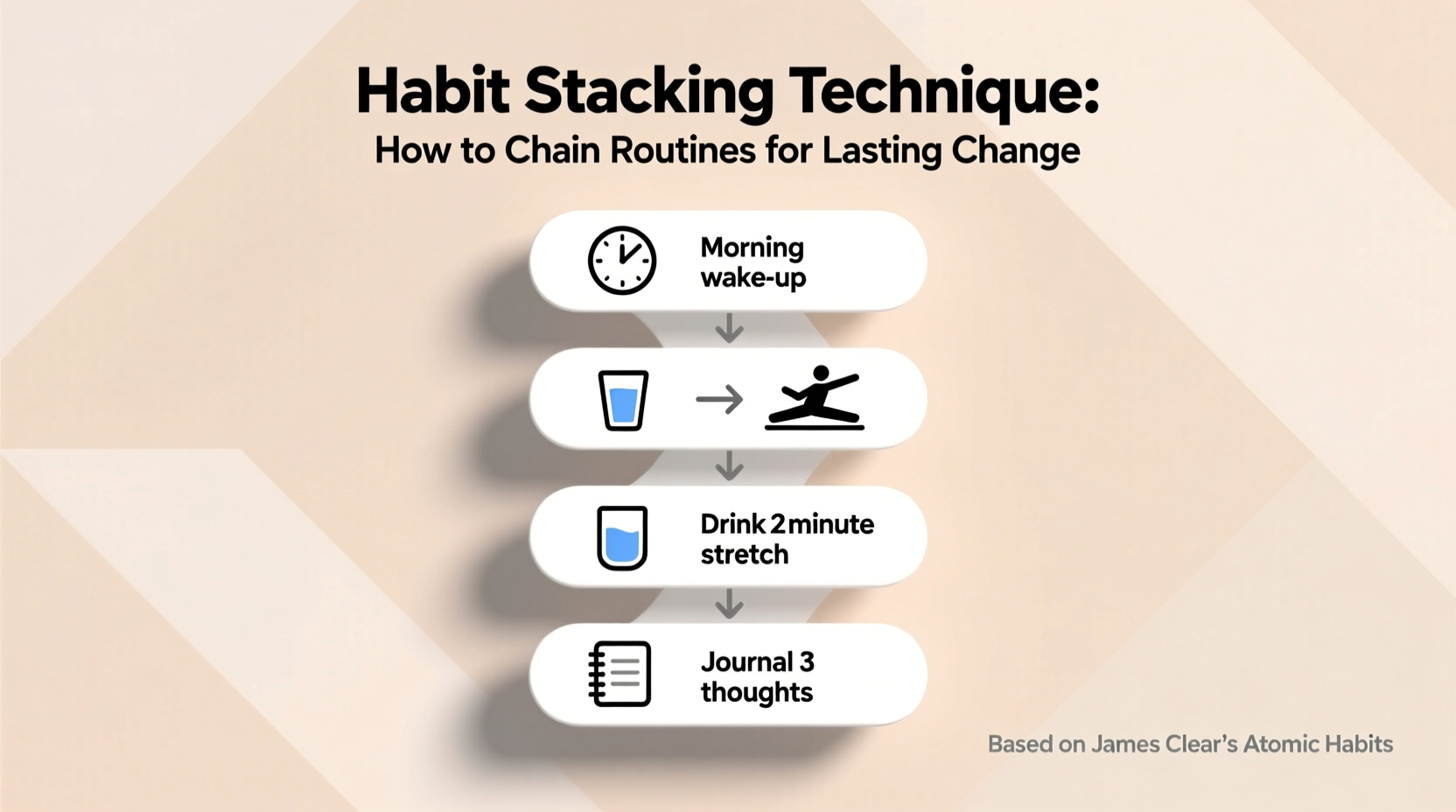
Habits are mental shortcuts. Every time you repeat a behavior in a consistent context, your brain encodes it as a cue-routine-reward loop. Over time, the cue triggers the routine automatically, bypassing conscious thought. This process, known as procedural memory, is why you can brush your teeth without thinking or drive a familiar route while lost in conversation.
Habit stacking works because it piggybacks on these automatic sequences. Instead of trying to insert a new habit into a vacuum—where it competes with distractions and requires effort—you attach it to an established trigger. The existing habit becomes the “cue” for the new one, creating a domino effect of behavior.
“We don’t rise to the level of our goals. We fall to the level of our systems.” — James Clear, author of *Atomic Habits*
When you stack habits, you’re not relying on motivation. You’re building a system where success is baked into your daily rhythm. Neurologically, this strengthens synaptic pathways associated with the new behavior, increasing the likelihood it will stick.
How to Build Effective Habit Stacks: A Step-by-Step Guide
Creating powerful habit stacks follows a simple but precise formula. Done correctly, this method turns intention into instinct. Follow these six steps to engineer routines that endure.
- Identify Keystone Habits
Start by listing your existing daily routines—especially those that happen at the same time and place every day. These include waking up, brushing your teeth, brewing coffee, sitting down for lunch, or locking the front door at night. These are your anchors. - Define Your Target Behavior
Choose one small, specific action you want to adopt. Avoid vague goals like “be healthier” or “read more.” Instead, define micro-behaviors such as “drink a glass of water” or “read one page of a book.” Precision increases adherence. - Use the Formula: “After [CURRENT HABIT], I will [NEW HABIT]”
This structure embeds timing and context. For example: “After I pour my morning coffee, I will meditate for one minute.” The first habit cues the second. - Keep It Tiny
Begin with a version of the new habit so easy it feels effortless. Want to journal? Start with writing one sentence. Want to exercise? Begin with two push-ups. Small wins build confidence and momentum. - Test and Refine
Try the stack for three days. If you forget or resist, adjust either the timing or the size of the new habit. Maybe the trigger isn’t strong enough, or the action is still too demanding. - Chain Gradually
Once the first stack feels automatic (usually 5–7 days), add another layer. But never add complexity until the current sequence runs smoothly.
Real-Life Example: Building a Morning Mindfulness Routine
Sarah, a 34-year-old project manager, wanted to reduce anxiety and improve focus. She had tried meditation apps and scheduled morning sessions, but consistency eluded her. After learning about habit stacking, she redesigned her approach.
She started by identifying her strongest morning anchor: brushing her teeth. That habit was non-negotiable and occurred at the same time every day. Her target behavior was mindfulness—but instead of committing to 10 minutes of meditation, she began with just one deep breath.
Her first stack: “After I finish brushing my teeth, I will take one slow, deep breath.”
It felt almost silly, but within two days, it became automatic. She then expanded: “After I take one deep breath, I will say one thing I’m grateful for.” A week later, she added a 60-second meditation using a voice memo app.
Within a month, Sarah had built a 5-minute mindfulness ritual that started without fail each morning. Because each step was anchored to the previous one, she no longer needed reminders or willpower. The routine unfolded naturally.
This case illustrates a core principle: sustainability comes from simplicity. Sarah didn’t start with grand intentions. She started with a breath—and let the stack grow organically.
Common Pitfalls and How to Avoid Them
Habit stacking sounds simple, but subtle mistakes can derail progress. Here are frequent errors and how to correct them.
| Pitfall | Why It Fails | Solution |
|---|---|---|
| Stacking too many habits at once | Overwhelms working memory and increases dropout risk | Limit to 1–2 new behaviors per stack initially |
| Choosing weak or inconsistent triggers | If the anchor habit varies in time or location, the cue fails | Pick high-consistency anchors (e.g., morning coffee, bedtime) |
| Making the new habit too difficult | Triggers resistance and decision fatigue | Scale down until it feels effortless |
| Ignoring environment design | Friction in the physical space breaks the chain | Prepare tools in advance (e.g., journal on pillow, water bottle on counter) |
| Skipping reflection and tracking | No feedback loop means blind spots persist | Review weekly: What worked? What needs adjustment? |
Advanced Habit Stacking: Creating Behavioral Chains
Once you’ve mastered single stacks, you can build full chains—sequences of linked behaviors that transform entire parts of your day. These are especially useful for complex goals like fitness, learning, or digital detox.
Consider a professional who wants to read more but struggles to find time. Instead of blocking out an hour before bed (which often gets cut by fatigue), they could create a chain like this:
- After I plug in my phone to charge, I will open my e-reader app.
- After I open the app, I will read one page.
- After reading one page, I will highlight one sentence that stood out.
Each step reinforces the next. The act of charging the phone becomes a powerful cue. Opening the app takes less than five seconds. Reading one page is nearly impossible to refuse. And highlighting creates a sense of completion and engagement.
Over time, this mini-chain can expand naturally. The reader might stay for ten pages instead of one—not because they forced themselves, but because the entry barrier was so low.
Another example: someone aiming to improve posture at work.
- After I sit down at my desk, I will adjust my chair height.
- After adjusting my chair, I will roll my shoulders back twice.
- After rolling my shoulders, I will set a timer for 25 minutes of focused work.
These aren’t isolated actions—they’re a designed ecosystem of behavior. The result? Better ergonomics, fewer slouching episodes, and improved concentration—all triggered by a single, mundane event: sitting down.
Checklist: Building Your First Habit Stack
Use this checklist to create a personalized habit stack today:
- ☐ Identify a high-consistency daily habit (e.g., washing face, drinking morning tea)
- ☐ Choose a tiny, specific new behavior you’d like to adopt
- ☐ Write the stack using the formula: “After [current habit], I will [new habit]”
- ☐ Make the new habit so small it feels unavoidable
- ☐ Perform the stack for three consecutive days without fail
- ☐ Reflect: Did it feel natural? If not, adjust the trigger or behavior size
- ☐ Add a second layer only after the first stack feels automatic
Frequently Asked Questions
Can habit stacking work for breaking bad habits?
Yes, but indirectly. Habit stacking is best for adding positive behaviors. To replace a negative habit, use stacking to insert a competing routine. For example: “After I feel the urge to check social media, I will write one sentence in my journal.” Over time, the new behavior crowds out the old one by offering a better response to the same trigger.
How long does it take for a habit stack to become automatic?
Research suggests it takes anywhere from 18 to 254 days for a behavior to become automatic, depending on complexity and individual differences. However, habit stacks typically integrate faster—often within 2 to 3 weeks—because they rely on existing neural pathways. Consistency matters more than duration.
What if my schedule changes frequently? Can I still use habit stacking?
Absolutely. In fact, flexible schedules require even stronger anchoring. Focus on portable triggers—like “after I eat a meal” or “after I finish a work task”—rather than time-based ones. The key is consistency of context, not clock time.
Conclusion: Start Small, Chain Smart, Change Lastingly
Lasting change doesn’t come from dramatic resolutions. It comes from intelligent design—structuring your environment and routines so that good choices happen by default. The habit stacking technique transforms abstract goals into concrete, executable sequences embedded in your daily life.
You don’t need more motivation. You need better triggers. By linking new behaviors to what you already do without thinking, you bypass resistance and build momentum through compounding actions. Whether you're aiming to improve your health, boost productivity, or deepen relationships, habit stacking provides a practical, science-backed framework for success.




 浙公网安备
33010002000092号
浙公网安备
33010002000092号 浙B2-20120091-4
Comments
No comments yet. Why don't you start the discussion?