
When boarding a flight, one of the most pressing concerns for travelers isn’t just what to pack—but whether their carry-on will actually fit in the overhead bin. With airlines enforcing strict size limits and gate agents quick to tag oversized bags, choosing the right type of luggage can make the difference between a smooth boarding experience and an unexpected checked bag fee. At the heart of this decision lies a key question: does hard shell or soft shell luggage fit better in the overhead bin?
The answer isn’t as straightforward as it seems. While both types have strengths and trade-offs, the real-world performance depends on design, material flexibility, packing habits, and even airline-specific storage dimensions. This guide dives deep into how each type performs under actual travel conditions, backed by expert insight, traveler experiences, and practical comparisons.
Understanding Overhead Bin Dimensions
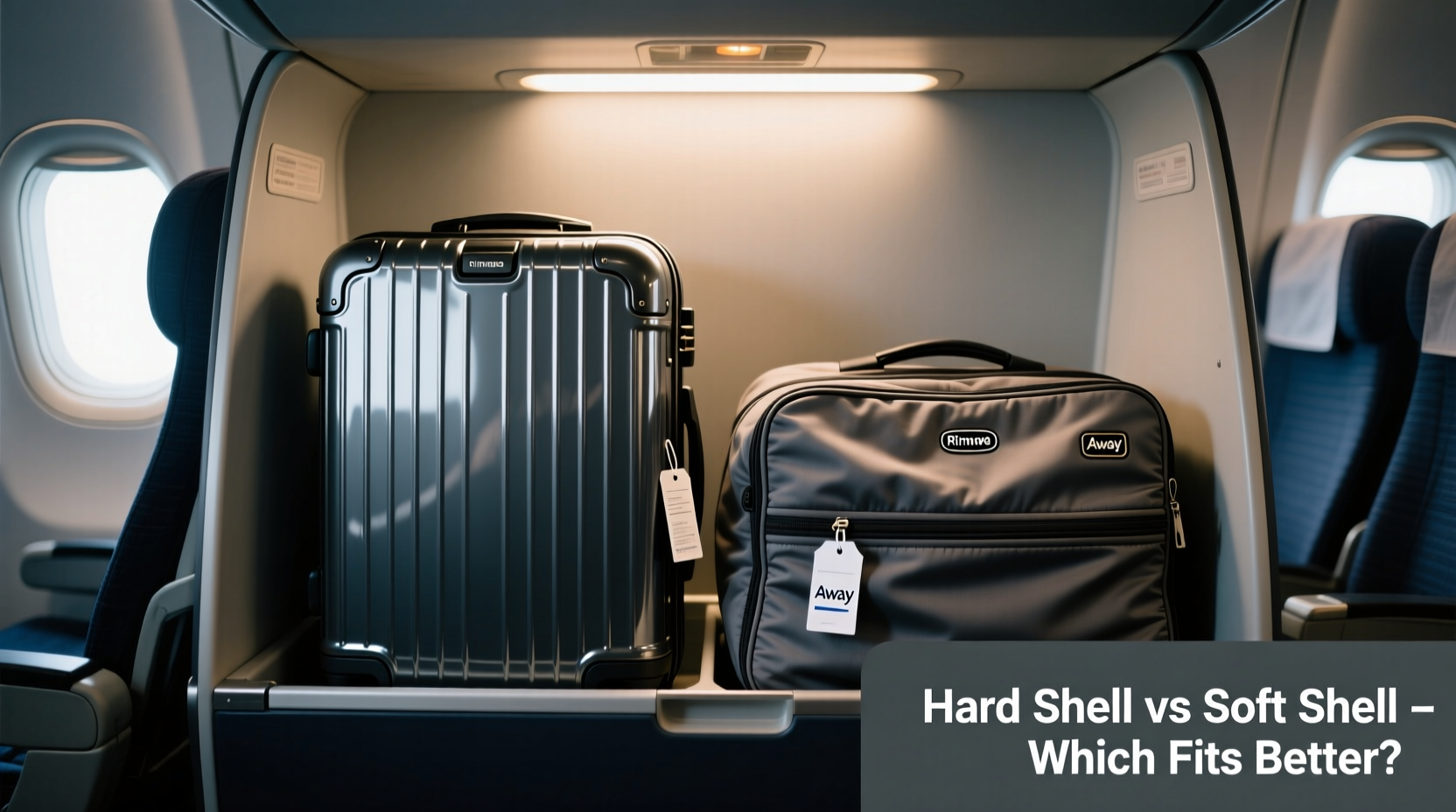
Before comparing luggage types, it’s essential to understand what you’re working with. Overhead bins vary significantly across aircraft models. A regional jet like the Embraer E175 has notably smaller bins than a Boeing 737 or Airbus A320. Even within the same airline, fleet differences mean bin space is never guaranteed.
Most major U.S. carriers list the maximum carry-on dimensions as 22 x 14 x 9 inches (56 x 36 x 23 cm), including handles and wheels. However, that number doesn’t tell the full story. The shape and curvature of bins often allow slightly taller or wider bags if they’re flexible or tapered. Rigid cases, no matter how precisely sized, can fail to fit if they don’t align with the bin’s internal contours.
“Many passengers assume compliance with airline dimensions guarantees bin fit—but geometry matters more than measurements alone.” — David Lin, Airline Operations Consultant
Because of this, the structural flexibility of your luggage becomes a decisive factor during boarding, especially on full flights where every inch counts.
Hard Shell Luggage: Rigidity vs Real-World Fit
Hard shell suitcases, typically made from polycarbonate, ABS plastic, or composite materials, are prized for durability, water resistance, and sleek appearance. Their rigid structure protects contents from crushing and offers excellent impact resistance. But when it comes to fitting into overhead bins, that rigidity can become a liability.
A hard shell case maintains its exact dimensions at all times. If it measures 22 inches tall, it cannot compress—even slightly—to squeeze into a tight space. On narrow-body aircraft with curved or shallow bins, this lack of give often means the bag must be placed vertically or risks protruding, prompting gate agents to require checking.
Additionally, many hard shell designs feature squared-off corners and fixed frames, which reduce their ability to conform to bin shapes. Some high-end models now incorporate slight tapering or rounded edges to improve compatibility, but these are exceptions rather than the norm.
Soft Shell Luggage: Flexibility as a Strategic Advantage
Soft shell luggage, usually constructed from nylon, polyester, or ballistic fabrics, excels where hard cases struggle: adaptability. The fabric exterior and collapsible frame allow the bag to compress, bulge, or shift shape slightly when pressed against bin walls or other luggage.
This flexibility is particularly valuable during peak travel times. When bins are nearly full, a soft-sided bag can often “nest” into gaps left by rigid cases. It may bulge slightly at the sides or top, yet still remain within acceptable limits because fabric yields instead of resisting.
Moreover, many soft shell designs include expansion zippers that can be left partially unzipped to reduce height or width when needed—a trick some frequent flyers use discreetly before stepping onto the plane. While expanded mode exceeds airline limits, returning to standard size is quick and seamless.
Another advantage: soft shell bags often have external pockets that can be flattened or folded inward. A water bottle or duty-free bag tucked into an outside compartment on the way to the gate can be moved inside mid-flight, instantly reducing the bag’s footprint.
Comparative Analysis: Key Differences at a Glance
| Feature | Hard Shell | Soft Shell |
|---|---|---|
| Bin Fit Flexibility | Low – maintains fixed shape | High – compresses and conforms |
| Durability Against Impact | Excellent – resists dents and cracks | Moderate – fabric can tear or scuff |
| Water Resistance | High – sealed construction | Variable – depends on coating and seams |
| Weight | Heavier – due to rigid materials | Lighter – especially in nylon variants |
| Packing Efficiency | Rigid compartments limit stuffing | Flexible interior allows overstuffing |
| Security & Locks | Often TSA-approved integrated locks | External zipper locks; easier to tamper |
The table highlights a central trade-off: protection versus adaptability. For travelers prioritizing item safety and aesthetics, hard shell wins. For those focused on hassle-free boarding and bin compatibility, soft shell holds a clear edge.
Real-World Scenario: Boarding a Full Regional Flight
Consider Sarah, a business traveler flying from Denver to Boise on a Friday afternoon. She boards last due to a delayed connection. The overhead bins on the CRJ-700 aircraft are already 80% full. Her carry-on is a premium polycarbonate hard shell case, exactly 22 inches tall.
At the front of the cabin, she finds only one bin with space. She lifts her bag—only for the flight attendant to stop her. “Ma’am, that won’t close. We’ll need to check it.” Despite being within airline size limits, the rigid case extends too far into the bin’s curved ceiling, preventing the door from latching.
In contrast, the passenger behind her places a slightly bulging soft shell roller in the same bin. Though similar in volume, the fabric case compresses naturally as the bin door closes. It stays onboard.
This scenario plays out daily across regional routes. Airlines increasingly rely on smaller jets where bin capacity is limited. In such environments, structural flexibility becomes a functional necessity—not just a convenience.
Expert Packing Strategies for Maximizing Bin Fit
No matter which luggage type you choose, smart packing techniques can improve your chances of securing overhead space. Here are proven methods used by seasoned travelers:
- Keep height below 21 inches – Even if your bag is labeled “carry-on,” measure it with wheels and handle extended. Aim for at least 1 inch under the limit.
- Use compression cubes – These help maintain a rectangular profile, reducing awkward bulges that prevent clean stacking.
- Avoid top-heavy loads – Weight concentrated at the top increases instability and makes bags harder to stow.
- Remove external items pre-boarding – Take out umbrellas, laptop sleeves, or shopping bags before reaching the jet bridge.
- Board early or request pre-boarding – Priority access ensures bin availability regardless of luggage type.
When Hard Shell Still Makes Sense
Despite its disadvantages in bin fit, hard shell luggage remains the preferred choice in specific situations:
- Traveling with fragile items – Cameras, lenses, or delicate souvenirs benefit from crush-proof enclosures.
- Long layovers or multi-leg journeys – Hard cases often endure rougher handling when briefly checked at the gate.
- Hot or humid climates – Sealed shells provide better moisture and dust protection than fabric.
- Personal preference for organization – Built-in dividers and clamshell openings make packing visible and structured.
For international travelers on wide-body aircraft (like the A330 or 777), where overhead bins are larger and more consistently available, the bin-fit disadvantage of hard shell cases diminishes significantly.
Frequently Asked Questions
Can I bring a hard shell suitcase as carry-on?
Yes, provided it meets the airline’s size requirements. Most standard carry-on hard shells (22” x 14” x 9”) are allowed. However, final acceptance depends on gate agent discretion and available bin space.
Do soft shell bags get damaged more easily?
They are more prone to surface scratches and punctures, but high-denier fabrics like 1680D ballistic nylon offer impressive resilience. Regular cleaning and storing in a protective cover can extend lifespan.
Is there a hybrid option that combines both benefits?
Yes—some brands offer “hybrid” luggage with rigid side panels and flexible front/back faces. These aim to balance structure with mild compression ability. Examples include the Away Hybrid and Samsonite Winfield 3 Hybrid. They perform better in bins than full hard shells while offering more protection than traditional soft cases.
Actionable Checklist Before Your Next Flight
- ✅ Measure your luggage—including wheels and handles—against airline specs
- ✅ Test bin fit using a doorway or cabinet at home
- ✅ Pack heavier items at the bottom for stability
- ✅ Remove all external accessories before boarding
- ✅ Consider soft shell if flying regional jets frequently
- ✅ Use compression packing to minimize volume
- ✅ Arrive early or opt for priority boarding when possible
Final Verdict: Which Fits Better?
When evaluated strictly on overhead bin compatibility, soft shell luggage outperforms hard shell in most real-world scenarios. Its ability to compress, conform, and adapt to irregular spaces gives it a tangible advantage—especially on smaller aircraft and crowded flights. While hard shell cases offer superior protection and aesthetic appeal, they do so at the cost of spatial flexibility.
For the average traveler focused on minimizing hassle and avoiding last-minute checking fees, soft shell is the more practical choice. However, if you regularly transport sensitive equipment or prioritize long-term durability over bin fit, a hard shell model—particularly one with a tapered design—can still serve you well, especially on larger planes.
The smartest approach? Match your luggage type to your typical route. Frequent flyer on narrow-body regional jets? Lean toward soft shell. Mostly international or cross-country on mainline carriers? A hard shell may be worth the slight bin risk.




 浙公网安备
33010002000092号
浙公网安备
33010002000092号 浙B2-20120091-4
Comments
No comments yet. Why don't you start the discussion?