
Waking up to bouncy, voluminous curls that look like they were styled by a professional is a dream many chase. The beauty industry has responded with two dominant paths: the traditional curling iron and the increasingly popular heatless curl methods. But can you truly achieve salon-worthy volume without ever turning on a hot tool—and more importantly, should you? This in-depth comparison breaks down both approaches, examining effectiveness, hair health, convenience, and real-world outcomes.
The Curling Iron: Speed, Precision, and Heat Damage Risk
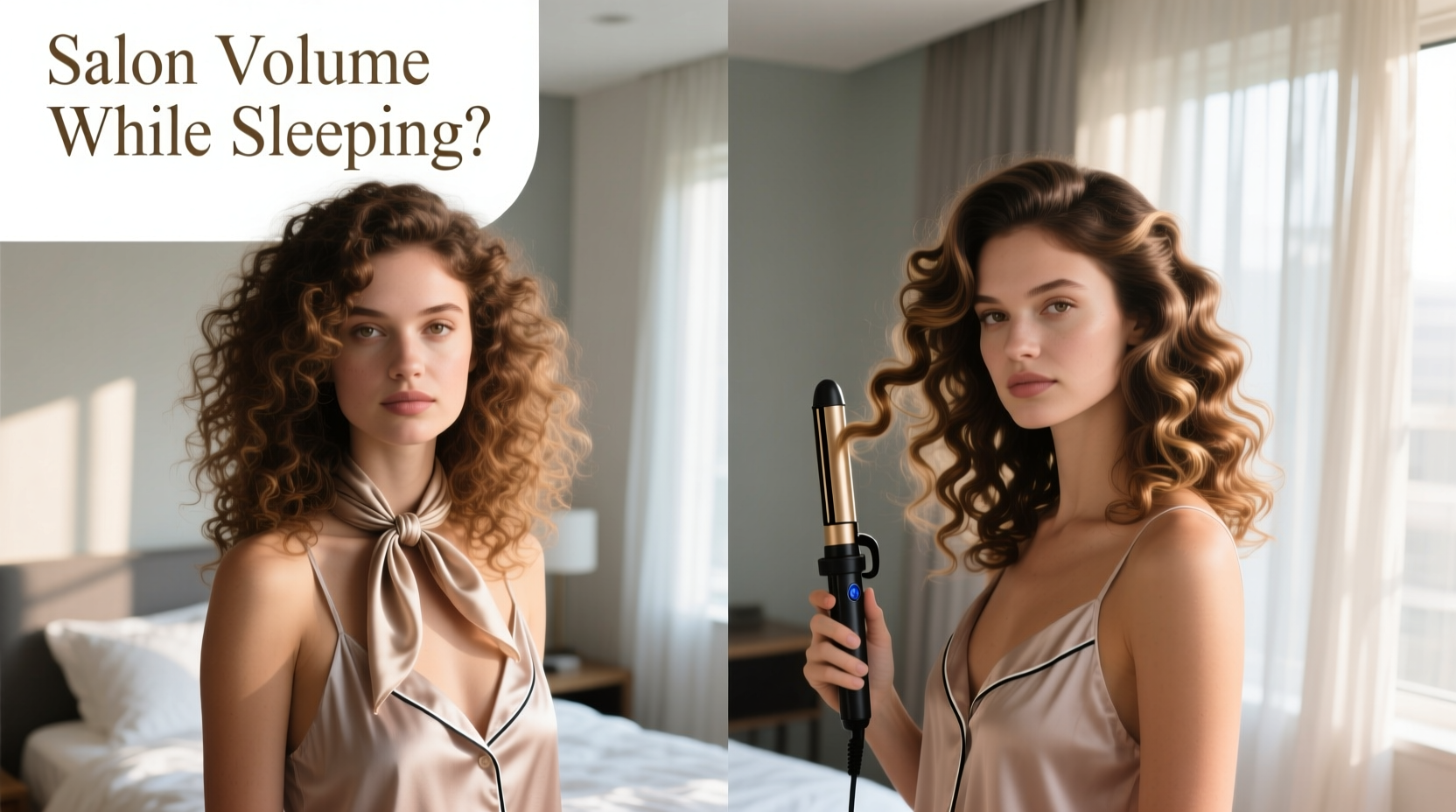
Curling irons have long been the go-to for instant, defined waves. With adjustable temperature settings, barrel sizes, and directional control, they offer unmatched precision. A 1-inch barrel creates tight ringlets; a 1.5-inch gives loose beachy waves. When used correctly—with proper heat protectant and technique—they produce polished, camera-ready styles in under 20 minutes.
But this speed comes at a cost. High heat (often between 300°F and 400°F) disrupts the hair’s keratin structure, leading to moisture loss, cuticle damage, and increased brittleness over time. Frequent use without protection can result in split ends, frizz, and reduced elasticity—especially in fine, color-treated, or already-damaged hair.
“While curling irons deliver immediate results, daily heat exposure accelerates aging of the hair fiber. Think of it like sun damage—it accumulates silently until the damage becomes visible.” — Dr. Lena Reyes, Trichologist & Hair Research Scientist
Heatless Curls: The Overnight Revolution
Heatless curling methods rely on tension and time rather than temperature. Techniques include braiding, twisting, flexi rods, sock curls, and silk scrunchies—all designed to be worn overnight. These methods reshape the hair shaft through mechanical manipulation, allowing natural humidity and body heat to set the form as you sleep.
Because no external heat is applied, these techniques are inherently gentler. There’s no risk of thermal shock or dehydration. Instead of weakening the hair, consistent heatless styling can actually support healthier growth patterns by reducing breakage at the midshaft and ends.
The trade-off is time. While a curling iron takes minutes, heatless curls require planning—often several hours or an entire night. However, for those who value long-term hair integrity and convenience, the investment pays off. Many users report enhanced volume, improved texture definition, and even reduced frizz after switching full-time.
How Heatless Curls Create Volume While You Sleep
The secret behind “salon volume” from heatless methods lies in root lift and structural memory. When hair is wrapped or twisted from the roots upward—especially when pinned close to the scalp—it creates natural elevation. Silk pillowcases or bonnets reduce friction, preventing flattening during sleep. Upon release in the morning, the hair retains shape with softness and bounce, mimicking the volume achieved by backcombing or volumizing sprays with a fraction of the effort.
Unlike heat-styled hair, which often collapses by midday due to weight and gravity, heatless curls tend to loosen gradually into romantic waves—maintaining fullness at the crown longer.
Comparative Analysis: Heatless Curls vs Curling Iron
| Factor | Heatless Curls | Curling Iron |
|---|---|---|
| Time Required | 6–8 hours (overnight) | 10–30 minutes |
| Hair Health Impact | Low (no heat stress) | High (thermal damage with frequent use) |
| Volume Longevity | Moderate to high (gradual loosening) | High initially, drops sharply after 4–6 hours |
| Style Control | Moderate (depends on technique) | High (adjustable barrel size, direction, hold) |
| Learning Curve | Moderate (trial and error needed) | Low to moderate (with practice) |
| Cost Over Time | Low (one-time tools like rods, scrunchies) | High (tool replacement, heat protectants, repair treatments) |
| Suitability for Fine Hair | Excellent (gentle, adds body) | Poor (prone to damage and limpness) |
Step-by-Step: Achieving Salon Volume with Heatless Curls Overnight
Getting professional-level volume from heatless methods requires technique, not magic. Follow this proven routine:
- Prep Clean, Damp Hair: Wash and condition your hair. Towel-dry until it’s about 70% dry—too wet and it won’t hold; too dry and it won’t set.
- Apply Setting Product: Use a lightweight mousse or curl-enhancing cream. Focus on mid-lengths to ends, but avoid heavy buildup at the roots, which can weigh hair down.
- Section and Twist: Divide hair into 4–6 sections. For volume, begin twisting or braiding from the root, pulling each section slightly away from the scalp as you go. This creates lift.
- Secure Gently: Use soft spiral rods, foam rollers, or silk scrunchies. Avoid tight elastics that cause creasing or tension breakage.
- Sleep Smart: Wear a satin bonnet or sleep on a silk pillowcase to minimize friction and preserve curl pattern.
- Release and Refresh: In the morning, carefully undo the twists. Do not brush. Instead, flip head over and gently shake out curls. Use fingers or a wide-tooth comb to separate. Finish with a light-hold hairspray or texturizing spray.
Real Example: From Daily Heat to Overnight Volume
Maya, a 28-year-old marketing executive, used a curling iron every weekday for five years. Her hair, once thick and shiny, became thin at the crown and prone to snapping. After a trichologist diagnosed heat-induced miniaturization, she switched to heatless curls using flexi rods twice a week and braids on weekends.
Within three months, her hair felt stronger. By month six, she noticed new baby hairs along her hairline and increased fullness at the roots. “I was skeptical at first,” she says, “but now I get compliments on my ‘voluminous waves’ all the time. And I’m saving at least 15 minutes each morning.”
Her routine: wash on Sundays and Wednesdays, apply mousse, braid damp hair into eight sections, and sleep on silk. By morning, she has soft, bouncy waves that last all day with minimal touch-ups.
When the Curling Iron Still Wins
Despite the benefits of heatless styling, there are scenarios where a curling iron remains the superior choice:
- Events with tight timelines: If you need perfect curls in under 15 minutes, heat is unavoidable.
- Humid climates: Heat-set curls often hold better in high humidity because the cuticle is temporarily sealed.
- Fine, straight hair: Some hair types lack enough texture to hold a heatless curl overnight unless product-heavy, which can lead to residue buildup.
- Special occasions: For weddings or photoshoots, the precision of a curling iron allows for uniform, repeatable patterns that heatless methods may struggle to match.
The key is moderation. Even if you use a curling iron occasionally, pairing it with deep conditioning and avoiding daily heat can preserve hair health.
Checklist: Optimizing Your Curling Routine (Heatless or Heated)
- ✅ Assess your hair type and porosity before choosing a method
- ✅ Use a heat protectant if using hot tools—even once a week
- ✅ Invest in silk or satin pillowcases and bonnets
- ✅ Deep condition weekly to maintain moisture balance
- ✅ Limit heat styling to 1–2 times per week maximum
- ✅ Choose non-damaging setting products (alcohol-free, sulfate-free)
- ✅ Detangle with a wide-tooth comb before styling
- ✅ Sleep with hair loosely secured to prevent tangles
Frequently Asked Questions
Can heatless curls work on short hair?
Absolutely. Short hair can be curled using small flexi rods, perm rods, or pin curls. The key is sectioning finely and ensuring the hair is evenly damp before setting. Many short-haired individuals find heatless methods easier to manage than curling irons, which can be awkward on shorter lengths.
Why do my heatless curls fall flat by noon?
This usually stems from insufficient setting time, lack of product, or high-porosity hair that doesn’t retain shape. Try using a stronger-hold mousse, wrapping hair tighter at the roots, or diffusing briefly after removal to reactivate the product. Also, avoid touching your hair throughout the day—oils from hands can deflate volume.
Is it safe to leave braids in for more than one night?
Generally, no. Leaving braids or wraps in for over 8–10 hours increases the risk of tension on the scalp and potential breakage, especially if done regularly. Overnight is ideal. If you’re traveling or want extended wear, opt for ultra-loose twists and avoid pulling at the roots.
Conclusion: Can You Really Get Salon Volume While Sleeping?
You absolutely can—but with nuance. Heatless curls won’t replicate the exact sharp definition of a 1-inch curling iron, nor will they work instantly. What they offer instead is sustainable, healthy volume built over time. With the right technique, quality products, and consistency, many people achieve not just salon-like volume, but better-than-salon hair health.
The modern standard of beauty is shifting—from perfection on day one to longevity and vitality over time. Heatless curls align perfectly with this evolution. They reward patience, promote self-care, and eliminate the hidden costs of daily heat styling: damaged hair, expensive repairs, and lost confidence.




 浙公网安备
33010002000092号
浙公网安备
33010002000092号 浙B2-20120091-4
Comments
No comments yet. Why don't you start the discussion?