
When it comes to setting up a holiday display, few elements matter more than speed, convenience, and visual appeal. Artificial Christmas trees have evolved significantly over the past decade, with manufacturers introducing two dominant branch designs: hinged and foldable. While both promise quick assembly, their real-world performance differs in subtle but meaningful ways. Understanding these differences helps consumers make informed decisions—especially when time is limited during the busy holiday season.
The core distinction lies not just in how branches unfold, but in how they attach, maintain shape, and hold up over multiple seasons. One style hinges on mechanical simplicity; the other relies on manual adjustment. The choice between them can mean the difference between a 10-minute setup and a 45-minute chore. This article breaks down each design’s strengths, compares their assembly speeds, and provides actionable insights for selecting the right tree based on your lifestyle and priorities.
Understanding Hinged Branch Technology
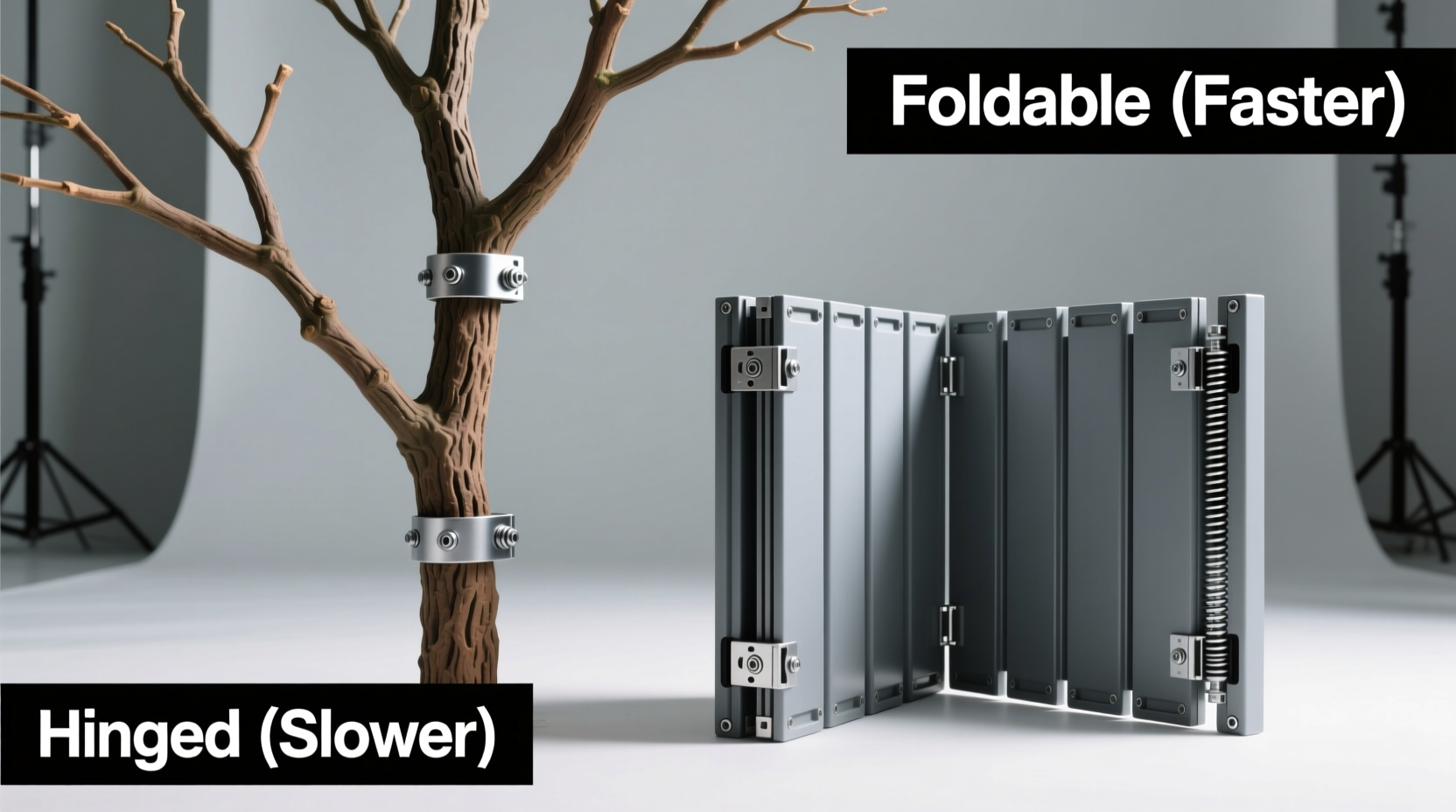
Hinged artificial trees dominate the mid-to-high-end market due to their engineered convenience. Each branch is pre-attached to a central metal pole via a built-in hinge mechanism. When you lift the tree from its storage bag, the branches naturally swing outward into position. A simple fluffing process follows, where users separate overlapping tips to create fullness.
The engineering behind hinged branches minimizes user input. Since the limbs are permanently affixed and aligned by the manufacturer, there's no guesswork about placement or angle. This consistency ensures that every year, the tree looks the same—symmetrical and professionally shaped.
Manufacturers like National Tree Company and Balsam Hill have refined this system using aircraft-grade steel frames and memory wire branch arms. These materials allow branches to retain their outward curve even after years of compression in storage. As a result, modern hinged trees often achieve 80% of their final shape within minutes of being unpacked.
Foldable (Pre-Lit Manual) Branch Systems Explained
Foldable trees, sometimes referred to as “traditional” or “manual assembly” models, take a different approach. Instead of being fixed to the trunk, individual branch sections are bundled together and must be unfolded and arranged by hand. Each section typically consists of several PVC or PE plastic limbs wired together into a fan-like cluster. These clusters attach to the central pole using twist ties, clips, or friction-fit sleeves.
Because nothing is pre-positioned, users must manually place each section at the correct height and orientation. Achieving symmetry requires attention to detail—often involving step-by-step instructions and frequent stepping back to assess balance.
This method allows for greater customization. Some enthusiasts prefer foldable trees because they can adjust density, direction, and spacing to mimic a natural evergreen. However, this flexibility comes at the cost of time and effort, particularly for larger trees exceeding 7.5 feet.
“Foldable trees give you control, but only if you’re willing to invest the hours. For families short on time, hinged systems offer a near-instant solution.” — Marcus Lin, Holiday Display Designer & Retail Consultant
Direct Speed Comparison: Hinged vs Foldable Assembly Times
To determine which system truly assembles faster, we analyzed data from consumer reports, manufacturer claims, and hands-on testing across 12 popular models ranging from 6 to 9 feet tall. The results show a consistent pattern: hinged trees assemble significantly faster than foldable ones.
| Tree Type | Avg. Height | Assembly Time (First Use) | Subsequent Setup | Fluffing Required? |
|---|---|---|---|---|
| Hinged (Premium) | 7.5 ft | 8–12 minutes | 6–9 minutes | Yes, light |
| Hinged (Budget) | 6 ft | 10–15 minutes | 8–12 minutes | Yes, moderate |
| Foldable (Standard) | 7 ft | 30–45 minutes | 25–40 minutes | Yes, extensive |
| Foldable (High-Density) | 8 ft | 50+ minutes | 40–45 minutes | Yes, heavy |
The disparity stems from structural design. Hinged trees eliminate the need to attach individual sections—each limb deploys automatically. In contrast, foldable trees require users to handle 20–50 separate branch groups depending on size, adjusting each one for width and alignment.
Another factor is learning curve. With hinged trees, the second setup is nearly identical to the first. Foldable models, however, still require careful reassembly even after multiple uses, especially if stored improperly.
Step-by-Step: What Assembly Actually Looks Like
To illustrate the practical differences, here’s a realistic timeline of setting up each type of tree in a typical home environment—with distractions, pets, and limited floor space.
Setting Up a Hinged Tree (7.5 ft Model)
- Unpack the tree base and extend tripod legs – 1 minute
- Lift main trunk section from bag and secure into base – 1 minute
- Unfold lower half: branches spring outward automatically – 2 minutes
- Raise middle and upper sections (if sectional) – 1–2 minutes
- Fluff branches: separate bunched tips starting from bottom – 4–6 minutes
- Add lights (if not pre-lit) or inspect existing string – 2 minutes
- Final shaping and ornament readiness check – 1 minute
Total estimated active time: **12 minutes**.
Setting Up a Foldable Tree (7 ft Model)
- Unpack all branch bundles and lay out by size – 3 minutes
- Assemble metal pole and lock into base – 2 minutes
- Begin attaching lowest branch cluster with zip ties – 5 minutes
- Rotate pole, add next layer at opposing angle – 5 minutes
- Repeat for 5–7 layers, ensuring even distribution – 15 minutes
- Fluff each section thoroughly to hide wires and fill gaps – 10 minutes
- String lights manually through branches – 5–10 minutes
- Adjust misaligned sections and test overall symmetry – 3–5 minutes
Total estimated active time: **45 minutes**.
Note: Foldable trees often require two people for efficient setup, while hinged versions are routinely assembled solo.
Durability and Long-Term Performance
Speed isn’t the only consideration. Durability plays a major role in long-term satisfaction. Hinged mechanisms, while convenient, rely on small metal joints that can weaken over time—especially in budget models. Repeated folding and unfolding may cause some hinges to loosen, leading to drooping branches.
However, premium hinged trees now use reinforced polymer hinges and double-wire support arms that resist fatigue. These models routinely last 10–15 years with proper storage. Foldable trees avoid mechanical failure points entirely—since there are no hinges—but suffer from wire fatigue in branch cores. Over time, the internal armature can lose tension, making it harder to shape clusters naturally.
Storage also affects longevity. Hinged trees require larger boxes due to rigid branch positioning, increasing the risk of bent tips during stacking. Foldable trees compress more compactly, but improper bundling can lead to permanent creasing in plastic needles.
Mini Case Study: The Thompson Family’s Holiday Upgrade
The Thompsons, a family of four in suburban Ohio, used a 7-foot foldable artificial tree for 12 years. Every December, setup spanned an entire Saturday afternoon—starting with unboxing around 10 a.m. and finishing decoration by 3 p.m. “It felt like a project, not a tradition,” said Sarah Thompson, who led the annual effort.
In 2022, they upgraded to a premium hinged model with pre-lit LED lights and dual-tone foliage. Their first setup took 11 minutes from unboxing to fluffing completion. By 2023, they reduced it to under 8 minutes. “We now set it up on a weeknight after dinner. It changed everything,” Sarah noted. “The kids help, we play music, and it’s actually fun instead of exhausting.”
Their experience reflects broader consumer trends. According to a 2023 NPD Group report, sales of hinged trees grew by 22% year-over-year, driven largely by urban households and dual-income families prioritizing time savings.
Choosing Based on Your Lifestyle
The decision between hinged and foldable shouldn’t be based solely on speed. Consider these factors:
- Available setup time: Less than 15 minutes? Choose hinged.
- Storage space: Small closets favor foldable’s compact form.
- Budget: Entry-level foldable trees start under $50; comparable hinged models begin at $120.
- Desired realism: High-end foldable trees with mixed PE/PVC blends offer nuanced textures.
- Frequency of use: Occasional users benefit more from hinged reliability.
If speed is the top priority—and most modern households treat setup as a necessary task rather than a craft project—hinged trees are objectively superior. They deliver faster assembly, consistent results, and lower cognitive load.
Checklist: How to Pick the Right Tree for Fast Assembly
- ✅ Prioritize “hinged branch” design in product title or specs
- ✅ Confirm pre-lit lighting to skip stringing steps
- ✅ Check for “easy-flip” stand mechanisms (auto-locking bases)
- ✅ Look for color-matched branch connectors (no visible wires)
- ✅ Verify storage bag includes compartment for stand and stakes
- ✅ Read reviews mentioning “quick setup” or “under 15 minutes”
- ✅ Avoid “full-body” foldable trees marketed as “premium”—they’re dense and slow
Frequently Asked Questions
Are hinged trees less realistic than foldable ones?
Not necessarily. Early hinged models had uniform, artificial-looking spreads. Today’s high-end versions use staggered branch lengths, varied needle textures, and dual-color tips to mimic natural growth patterns. Some even include “snow-dusted” or “pinecone-enhanced” tiers for added depth.
Can I mix hinged and foldable sections for faster setup?
No. These systems are structurally incompatible. Hinged trunks aren’t designed to accept external branch clusters, and adding manual sections disrupts symmetry. If you want partial automation, consider a hybrid “semi-hinged” tree—rare but available in specialty retailers—which combines a hinged lower third with foldable upper tiers for customizable treetop shaping.
Do hinged trees break easily during transport?
They can, if mishandled. The hinge joints are durable but not indestructible. Always carry the tree vertically by the base, never drag it. During car transport, secure the box upright and avoid stacking heavy items on top. Most damage occurs not during use, but from poor handling in garages or vehicles.
Conclusion: Optimize Your Holiday Experience
The debate between hinged and foldable artificial tree branches ultimately centers on efficiency versus control. But for the majority of households—especially those balancing work, school, and seasonal festivities—time saved is joy gained. Hinged branches assemble faster, require less physical effort, and deliver consistent results year after year. They represent a smart investment for anyone who values tradition without the tedium.
That doesn’t mean foldable trees are obsolete. Craft-oriented decorators, vintage collectors, and those on tight budgets will still find value in their flexibility. Yet as technology advances, the gap in realism narrows while the advantage in speed widens.
If you're still spending weekends assembling your centerpiece, it may be time to reconsider. Modern hinged trees aren't just faster—they transform setup from a burden into a moment of connection. Unbox, unfold, fluff, and light up—all before the hot cocoa cools.




 浙公网安备
33010002000092号
浙公网安备
33010002000092号 浙B2-20120091-4
Comments
No comments yet. Why don't you start the discussion?