
Magic at Christmas isn’t measured in lumens or branch density—it lives in the pause between breaths: when a child’s eyes widen, when a memory surfaces unbidden, when time seems to soften at the edges. In recent years, holographic projection Christmas trees have entered living rooms with dazzling precision—floating light, customizable colors, zero pine needles on the floor. Yet millions still haul real firs into their homes, wrestle with stands, and inhale that sharp, resinous scent as if it were oxygen. Which delivers the deeper sense of magic? Not which is more convenient, or eco-friendly, or Instagrammable—but which *feels* more magical: emotionally resonant, sensorially rich, and meaningfully alive. This isn’t about choosing sides. It’s about understanding how magic is made—and where it takes root.
The Physics of Presence: How We Experience “Real” vs “Rendered”
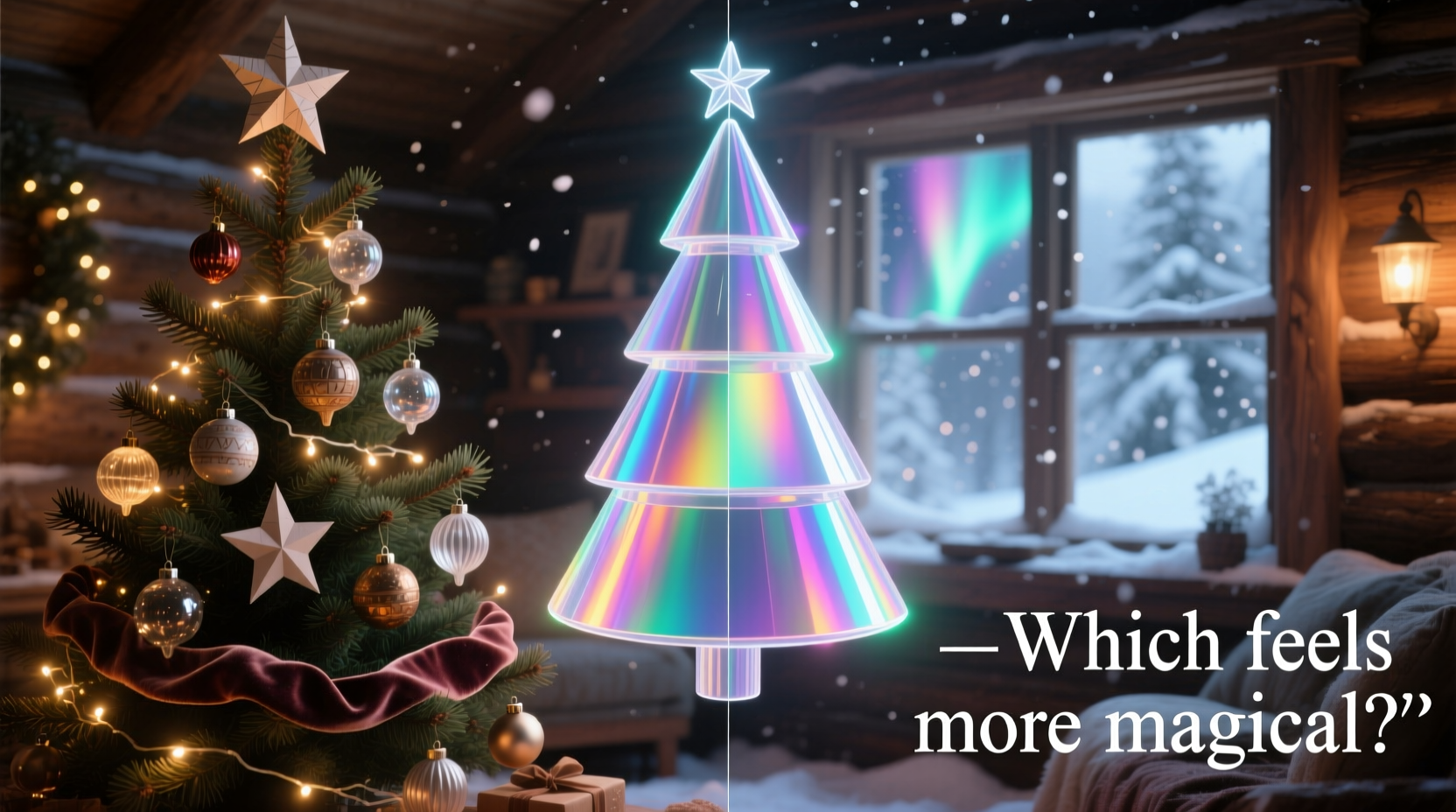
Human perception doesn’t process reality as raw data. We interpret it through embodied cognition—the idea that our thoughts, emotions, and memories are shaped by physical interaction with the world. A physical tree engages at least four senses simultaneously: the crisp snap of a snapped branch, the sticky residue of sap on fingertips, the low-pitched rustle of boughs shifting under ornament weight, the unmistakable green-woody aroma that lingers for days. These aren’t incidental details—they’re neural anchors. Each sensation reinforces presence, grounding the experience in biological continuity.
Holographic projections, by contrast, operate almost exclusively through vision and, to a lesser extent, sound (if paired with audio). Modern systems use volumetric light fields or Pepper’s Ghost-style optical illusions to create 3D-like floating forms. They render perfect symmetry, seamless color transitions, and gravity-defying animations—qualities no organic tree can match. But they lack thermal signature (no warmth radiating from bark), tactile resistance (you can’t run a hand over textured bark or feel the slight give of a live needle), and olfactory depth. That absence isn’t neutral: neuroimaging studies show multisensory congruence strengthens memory encoding. When sight is uncoupled from touch, smell, and even subtle ambient sound (like wind brushing real branches), the brain registers the experience as *representational*, not *relational*.
The Ritual Architecture of Magic: Why Process Matters More Than Product
Physical trees arrive embedded in ritual: selecting one at a lot or farm, sawing the base, wrestling it upright, adjusting the stand until it stops swaying, watering it daily, watching its posture subtly change over weeks. Each step is minor labor—and labor, when voluntary and seasonal, becomes ceremony. Psychologists call this “effort justification”: we assign greater value to outcomes requiring investment. The slight imperfection of a bent branch becomes endearing; the fallen needle under the sofa becomes a tiny relic of shared effort.
Holographic trees bypass this entirely. Setup is often five minutes: position the projector, align the reflective surface (or clear space), select a theme via app. There’s no risk of drooping, no need for water, no seasonal decay to witness. That efficiency is objectively valuable—especially for renters, those with allergies, mobility limitations, or small spaces. But it also removes the scaffolding of meaning. Magic, in cultural anthropology, rarely resides in the flawless object—it lives in the friction of making it *yours*. As Dr. Lena Torres, cultural historian at Boston University, observes:
“Rituals don’t exist to produce perfection. They exist to mark time, affirm continuity, and invite participation. A physical tree is a co-creation—not just decorated, but *tended*. That tending is where intergenerational memory gets woven.” — Dr. Lena Torres, author of Seasonal Time: Ritual and Resonance in Modern Life
A Side-by-Side Sensory & Emotional Comparison
To move beyond abstraction, consider how each tree performs across dimensions that shape lived magic:
| Dimension | Physical Tree | Holographic Projection Tree |
|---|---|---|
| Tactile Engagement | Rich variation: rough bark, pliant needles, brittle twigs, cool metal hooks, smooth glass ornaments. Invites touch, rearrangement, tactile exploration. | No direct interaction. Touch disrupts the illusion. Viewers remain observers, not participants. |
| Olfactory Signature | Distinctive, complex scent profile—terpenes (pinene, limonene), volatile organic compounds released by stressed conifers. Triggers strong autobiographical memory (Proust effect). | No inherent scent. Requires external aids (essential oil diffusers, sprays) that rarely replicate botanical complexity or consistency. |
| Temporal Narrative | Visible life cycle: fresh sheen → subtle needle drop → gradual drying → eventual composting. Embodies impermanence and care. | Static perfection. No visible change unless manually updated. Lacks narrative arc; feels suspended outside time. |
| Light Interaction | Natural diffusion: light bends through translucent needles, casts dappled, shifting shadows. Real bulbs glow warmly, flicker subtly (if incandescent), reflect off glass. | Precise, uniform illumination. Light originates *from* the projection, not *through* material. Shadows are minimal or digitally simulated—lacking organic variance. |
| Emotional Resonance Trigger | Strongest for nostalgia, family continuity, nature connection, and quiet reverence. Often evokes childhood, parental presence, generational traditions. | Strongest for wonder, novelty, futurism, and aesthetic control. Often evokes tech fascination, creative expression, and design-conscious celebration. |
A Real-World Example: The Thompson Family’s Two Winters
In Portland, Oregon, the Thompsons—a family of four with two children aged 7 and 10—used a 6-foot noble fir for 12 years. Every December, they drove to a local farm, let the kids choose the tree, and spent an afternoon trimming and decorating while listening to a vinyl record of Bing Crosby. The scent filled their house; the dog loved napping beneath its lower branches; the older child kept a “needle count journal” tracking weekly drops.
After moving into a high-rise apartment with strict fire codes and no balcony access, they switched to a premium holographic system for Year 13. Setup was effortless. The kids loved changing themes nightly—“Galaxy Nebula,” “Candy Cane Swirl,” “Antique Gold Filigree.” But something felt hollow. “It looked incredible,” says parent Maya Thompson, “but when I walked into the room alone at night, it didn’t *hold* me. It was beautiful, but it wasn’t *there* with me.” By January, they’d purchased a compact, potted Norfolk Island pine—small, living, fragrant, and perfectly code-compliant. “We water it together. We watch new fronds unfurl. It’s not a Christmas tree anymore—it’s our winter plant. And somehow, that feels more magical than any light show.”
Their story illustrates a crucial nuance: magic isn’t binary. It’s contextual. For the Thompsons, the hologram delivered visual delight but failed at emotional anchoring—until they reintroduced living presence, however modest.
Building Your Own Magic: A Practical Decision Framework
Choosing isn’t about superiority—it’s about alignment. Use this step-by-step reflection to determine which option deepens *your* sense of magic:
- Identify your primary magic trigger: Is it nostalgia and sensory immersion (leaning physical), or innovation and visual storytelling (leaning holographic)? Be honest—not aspirational.
- Map your constraints honestly: Allergies? Space? Mobility? Pet safety? Fire regulations? Budget for long-term upkeep (watering, replacement) vs. upfront tech cost?
- Assess household participation: Who decorates? Who waters? Who adjusts the lights? Does shared labor strengthen bonds—or create friction? Holograms reduce labor; physical trees distribute it.
- Consider longevity beyond December: Will the physical tree be composted? Can the holographic unit be repurposed (e.g., for birthdays, weddings, art displays)? What happens to the “magic” after New Year’s?
- Test the silence: Sit quietly in your space with both options (if possible). Which invites lingering? Which makes you want to sit beside it, not just look at it?
FAQ: Addressing Common Concerns
Does a holographic tree diminish the “spirit” of Christmas?
Not inherently. Spirit isn’t tied to biology—it’s tied to intention. A holographic tree chosen to honor a loved one’s love of astronomy, or to include a child with severe pine allergies in full celebration, carries profound spiritual weight. Diminishment occurs only when technology replaces presence without adding meaning.
Are physical trees ecologically irresponsible?
Not when sourced responsibly. Most U.S. Christmas trees are grown on farms specifically for harvest (not wild-cut), sequestering carbon during growth and supporting rural land stewardship. Recycled trees become mulch, erosion barriers, or wildlife habitat. The carbon footprint of a locally grown, composted tree is typically lower than that of manufacturing, shipping, and powering a holographic system for 10+ years—though lifecycle analysis varies by model and usage.
Can I blend both approaches meaningfully?
Absolutely—and increasingly, people do. A small, potted living tree (like a dwarf Alberta spruce or rosemary topiary) serves as the centerpiece, while subtle holographic accents—floating snowflakes above it, animated light ribbons winding through its branches—enhance without overwhelming. This hybrid honors materiality while embracing innovation, letting each element do what it does best.
Conclusion: Magic Is Grown, Not Generated
Holographic projection Christmas trees are marvels of engineering—precise, adaptable, and breathtakingly novel. They expand what’s possible in festive expression. Physical trees are marvels of ecology and evolution—imperfect, aromatic, transient, and deeply entwined with human history. Neither is “more magical” in absolute terms. Magic emerges not from the object itself, but from the quality of attention we bring to it, the memories it activates, and the relationships it holds space for.
If your heart quickens at the thought of sawdust on your boots and the weight of a real branch in your hands—if you find reverence in the quiet work of caring for something alive—then your magic lives in the soil, the sap, and the scent. If your wonder ignites at the physics of light bending in air, at the joy of co-creating a dream-world with your children using color sliders and animation presets—then your magic lives in the code, the calibration, and the collective gasp at the first shimmer.
The most magical choice isn’t the one that looks best online. It’s the one that makes your breath catch—not because it’s impressive, but because it’s *yours*. So this year, pause before you buy, rent, or stream. Place your hand on your chest. Feel the beat. Then ask: what does *this* heart need to feel wonder?




 浙公网安备
33010002000092号
浙公网安备
33010002000092号 浙B2-20120091-4
Comments
No comments yet. Why don't you start the discussion?