
Body Mass Index (BMI) is a widely used metric for assessing body composition in relation to health risk. While it doesn’t measure body fat directly, it provides a practical estimate based on height and weight. But what if you’re missing one of those two values? Can you reverse-engineer height from BMI and weight—or vice versa? The answer is yes, provided you use the correct mathematical relationships and accurate data. This guide walks through the science, formulas, and practical steps to determine either height or weight when given BMI and one other variable.
Understanding the BMI Formula and Its Reversibility
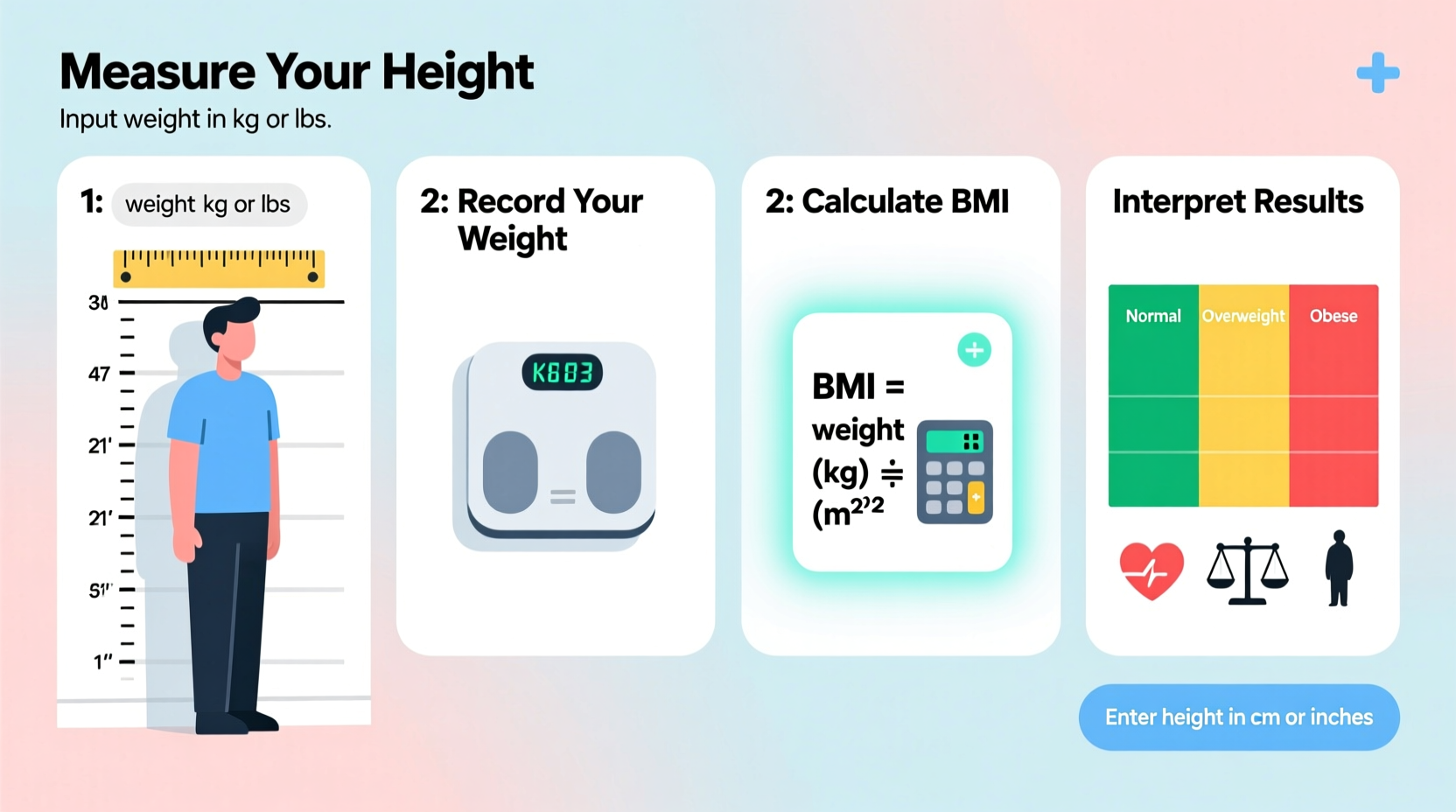
BMI is calculated using the formula:
BMI = weight (kg) / [height (m)]²
This simple equation allows for straightforward calculation when both weight and height are known. However, it can also be rearranged algebraically to solve for either unknown—provided the other two variables are available.
To find weight: Weight (kg) = BMI × [height (m)]²
To find height: Height (m) = √[weight (kg) / BMI]
These reversed formulas are mathematically sound but require precise inputs. Even small measurement errors can lead to significant inaccuracies, especially when calculating height, since it involves a square root function.
Step-by-Step Guide to Calculating Missing Values
Step 1: Confirm Which Variable Is Missing
Determine whether you need to calculate height or weight. You must have two of the three values (BMI, weight, height) to proceed. For example:
- If you know BMI and weight → calculate height
- If you know BMI and height → calculate weight
Step 2: Standardize Units
Ensure all measurements are in metric units. Common conversions:
| Imperial | Metric Equivalent |
|---|---|
| 1 inch | 0.0254 meters |
| 5'7\" (67 inches) | 1.70 meters |
| 150 lbs | 68.04 kg |
| 200 lbs | 90.72 kg |
Step 3: Apply the Correct Formula
Example 1: Finding Weight
Given: BMI = 24.5, Height = 1.75 m
Calculation: Weight = 24.5 × (1.75)² = 24.5 × 3.0625 ≈ 75.03 kg
Example 2: Finding Height
Given: BMI = 27.0, Weight = 85 kg
Calculation: Height = √(85 / 27.0) = √3.148 ≈ 1.775 meters (or about 5'10\")
Step 4: Validate Results Against Realistic Ranges
After calculation, check whether the result falls within biologically plausible ranges:
- Average adult height: 1.50–1.90 m
- Healthy BMI range: 18.5–24.9
- Extreme BMIs (<16 or >40) may indicate underweight or severe obesity
Step 5: Double-Check Your Math
Use a calculator with scientific functions to ensure precision, especially when dealing with square roots. Re-enter your numbers to confirm consistency.
“Reversing BMI calculations can be useful in clinical estimation or retrospective analysis, but always cross-verify with actual measurements when possible.” — Dr. Alan Reyes, Public Health Nutritionist
Common Errors and How to Avoid Them
Even with correct formulas, mistakes frequently occur due to unit confusion, rounding, or incorrect assumptions. Here’s a breakdown of common pitfalls:
| Error Type | Consequence | Prevention Strategy |
|---|---|---|
| Using pounds instead of kilograms | Overestimates required weight by over 2x | Always convert to metric before calculating |
| Forgetting to square height | Inflates BMI dramatically | Write out full equation before solving |
| Rounding too early | Compounds inaccuracies in final result | Keep 3–4 decimal places until final step |
| Assuming BMI applies universally | Ignores muscle mass, age, sex differences | Use BMI as a screening tool, not diagnostic proof |
Real-World Application: A Clinical Case Study
A 42-year-old male patient visits a telehealth clinic reporting fatigue and joint pain. His electronic record shows a BMI of 31.2 but lacks height data due to a system error. He recalls weighing 98 kg during his last physical.
Using the reverse height formula:
Height = √(98 / 31.2) = √3.141 ≈ 1.772 meters (~5'10\")
Clinicians cross-referenced this with old intake forms and confirmed he was previously recorded at 1.78 m. The calculated value was within 0.5%—a negligible difference. This allowed them to proceed with obesity classification and treatment planning without requiring an in-person visit.
This case illustrates how reverse BMI calculations can support continuity of care, particularly in remote or digital health settings where data gaps exist.
Essential Checklist for Accurate Reverse BMI Calculation
- ✅ Confirm which variable (height or weight) is missing
- ✅ Convert all units to metric (kg and meters)
- ✅ Use the correct rearranged formula
- ✅ Perform calculations with a scientific calculator
- ✅ Round only at the final step
- ✅ Compare results to typical human ranges
- ✅ Document assumptions and sources of input data
- ✅ Flag any extreme or unexpected outcomes for review
Frequently Asked Questions
Can BMI be used to find exact body fat percentage?
No. BMI is a proxy for body fatness, not a direct measurement. It does not distinguish between muscle and fat. Two people with the same BMI can have very different body compositions.
Is it safe to rely on calculated height or weight in medical decisions?
Calculated values are acceptable for preliminary assessment or when direct measurement isn't feasible. However, they should be verified with actual measurements before making critical health decisions.
What BMI category is considered healthy?
According to the World Health Organization, a BMI of 18.5–24.9 is classified as normal weight. Below 18.5 is underweight, 25–29.9 is overweight, and 30+ indicates obesity.
Final Thoughts and Action Steps
Being able to determine height or weight from BMI is a valuable skill in healthcare, fitness training, epidemiology, and personal wellness tracking. Whether you're filling gaps in historical data or estimating metrics for a client consultation, understanding the underlying math ensures reliability and professionalism.
The key is precision: use correct units, double-check formulas, and remain aware of BMI’s limitations. Never treat a calculated number as absolute truth—always contextualize it within broader health indicators like waist circumference, activity level, and medical history.




 浙公网安备
33010002000092号
浙公网安备
33010002000092号 浙B2-20120091-4
Comments
No comments yet. Why don't you start the discussion?