
Choosing the right-sized napkin for a rectangular napkin holder may seem like a minor detail, but it significantly impacts both functionality and aesthetics. A napkin that's too large can bunch up or fail to dispense properly; one that’s too small may slip out of place or look unbalanced. Whether you're organizing your kitchen, setting up a dining table, or managing supplies in a commercial space, accurate measurements are essential. This guide walks through the exact steps to measure napkins correctly, avoid common errors, and ensure seamless compatibility with your holder.
Understanding Napkin and Holder Dimensions
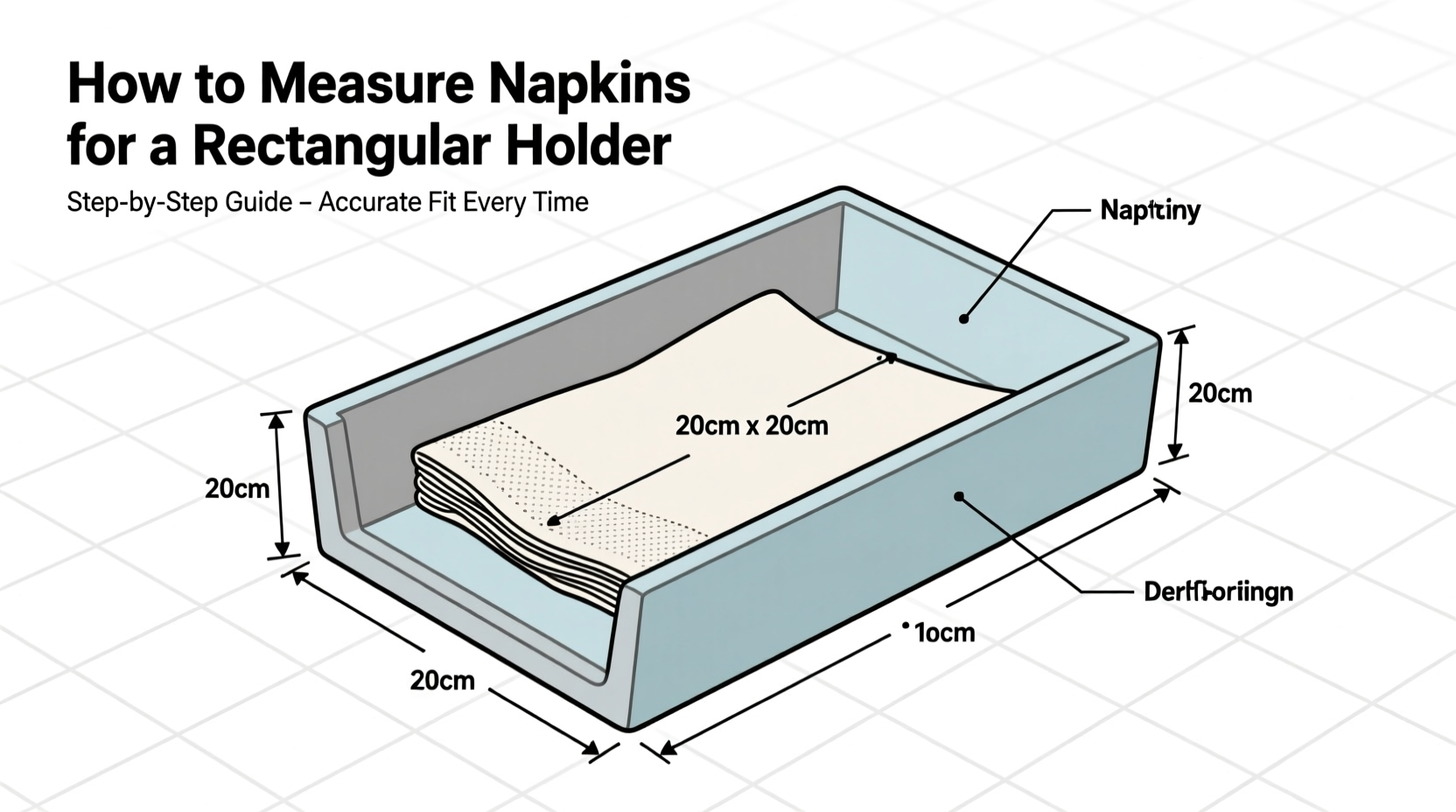
Napkin holders—especially rectangular ones—are designed to accommodate specific napkin sizes. However, not all napkins labeled as “standard” are truly standardized. Variations exist between brands, materials (paper vs. cloth), ply thickness, and folding methods. The key is matching three critical dimensions: length, width, and thickness (stack height).
Rectangular holders typically have an open slot at the top or front for dispensing. The internal cavity must be slightly larger than the napkin stack to allow smooth sliding but tight enough to prevent shifting. Most holders are built for either cocktail (5x5 inches), luncheon (6.5x6.5 inches), or dinner napkins (up to 16.5x16.5 inches when unfolded). But since many holders are marketed without clear size guidelines, measuring manually is often necessary.
Step-by-Step Guide to Measuring Napkins and Holders
To guarantee a proper fit, follow this five-step process:
- Measure the internal cavity of the holder. Use a ruler or tape measure to determine the inside length, width, and depth. Focus on the usable space where the napkins will sit—not the outer frame. Record these numbers precisely.
- Determine the desired fold style. Common folds include single-fold (half-fold), quarter-fold, or envelope fold. Each affects the final dimensions. For example, a 12-inch square napkin folded in half becomes 6x12 inches.
- Measure the folded napkin stack. Arrange a typical stack of napkins in the intended fold and compress it lightly (as it would be inside the holder). Measure its length, width, and thickness. Include at least 20–25 napkins for accuracy.
- Compare napkin stack to holder capacity. The napkin length and width should be no more than 1/8 inch smaller than the holder’s interior to prevent jamming, while allowing easy access. The stack thickness should leave about 0.25–0.5 inches of clearance at the top for comfortable removal.
- Test with a sample load. Insert the folded stack into the holder. Open and close the lid (if applicable), and try dispensing a few napkins. Adjust folding or quantity if resistance occurs.
Do’s and Don’ts When Matching Napkins to Holders
| Do’s | Don’ts |
|---|---|
| Use a metal ruler for precise measurements | Estimate dimensions by eye |
| Fold napkins consistently before measuring | Mix different sizes or brands in one holder |
| Allow 1/8 inch clearance per side for smooth dispensing | Overfill the holder beyond its depth capacity |
| Label holders if using multiple sizes | Assume all “dinner napkins” are the same size |
| Re-measure periodically if switching brands | Ignore swelling caused by humidity in paper napkins |
Real-World Example: A Restaurant’s Napkin Problem
A mid-sized bistro in Portland recently switched napkin suppliers to reduce costs. Their new paper napkins were advertised as “compatible with standard holders,” but staff quickly noticed issues: napkins wouldn’t feed smoothly, and some got stuck halfway out of the slot. After investigation, the manager measured both the old and new napkins. Though both were labeled 6.75x6.75 inches, the new ones had a tighter fiber weave, making them slightly thicker when folded. Combined with the same stack count, the total height exceeded the holder’s depth by nearly half an inch.
The solution? Reducing the number of napkins per holder from 100 to 80 and switching to a looser quarter-fold. This restored smooth operation and eliminated jams. The case underscores that even minor dimensional changes matter—and why physical measurement beats relying on product labels.
“Even a 1/16-inch difference in folded thickness can cause friction buildup over time, especially in high-use settings.” — Daniel Reeves, Commercial Kitchen Equipment Consultant
Tips for Different Napkin Types
Not all napkins behave the same way in holders. Material and construction influence how they fold and slide.
- Paper napkins: Tend to compress more under pressure but can swell slightly in humid environments. Opt for double- or triple-ply if durability matters.
- Cloth napkins: Thicker and less compressible. Best folded uniformly and stored in low-moisture areas. May require deeper holders.
- Recycled-content napkins: Often rougher texture increases friction. Test dispensing performance before bulk purchase.
- Decorative napkins: Embossing or printing can affect surface glide. Pair with wider slots or lower stack counts.
Essential Checklist for Perfect Napkin Fit
Before loading any napkin into a rectangular holder, run through this checklist:
- ☐ Measure the internal length, width, and depth of the holder
- ☐ Decide on the folding method (half, quarter, roll, etc.)
- ☐ Fold a test batch of napkins exactly as intended
- ☐ Measure the folded stack dimensions under light pressure
- ☐ Ensure stack height leaves 0.25–0.5 inches of headroom
- ☐ Confirm length and width allow 1/8 inch clearance on all sides
- ☐ Perform a live test: insert stack and dispense 3–5 napkins smoothly
- ☐ Adjust fold style or quantity if needed
Frequently Asked Questions
Can I use dinner napkins in a holder designed for luncheon sizes?
Only if you fold them appropriately. A typical 16.5-inch dinner napkin folded twice becomes approximately 8.25 inches square—often too large for standard luncheon holders. Try a tri-fold or accordion fold to reduce footprint. Always measure first.
Why do my napkins keep jamming in the dispenser?
Jamming usually results from overfilling, inconsistent folding, or exceeding the holder’s internal dimensions. Humidity can also cause paper napkins to expand slightly. Reduce the stack size, ensure uniform folds, and verify that the napkin dimensions are within 1/8 inch of the holder’s interior space.
How many napkins should I put in a rectangular holder?
Depends on the holder depth and napkin thickness. As a rule, fill to about ¾ of the holder’s height. For most standard holders, this means 50–100 paper napkins or 25–40 cloth ones. Never pack tightly—napkins need room to move upward as they’re removed.
Final Thoughts: Precision Makes All the Difference
Accurately measuring napkins for a rectangular holder isn’t just about avoiding inconvenience—it’s about creating a seamless experience in daily routines or professional service. A well-fitted napkin stack looks tidy, functions reliably, and reflects attention to detail. By taking a few minutes to measure properly, test folds, and adjust as needed, you eliminate frustration and enhance both utility and presentation.




 浙公网安备
33010002000092号
浙公网安备
33010002000092号 浙B2-20120091-4
Comments
No comments yet. Why don't you start the discussion?