
Whether you're planning a road trip, evaluating walking routes, or calculating delivery distances, knowing how to measure the exact distance between two points is essential. Google Maps offers a built-in tool that makes this task fast, accurate, and accessible from any device. This guide walks you through the process in detail—on desktop and mobile—so you can get precise measurements anytime, anywhere.
Why Measuring Distance Matters
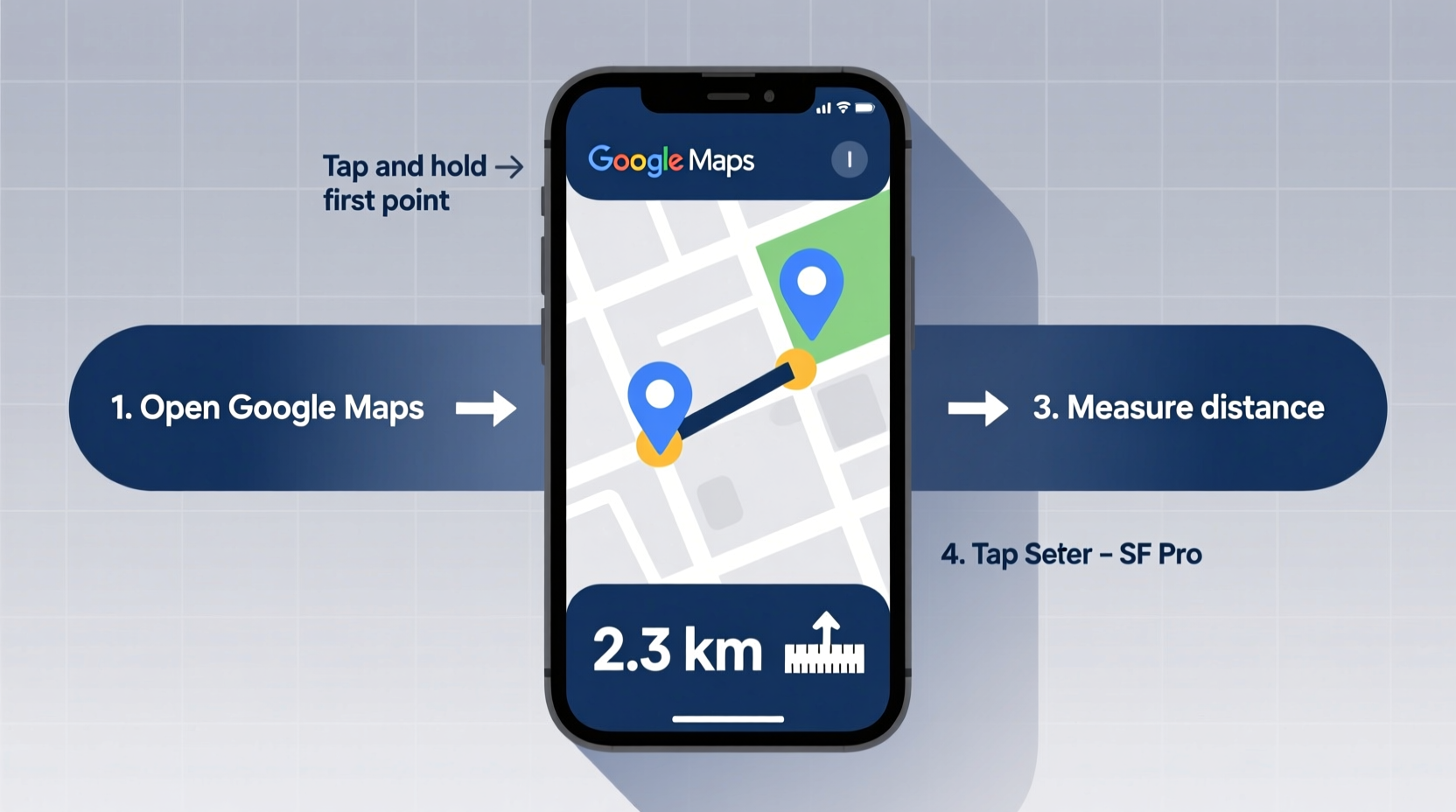
Accurate distance measurement supports better decision-making across various scenarios. Urban planners use it to assess infrastructure needs. Cyclists rely on it to plan training routes. Real estate professionals calculate proximity to amenities. Even hikers benefit when estimating trail lengths before heading out.
Google Maps' measurement tool eliminates guesswork. It accounts for real-world geography, including curves in roads and elevation changes, delivering results that reflect actual travel distance rather than straight-line estimates.
“Precise distance data improves route efficiency and reduces fuel consumption in logistics.” — Dr. Alan Torres, Transportation Analyst at MIT
Step-by-Step Guide: Measuring Distance on Desktop
The desktop version of Google Maps provides the most intuitive interface for measuring multi-point distances. Follow these steps:
- Open your web browser and go to maps.google.com.
- Right-click on the starting point of your measurement. A context menu will appear.
- Select \"Measure distance\" from the dropdown menu.
- Click on another point on the map to create a path. Each click adds a new segment.
- To adjust the route, drag any point to reposition it. This is useful for following winding roads or trails.
- To remove the last point, press Ctrl+Z (Cmd+Z on Mac) or right-click and choose \"Remove last point.\"
- To finish, double-click the final location or click \"Done\" in the pop-up box at the bottom.
The total distance is displayed in miles and kilometers at the bottom of the screen. You can continue adding points to extend the measurement or clear the current line to start over.
Using the Mobile App: Android and iOS
Measuring distance on smartphones requires slightly different navigation but delivers the same accuracy. Here's how to do it on both platforms:
For iPhone and Android Users:
- Launch the Google Maps app on your phone.
- Tap and hold the screen to drop a pin at your starting point.
- Once the red pin appears, tap the location name in the bar at the bottom of the screen.
- Scroll up and select \"Measure distance\".
- Move the map so the black circle (crosshair) is over the next point you want to measure to.
- Tap the \"+\" icon in the bottom-right corner to add that point.
- Repeat steps 5–6 to add more waypoints along a route.
- Tap \"Done\" to view the total distance in the bottom-left corner.
Note that the mobile interface does not allow dragging points like the desktop version. If you make an error, tap \"Clear\" to restart.
Real Example: Planning a Bike Commute
Sophia lives in Portland and wants to bike to work instead of driving. She opens Google Maps on her laptop, right-clicks her home address, and selects \"Measure distance.\" She then clicks along the bike lanes and greenways leading to her office, adjusting points to follow protected paths. After placing six segments, she sees the total distance is 7.2 miles—one way. With this information, she calculates average speed and commute time, helping her decide whether biking is feasible during weekdays.
Advanced Tips for Greater Accuracy
While basic measurement is straightforward, small adjustments can significantly improve precision. Consider these strategies:
- Zoom in closely before placing points to avoid misalignment, especially in dense urban areas.
- Follow actual roads or trails by adding intermediate points where turns occur.
- Use satellite view to verify terrain features such as footpaths or unpaved roads not visible in standard mode.
- Save key locations as labeled pins before measuring to ensure consistency across sessions.
- Avoid long straight lines across complex landscapes; they underestimate true travel distance.
Do’s and Don’ts of Using the Measure Tool
| Do’s | Don’ts |
|---|---|
| Use multiple points to trace winding roads accurately | Assume diagonal lines reflect real travel distance |
| Check units (miles vs. kilometers) based on your region | Forget to zoom in—precision drops at high altitudes |
| Combine with Street View to validate inaccessible routes | Rely solely on straight-line (\"as the crow flies\") measurements |
| Clear old measurements before starting new ones | Expect elevation gain/loss—this tool doesn't calculate vertical distance |
Frequently Asked Questions
Can I measure curved paths like hiking trails?
Yes. By placing multiple connected points along the trail’s contours, you can closely approximate its length. The more points you add, the more accurate the result.
Does Google Maps account for elevation changes?
No. The measurement tool calculates horizontal distance only. Elevation gains are not included, which means uphill hikes may feel longer than the measured distance suggests.
Is there a limit to how many points I can add?
There is no official limit, but performance may degrade with very long routes containing dozens of points. For best results, keep paths under 50 segments unless necessary.
Checklist: Measuring Distance Like a Pro
- ✅ Open Google Maps on desktop or mobile
- ✅ Right-click (desktop) or long-press (mobile) to start measuring
- ✅ Add points along the desired route, following roads or trails
- ✅ Zoom in for greater placement accuracy
- ✅ Review total distance in miles/kilometers
- ✅ Clear the measurement when finished to avoid confusion
- ✅ Save or note down results for future reference
Conclusion: Take Control of Your Route Planning
Measuring distance between two points using Google Maps is a simple yet powerful skill. Whether you're mapping a weekend hike, optimizing delivery zones, or comparing potential homes based on commute length, this tool puts reliable data at your fingertips. With practice, you’ll be able to generate accurate measurements in seconds—helping you save time, reduce costs, and make smarter decisions.




 浙公网安备
33010002000092号
浙公网安备
33010002000092号 浙B2-20120091-4
Comments
No comments yet. Why don't you start the discussion?