
Determining whether a number is real—and identifying its specific type—is a foundational skill in mathematics, computer science, and data analysis. From validating user input in software applications to interpreting scientific measurements, understanding the nature of numerical values ensures accuracy and prevents errors. While the concept may seem straightforward, misclassification can lead to flawed calculations, incorrect logic flow, or security vulnerabilities. This guide provides a structured approach to verifying the reality and type of any number using both theoretical and practical methods.
Understanding Number Types in Mathematics
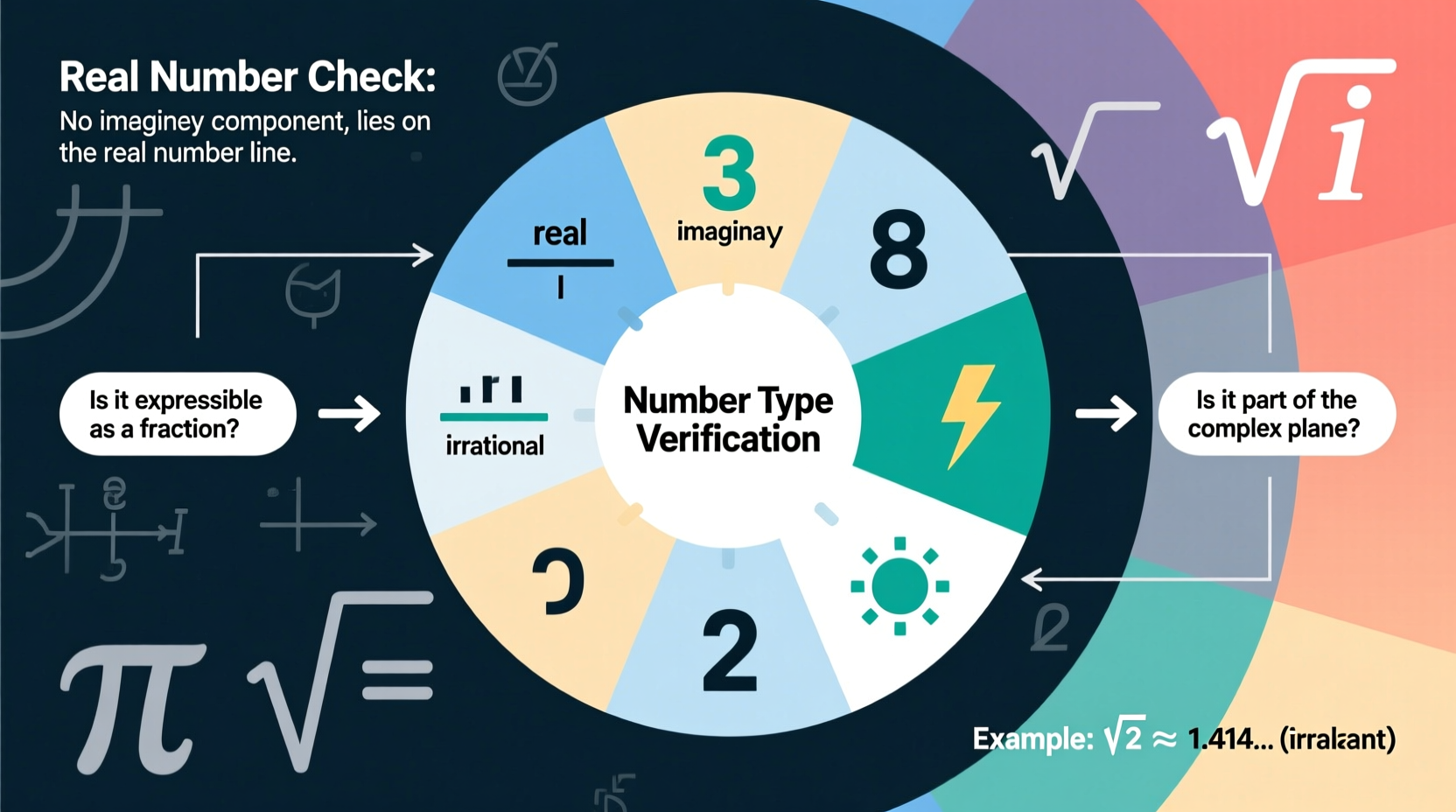
The classification of numbers begins with mathematical theory. Numbers are organized into sets based on their properties. The most relevant set for determining \"realness\" is the set of real numbers, which includes all rational and irrational numbers but excludes imaginary or complex components.
- Natural Numbers (ℕ): Positive integers starting from 1 (e.g., 1, 2, 3).
- Whole Numbers: Natural numbers plus zero (0, 1, 2, ...).
- Integers (ℤ): Whole numbers and their negative counterparts (..., -2, -1, 0, 1, 2, ...).
- Rational Numbers (ℚ): Numbers expressible as a fraction of two integers (e.g., 1/2, -4/7).
- Irrational Numbers: Real numbers that cannot be expressed as fractions (e.g., √2, π).
- Real Numbers (ℝ): The union of rational and irrational numbers.
- Complex Numbers (ℂ): Numbers with a real and imaginary part (e.g., 3 + 4i).
A number is considered \"real\" if it belongs to the set ℝ. Any number involving the square root of a negative value (like √-1 = i) is not real—it's imaginary or complex.
Step-by-Step Guide to Verify a Number’s Reality
Follow this systematic process to determine whether a given number is real and classify its type.
- Check for Imaginary Components: Look for symbols like 'i', 'j' (in engineering), or expressions such as √(-x) where x > 0. These indicate non-real numbers.
- Evaluate Expressions: Simplify algebraic or arithmetic expressions. For example, √(-9) simplifies to 3i, which is not real.
- Analyze Decimal Representation: Real numbers have finite, repeating, or non-repeating decimal expansions. Non-repeating decimals like π are still real.
- Confirm Membership in ℝ: Ensure the number lies somewhere on the continuous number line—left or right of zero, including fractions and irrationals.
- Use Set Notation When Possible: Explicitly define the domain when working mathematically. For instance, stating x ∈ ℝ confirms x is real.
Programming Methods to Validate Numerical Types
In software development, especially in languages like Python, JavaScript, or Java, verifying number types requires careful handling due to dynamic typing and string inputs.
| Language | Method to Check Real Number | Notes |
|---|---|---|
| Python | isinstance(x, (int, float)) and not isinstance(x, complex) |
Excludes complex numbers; handles int/float as real. |
| JavaScript | typeof num === 'number' && isFinite(num) && !isNaN(num) |
Ensures value is numeric and not Infinity or NaN. |
| Java | num instanceof Double || num instanceof Integer |
With additional check for NaN/Infinity via methods. |
In Python, you can further validate strings intended as numbers:
def is_real_number(value):
    try:
        float(value)
        return True
    except ValueError:
        return False

# Example usage
print(is_real_number(\"3.14\"))   # True
print(is_real_number(\"5+3j\"))   # False (complex)
print(is_real_number(\"sqrt(2)\")) # False (not parsed)
This function attempts conversion to float, which accepts most real number formats but fails on symbolic or complex representations.
Common Pitfalls and How to Avoid Them
Mistakes often arise from ambiguous input formats or incomplete validation logic.
- Assuming All Strings Are Numbers: User input like \"123abc\" may pass partial checks but isn't valid.
- Ignoring Special Float Values: In computing,
NaN(\"Not a Number\") andInfinityare technically of type float but are not meaningful real numbers in many contexts. - Misinterpreting Scientific Notation: Values like \"1e5\" represent real numbers (100,000), but parsers must support them.
- Overlooking Localization: Some regions use commas for decimals (e.g., \"3,14\"), which standard parsers may reject.
“Robust number validation isn’t just about syntax—it’s about context. A ‘valid’ number in one system might be meaningless noise in another.” — Dr. Lena Patel, Data Integrity Researcher at MIT
Mini Case Study: Validating Input in a Financial App
A fintech startup developed a mobile app allowing users to input monthly expenses. Early versions accepted any text input, leading to crashes when users entered symbols like \"$50\" or mistyped \"5o0\" instead of \"500\". The engineering team implemented a multi-step verification:
- Strip currency symbols and whitespace.
- Attempt parsing as float using locale-aware libraries.
- Reject values containing alphabetic characters after cleaning.
- Ensure result is finite and within expected range (e.g., 0 to 1,000,000).
After deployment, input error rates dropped by 92%, and backend processing became more reliable. This case highlights that accurate number verification combines formatting, type checking, and contextual constraints.
Checklist: Verifying a Number Is Real and Correctly Typed
- ✅ Remove extraneous characters (symbols, spaces, units).
- ✅ Confirm no imaginary unit (i or j) is present.
- ✅ Attempt safe parsing (e.g., float() in Python, Number() in JS).
- ✅ Check for NaN or Infinite values.
- ✅ Validate against expected range or format (e.g., positive only, max 2 decimal places).
- ✅ Use regular expressions if pattern matching is needed (e.g., ^-?\\d+(\\.\\d+)?$).
Frequently Asked Questions
Is zero a real number?
Yes, zero is a real number. It is also an integer and a rational number. It lies at the origin of the real number line and is neither positive nor negative.
Can a number be both real and imaginary?
A number can be both only if its imaginary part is zero. For example, 5 + 0i is technically a complex number but is equivalent to the real number 5. Purely imaginary numbers (like 4i) are not real.
How do I know if a decimal is rational or irrational?
If the decimal terminates (e.g., 0.25) or repeats (e.g., 0.333...), it is rational. If it continues infinitely without repetition (e.g., π = 3.14159...), it is irrational—but still real.
Conclusion: Building Confidence in Numerical Accuracy
Verifying whether a number is real and correctly typed is more than a technical step—it's a safeguard for precision across disciplines. Whether you're solving equations, writing code, or analyzing datasets, applying consistent validation practices ensures reliability. By combining mathematical awareness with robust programming techniques and contextual checks, you eliminate ambiguity and reduce errors. Don’t assume; always verify.




 浙公网安备
33010002000092号
浙公网安备
33010002000092号 浙B2-20120091-4
Comments
No comments yet. Why don't you start the discussion?