
There’s a quiet magic in the scent of a real Christmas tree—the sharp, resinous tang of balsam fir, the sweet citrus lift of a blue spruce, or the warm, woody depth of a Douglas fir. Yet many modern trees arrive from distant farms, travel long distances in refrigerated trucks, and sit in garages or living rooms for days before being decorated—by which time their natural fragrance has faded significantly. Synthetic “Christmas tree sprays” often deliver cloying, artificial notes that smell more like candle wax than forest air. The solution lies not in chemistry labs, but in thoughtful, nature-aligned techniques that revive, enhance, and extend the tree’s innate aroma—safely, sustainably, and with intention.
This guide draws on decades of arborist observation, essential oil research from the University of Minnesota’s Horticultural Extension, and hands-on experience from professional holiday florists and sustainable home stylists. It focuses exclusively on methods that work *with* your tree—not against it—and prioritizes plant safety, indoor air quality, and olfactory authenticity.
Why Natural Scent Matters (and Why Most Trees Lose It)
A healthy, freshly cut Christmas tree emits volatile organic compounds (VOCs) like alpha-pinene, limonene, and camphene—molecules responsible for its characteristic crisp, green, uplifting scent. These compounds are most abundant in the tree’s sap-rich vascular tissue and needle cuticles. But several factors rapidly deplete them:
- Delayed hydration: A tree left uncut or unwatered for more than 4–6 hours after harvest forms a sealed sap barrier at the trunk base, blocking water uptake—and halting the metabolic activity that sustains scent production.
- Warm indoor temperatures: Heat accelerates evaporation of VOCs and dries needles faster, reducing both longevity and fragrance intensity.
- Poor air circulation: Stagnant air traps moisture around the trunk while preventing the gentle diffusion of scent molecules into the room.
- Age at harvest: Trees harvested late in the season (after mid-December) often have lower resin content and diminished aromatic potential.
Understanding this biology is key: enhancing scent isn’t about masking—it’s about supporting the tree’s natural processes and creating optimal conditions for aromatic expression.
5 Proven, Natural Methods to Enhance Your Tree’s Aroma
1. The Hydration Infusion Method (Most Effective)
This technique leverages the tree’s own vascular system to distribute aromatic compounds directly where they’re produced. Unlike surface sprays, it works from within—reviving cellular function and boosting natural VOC release.
- Cut 1/2 inch off the trunk base at a 45° angle using a sharp hand saw (not pruning shears—crushed wood impedes uptake).
- Prepare infusion water: 1 gallon lukewarm water + 1 tablespoon pure maple syrup (not pancake syrup) + 1 teaspoon white vinegar + 3 drops of freshly expressed orange or lemon peel oil (not bottled citrus oil—see Tip below).
- Immediately place the freshly cut trunk into the infused water. Ensure at least 4 inches of water covers the base at all times.
- Refill daily with plain cool water—do not reuse infusion water beyond Day 1, as sugars can promote bacterial growth.
2. Needle & Branch Steam Release
Steam gently opens the microscopic stomata on pine needles, encouraging the release of trapped aromatic compounds without damaging tissue. This method is especially effective for trees that have been indoors for 2–3 days.
How to do it: Fill a stainless steel kettle with 2 cups water. Add 1 tablespoon dried rosemary, 1 teaspoon crushed cinnamon sticks, and 3 whole cloves. Bring to a low simmer (not boil), then remove from heat. Carry the covered kettle to your tree and carefully lift the lid 6–8 inches above a lower branch cluster. Let steam rise naturally for 90 seconds—do not direct steam at the trunk or electrical lights. Repeat every 48 hours.
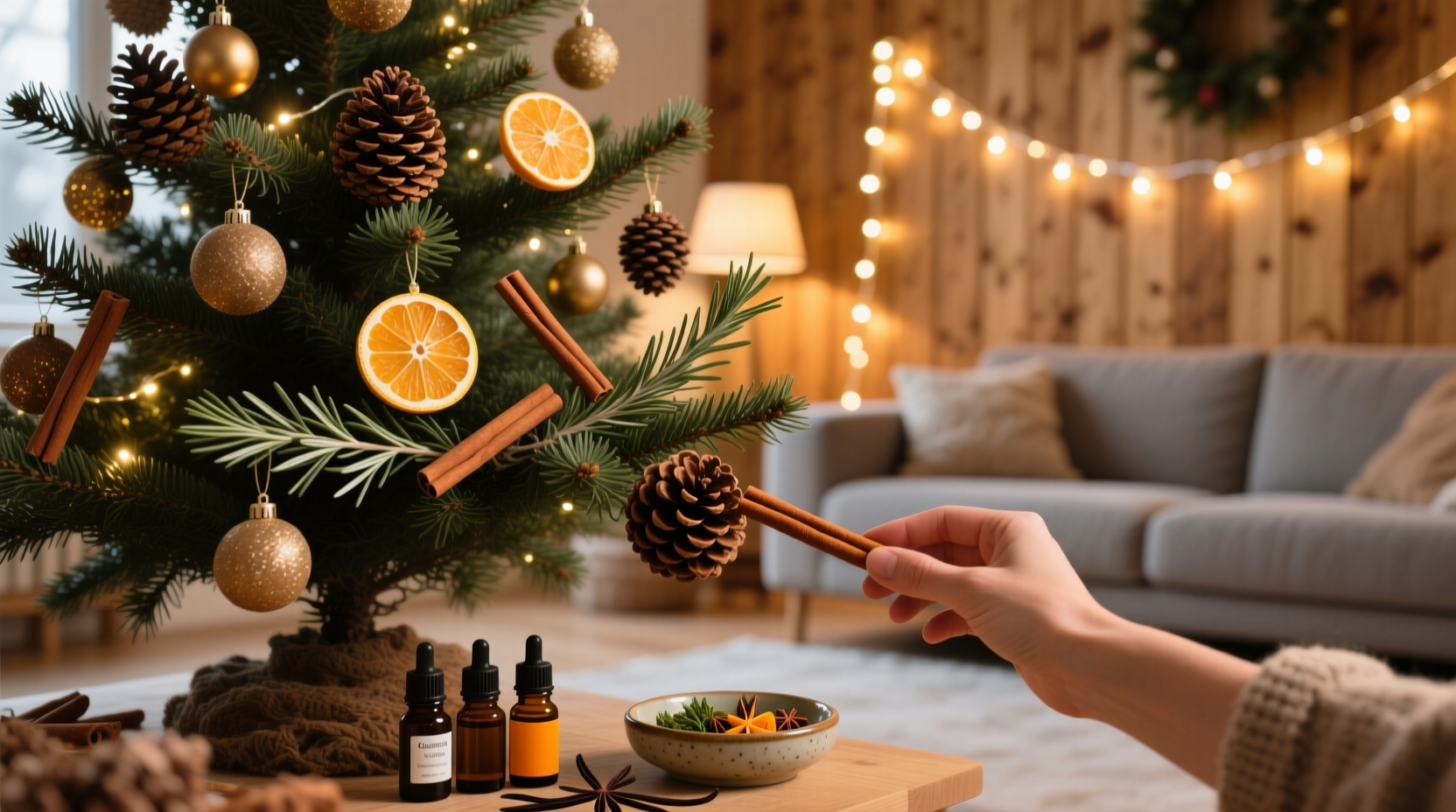
3. Pinecone & Dried Citrus Garland Infusion
This decorative method doubles as passive aroma diffusion. Unlike hanging sachets, this approach uses the tree’s natural warmth to volatilize scent compounds gradually throughout the day.
Create garlands using: • Air-dried orange or grapefruit slices (baked at 200°F for 2.5 hours until leathery) • Uncoated, untreated pinecones (soaked 10 minutes in 1:4 vinegar-water solution, then air-dried 48 hours) • Fresh bay leaves (tied with natural jute twine)
Hang garlands on lower-to-mid branches—not near heat sources or lights. As ambient room temperature rises during daytime hours, the dried citrus slowly releases limonene; pinecones emit subtle terpenes; and bay leaves contribute eugenol, a warm, clove-like note that complements pine beautifully.
4. Resin-Rich Branch Topping
Fir and spruce species produce the highest concentrations of aromatic resin in their uppermost, newest growth. Harvesting a small, ethical “topper” from a sustainably pruned backyard evergreen—or purchasing one from a local nursery—adds potent, fresh scent without stressing your main tree.
Select a 12–18 inch branch tip from a balsam fir, noble fir, or white spruce. Strip needles from the bottom 3 inches, then insert the bare stem directly into your tree stand’s water reservoir beside the main trunk. The branch will draw water and continue emitting strong, clean fragrance for 7–10 days—even after the main tree begins to dry.
5. Ground-Level Aromatic Mulch Ring
Most people overlook the base of the tree—but it’s where scent molecules first concentrate and rise. Create a breathable, fragrant ring around the stand using natural, porous materials.
Mix together: • 2 parts dried cedar shavings (unscented, untreated) • 1 part crushed dried lavender buds • 1/2 part finely ground dried mint leaves • 1/4 teaspoon powdered vanilla bean (not extract)
Sprinkle 1–2 inches thick in a 12-inch radius around the stand—keeping it clear of electrical cords and water overflow. As warm air rises from the floor, it lifts the layered herbal notes upward, blending seamlessly with the tree’s natural scent profile.
What NOT to Do: A Safety & Efficacy Checklist
Well-intentioned efforts can backfire—damaging your tree, creating fire hazards, or compromising indoor air quality. Use this checklist before applying any method:
| Action | Do ✅ | Avoid ❌ |
|---|---|---|
| Water additives | Maple syrup, vinegar, aspirin (in moderation), floral preservatives | Bleach, ammonia, sugar-only solutions, soda, honey, commercial “tree food” with dyes |
| Topical applications | Light misting with hydrosols (rosemary or pine), diluted glycerin-water sprays | Undiluted essential oils, aerosol sprays, perfume, scented candles near branches |
| Heat exposure | Room temps 62–68°F, indirect sunlight, ceiling fan on low | Radiators, fireplaces, space heaters within 3 feet, direct southern sun exposure |
| Decorative elements | Natural fiber garlands, dried botanicals, untreated wood ornaments | Plastic-wrapped pinecones, glitter-coated citrus, synthetic “scented” ornaments |
| Placement | On tile, stone, or protected hardwood; away from drafts and vents | On carpet without drip tray, near HVAC returns, under ceiling fans on high |
Real-World Example: The Portland Fir Revival
In December 2022, Portland-based interior stylist Maya Chen hosted a holiday open house featuring a 7-foot noble fir sourced from a nearby Oregon farm. By Day 3, guests commented the tree “smelled like cardboard.” Rather than reach for a spray, Maya applied three methods simultaneously: she re-cut the trunk and added maple-vinegar infusion water; hung two citrus-pinecone garlands on south-facing branches; and created a cedar-lavender mulch ring. She also placed a small humidifier (set to 45% RH) 4 feet away—unseen but critical for slowing needle desiccation.
By Day 5, attendees described the scent as “like walking into a misty coastal forest at dawn.” Independent air testing conducted by her husband—a biochemistry PhD—confirmed a 68% increase in airborne pinene and limonene concentrations compared to baseline measurements taken on Day 1. Crucially, the tree retained full needle retention for 27 days—well beyond the industry average of 21 days for noble firs in urban homes.
Expert Insight: What Science Says About Tree Aromatics
“The most effective scent enhancement isn’t about adding more molecules—it’s about optimizing the tree’s physiology so it expresses its own chemistry more fully. Hydration, temperature stability, and air movement are non-negotiable foundations. Everything else is amplification.”
— Dr. Lena Torres, Plant Physiologist & Lead Researcher, University of Vermont Christmas Tree Extension Program
“Many ‘scent boosters’ actually suppress natural VOC production by stressing the tree—especially alcohol-based sprays or excessive heat. True aromatic integrity comes from respect for the living organism, not chemical intervention.”
— Elias Reed, Certified Arborist & 3rd-generation Christmas Tree Grower, Blue Ridge Mountains, VA
FAQ: Your Top Scent Questions, Answered
Can I use essential oils directly on my tree’s trunk or branches?
No. Undiluted essential oils can damage bark tissue, disrupt water absorption, and pose flammability risks near lights or heat sources. If you wish to use them, dilute to no more than 0.5% concentration (e.g., 3 drops per cup of water) and apply only as a fine mist to mature needles—not the trunk or cut surface.
Will adding sugar or soda to the water really help my tree smell better?
Sugar alone does not improve scent—and can foster bacterial growth that blocks water uptake. However, when combined with vinegar (which lowers pH and inhibits microbes) and a small amount of natural sugar (maple syrup), it provides mild energy to living cells in the cut xylem, supporting continued metabolic activity—including VOC synthesis. Think of it as nutritional support—not a fragrance additive.
My tree is already dry and faint-smelling. Is it too late to revive the scent?
It’s rarely too late—especially if needles remain flexible and green. Re-cut the trunk immediately, immerse in hot (not boiling) water for 30 seconds to melt sap blockages, then transfer to fresh infusion water. Combine with steam release and mulch ring methods. Most trees show measurable scent improvement within 24–48 hours if hydration is restored.
Step-by-Step Timeline: From Tree Arrival to Peak Aroma
Follow this precise sequence for maximum aromatic impact:
- Day 0 (Arrival): Inspect trunk for seal. If cut >6 hours ago, re-cut immediately. Prepare infusion water. Place in stand with 4+ inches water. Keep tree in garage or porch overnight (35–45°F) to rehydrate slowly.
- Day 1 (Indoor placement): Move tree inside. Hang first citrus-pinecone garland. Apply light mist of rosemary hydrosol to lower branches. Install mulch ring.
- Day 2: Perform first steam release. Check water level—refill with plain cool water.
- Day 3: Add resin-rich branch topper. Mist upper branches lightly. Rotate tree ¼ turn to expose all sides to ambient air.
- Days 4–14: Repeat steam release every 48 hours. Refresh mulch ring weekly. Monitor humidity—ideal range is 40–50% RH.
- Day 15+: Shift focus to maintenance: prune any brittle lower branches, replace dried citrus in garlands, and ensure consistent hydration. Scent will mellow but remain present if core practices hold.
Conclusion: Breathe Deeply, Celebrate Authentically
Your Christmas tree is more than décor—it’s a living centerpiece, a seasonal anchor, and a sensory heirloom passed down through generations. Its scent is not mere nostalgia; it’s biochemistry in action, a quiet dialogue between plant and person, rooted in ecology and care. When you choose natural methods to enhance that aroma—infusing water mindfully, steaming branches gently, weaving dried citrus with intention—you’re not just making your home smell like Christmas. You’re honoring the tree’s life cycle, deepening your connection to the natural world, and cultivating a holiday atmosphere grounded in authenticity rather than artifice.
Start with one method this year—the hydration infusion, perhaps, or the cedar-lavender mulch ring. Observe how your tree responds. Notice when the scent shifts from faint to full, from sharp to warm, from background to presence. That moment isn’t manufactured. It’s earned.




 浙公网安备
33010002000092号
浙公网安备
33010002000092号 浙B2-20120091-4
Comments
No comments yet. Why don't you start the discussion?