
A well-organized bookshelf does more than store literature—it becomes a statement piece. Whether in a living room, home office, or bedroom, the way you arrange your books influences the overall ambiance of a space. While functionality matters, aesthetics play an equally important role in creating a harmonious environment. Arranging books by color and size is one of the most effective methods to achieve visual balance, rhythm, and elegance. This approach transforms cluttered shelves into curated displays that reflect both personal taste and design sensibility.
The key lies not just in sorting but in understanding how color palettes interact, how varying book heights affect flow, and how negative space contributes to visual rest. Done thoughtfully, a color-and-size-based arrangement can evoke calmness, sophistication, or even artistic flair—depending on your intent. This guide breaks down the principles, techniques, and common pitfalls to help you create a shelf that feels intentional and inviting.
Understanding Color-Based Book Arrangement
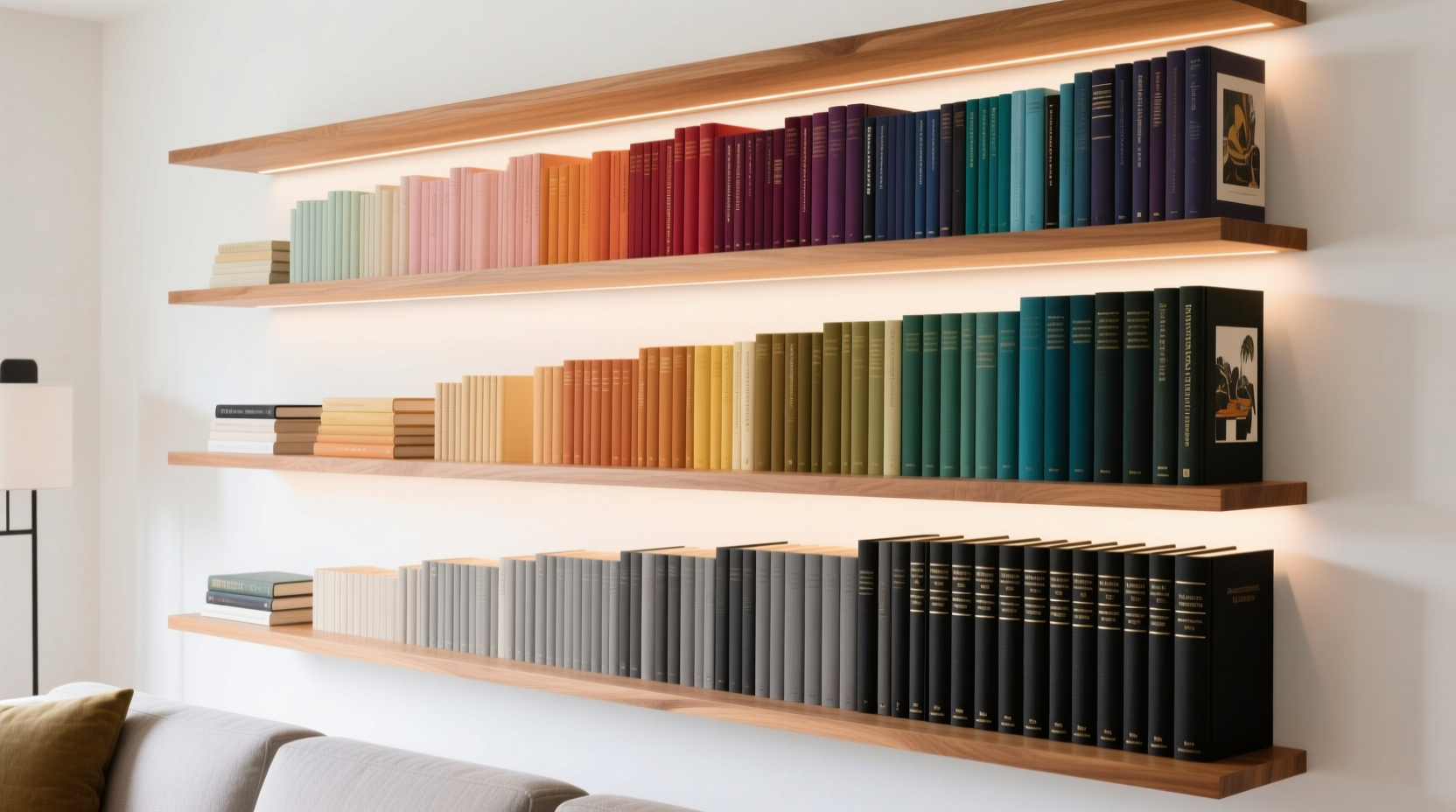
Color-coding books creates instant visual harmony. When done correctly, it turns a shelf into a gradient tapestry that draws the eye and adds depth to a room. The method works especially well in open-concept spaces where bookshelves serve as architectural elements.
Start by removing all books from the shelf and laying them out on a flat surface. Group them by spine color. Most collections will naturally fall into broad categories: blues, greens, reds, yellows, oranges, purples, neutrals (white, cream, gray, black), and multicolor spines. Don’t aim for perfection—focus on dominant hues. A navy cover with gold lettering still belongs in the blue group; a beige book with a red title goes in neutral unless the red dominates.
Once grouped, consider the order. You can go monochromatic (light to dark within one color family) or full spectrum (rainbow order). Rainbow sequencing follows the ROYGBIV pattern—red, orange, yellow, green, blue, indigo, violet—and offers a vibrant, energetic feel. Monochromatic arrangements, such as shades of gray or earth tones, deliver a minimalist, serene aesthetic. Both are valid; choose based on your room’s mood.
Be mindful of over-saturation. Too many bright reds or bold yellows in one section can overwhelm the eye. Balance intense colors with neutral buffers—place a stack of white or gray books between vibrant sections to create breathing room.
Sorting by Size: Creating Rhythm and Flow
While color captures attention, size governs movement. Books vary in height, thickness, and proportion, and arranging them with awareness of these dimensions prevents visual chaos. Uniformity isn’t the goal—rhythm is.
Begin by measuring book heights. Most fall into three categories: tall (over 9 inches), standard (7–9 inches), and short (under 7 inches). Hardcover editions tend to be taller and sturdier; paperbacks often sit lower. Grouping similar sizes together creates horizontal bands of consistency, which the eye perceives as orderly.
Alternatively, mix sizes intentionally. Staggering tall and short books introduces dynamic variation. Try placing two tall books at either end of a shelf with shorter ones in the middle—a framing effect that draws focus inward. Or alternate clusters: three tall, two short, repeat. This method works best when combined with color grouping to maintain cohesion.
Thickness also matters. Oversized art books or encyclopedias command presence. Place them strategically—either as anchors at shelf ends or centered as focal points. Avoid clustering too many thick volumes together, as they can make a shelf look heavy and unbalanced.
“Order isn’t about perfection—it’s about guiding the eye. A shelf should whisper, not shout.” — Lena Torres, Interior Stylist & Author of *Calm Spaces*
Combining Color and Size: A Strategic Approach
The most polished results come from merging color and size strategies. This dual-layer system maximizes both emotional impact and structural harmony. Here’s how to execute it effectively:
- Empty and assess: Remove all books and clean the shelf. Take inventory of your collection’s color distribution and size range.
- Sort by color first: Create piles based on dominant spine color.
- Sub-sort by size: Within each color group, separate books into tall, standard, and short.
- Plan the layout: Sketch a rough shelf map or use index cards to simulate placement.
- Install with intention: Begin arranging, adjusting as needed for visual flow.
When combining both systems, decide whether to prioritize color or size. For a bold, artistic look, lead with color. For a more traditional or library-like feel, emphasize size consistency within color blocks.
Consider breaking patterns occasionally. Insert a single gold-spined book into a blue section for a pop of warmth. Or place a small poetry collection upright between two large novels to create a pause in the rhythm. These micro-variations add personality without disrupting coherence.
Do’s and Don’ts of Aesthetic Book Arrangement
| Do | Don’t |
|---|---|
| Group books by dominant spine color | Force every book into exact color matches |
| Use neutral-colored books as visual buffers | Cluster too many bright colors together |
| Alternate orientations (some books horizontal) | Lay too many books horizontally—can look messy |
| Leave some negative space for balance | Overfill shelves to the point of clutter |
| Incorporate objects like vases or framed photos sparingly | Let decor outnumber books—dilutes purpose |
Step-by-Step Guide to Styling Your Shelf
Follow this timeline to transform your bookshelf in under three hours:
- Hour 1: Preparation (30–45 minutes)
Remove all items from the shelf. Dust the shelves and surrounding area. Sort books into color groups on the floor or table. - Hour 1: Sub-Sorting (15–30 minutes)
Within each color pile, organize by height and thickness. Identify standout pieces—books with unique covers, special editions, or sentimental value. - Hour 2: Layout Planning (20 minutes)
Dry-fit books on the shelf without committing. Test different sequences: rainbow, monochrome, mixed sizes. Step back frequently to assess from a distance. - Hour 2–3: Final Placement (40 minutes)
Begin installing books. Start with anchor pieces—large or colorful books at ends or center. Alternate vertical and horizontal stacks for texture. Leave gaps every few feet for visual rest. - Final Touches (20 minutes)
Add 1–3 decorative objects: a small plant, a ceramic figurine, or a framed photo. Ensure they complement, not dominate, the books.
Real Example: Transforming a Living Room Bookshelf
Sarah, a graphic designer in Portland, wanted to refresh her living room. Her floor-to-ceiling bookshelf had become a haphazard mix of work manuals, novels, and travel guides. “It looked like a storage unit,” she said. She decided to reorganize using color and size.
She began by pulling out all 127 books. After sorting, she found strong clusters in blue, gray, and cream—colors that matched her sofa and rug. She arranged the left third of the shelf in a cool gradient: navy to light blue. The center featured short paperbacks in neutral tones, stacked vertically with a few laid horizontally to hold a small succulent. The right side transitioned from rust red to deep purple, echoing the accent pillows in the room.
She interspersed sizes carefully: tall art books framed the top shelves, while compact poetry collections filled mid-level gaps. Two vintage cameras and a black-and-white photo added personality without overwhelming the books. The result was a cohesive, gallery-like display that guests consistently complimented. “It feels intentional now,” Sarah noted. “Like part of the design, not an afterthought.”
Essential Checklist for Aesthetic Book Arrangement
- ✅ Remove all books and clean the shelves
- ✅ Sort books by dominant spine color
- ✅ Sub-sort each color group by height and thickness
- ✅ Plan layout before final placement
- ✅ Balance color intensity with neutral buffers
- ✅ Vary orientation (vertical and horizontal stacking)
- ✅ Incorporate 1–3 decorative objects max
- ✅ Step back frequently to assess visual flow
- ✅ Adjust until the shelf feels balanced, not crowded
- ✅ Maintain the arrangement with quarterly touch-ups
Frequently Asked Questions
Can I mix fiction and non-fiction when arranging by color and size?
Absolutely. Genre shouldn’t dictate shelf placement unless accessibility is a priority. Aesthetics and visual harmony take precedence in display-focused arrangements. If you frequently reference certain non-fiction titles, consider dedicating one shelf to functional access while styling the rest decoratively.
What if my book collection has mostly neutral covers?
This is common and not a problem. Lean into the minimalist aesthetic. Focus on size variation, texture (matte vs. glossy), and subtle tonal shifts—cream next to gray, ivory beside taupe. Add interest with horizontal stacks, staggered depths, or a single bold object like a black vase or metallic sculpture.
Should all shelves follow the same pattern?
No. Consistency across shelves can feel rigid. Instead, establish a theme—such as color gradients on upper shelves and size-based groupings below. Or vary patterns per section: rainbow on the left, monochrome on the right. Just ensure there’s a unifying element, like recurring neutral tones or consistent spacing.
Final Thoughts: Turn Shelves into Statements
Arranging books by color and size is more than decoration—it’s curation. It reflects attention to detail, an appreciation for order, and a desire to live amidst beauty. The process invites mindfulness: slowing down to see each book not just as content, but as form, color, and texture. A thoughtfully styled shelf doesn’t hide your collection; it celebrates it.
Don’t wait for a redesign or new furniture to begin. Start with one shelf. Experiment. Step back. Adjust. The perfect arrangement isn’t fixed—it evolves with your taste and collection. What matters is the intention behind it.




 浙公网安备
33010002000092号
浙公网安备
33010002000092号 浙B2-20120091-4
Comments
No comments yet. Why don't you start the discussion?