
Military dog tags are more than just metal; they’re symbols of service, sacrifice, and identity. For collectors, historians, and families of veterans, owning an authentic set is both meaningful and valuable. However, the market is flooded with replicas—some so convincing they fool even seasoned enthusiasts. Authenticating military dog tags requires attention to detail, historical knowledge, and a methodical approach. This guide breaks down the key indicators of authenticity, equips you with practical verification techniques, and helps you avoid common pitfalls when evaluating these historic artifacts.
Understanding the Purpose and Evolution of Military Dog Tags
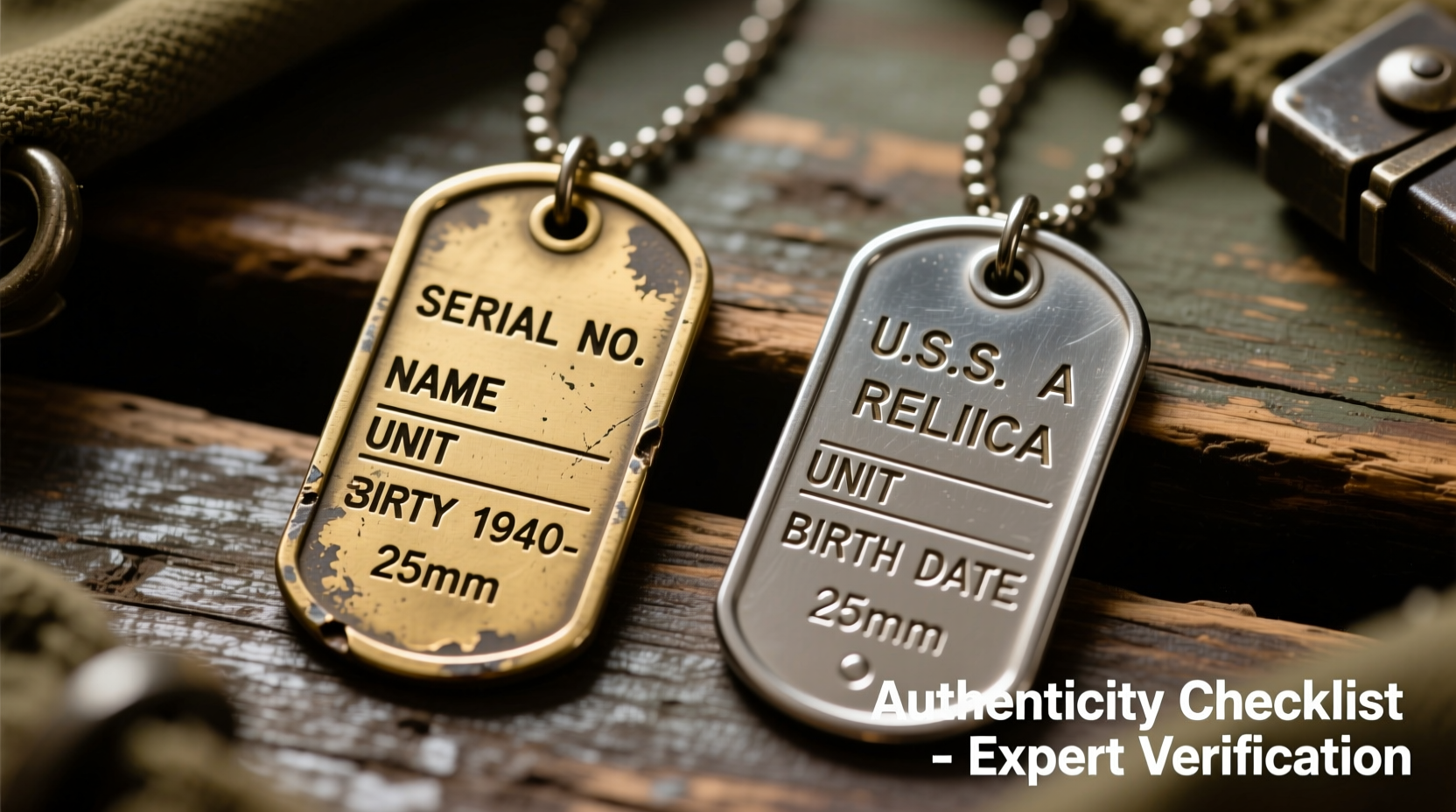
Military identification tags—commonly known as dog tags—have been used by armed forces since the American Civil War. Their primary purpose is to identify soldiers in case of injury or death. Over time, their design, material, and engraving standards have evolved in response to technological advances and changing military protocols.
The U.S. military standardized dog tag specifications during World War II, introducing stainless steel tags with specific dimensions: 1 inch wide by 2 inches long, 3/16 inch thick, with a notch at one end (used to align the impression in manual embossing machines). While modern versions have shifted slightly—especially after the Vietnam War—the core elements remain consistent across decades.
Knowing the era-specific features is crucial. For example:
- World War II tags often had the soldier’s blood type and “Tetanus” stamped on them.
- Korean and Vietnam War-era tags typically included Social Security numbers.
- Post-2000s tags may use laser engraving and include the DoD ID number instead of SSN.
“Authenticity begins with context. A tag claiming to be from WWII but engraved with a Social Security number issued in 1975 is immediately suspect.” — Colonel Robert Hayes (Ret.), Military Archivist and Historian
Physical Characteristics of Genuine Military Dog Tags
Real military dog tags follow strict manufacturing standards. Deviations often signal a replica. Here’s what to examine:
Material and Weight
Genuine WWII through Vietnam-era tags were made from corrosion-resistant stainless steel. They feel substantial—about 15–18 grams each. Replicas are often lighter, made from cheaper alloys like aluminum or nickel-plated base metals.
Size and Shape
Standard dimensions: 1\" x 2\" oval with rounded ends and a single hole at the top. A second smaller hole near the first was used for the breakable connection. The infamous \"notch\" was only present on machine-embossed tags from WWII to early Vietnam and was phased out by the 1970s.
Engraving Style
Authentic tags feature deep, hand-embossed or machine-stamped lettering. The characters are slightly raised on the reverse side due to displacement of metal. Laser-etched or chemically etched text is not period-correct for older eras. Look for consistency in font—typically a block sans-serif style with uniform depth.
Verification Checklist: How to Spot a Fake
Use this step-by-step checklist to assess any military dog tag:
- Check the material: Does it feel heavy and magnetic? Stainless steel will attract a magnet weakly.
- Measure the dimensions: Use calipers. Any deviation beyond ±1/16 inch suggests non-standard production.
- Inspect the notch: Only pre-1970s U.S. tags should have it. Its presence on a \"modern\" tag is a red flag.
- Review the information format: Match the data layout to the claimed era (e.g., WWII tags list name, service number, blood type, religion).
- Verify the font and spacing: Authentic tags have consistent character width and alignment. Inconsistent spacing indicates amateur stamping.
- Look for modern identifiers: Post-2011 tags use the EDIPI number. Pre-1975 tags should not have barcodes.
- Assess wear patterns: Real tags show uneven aging—scratches from gear, edge rounding from pocket friction—not uniform polishing.
Comparison Table: Authentic vs. Replica Dog Tags
| Feature | Authentic Tag | Replica/Fake |
|---|---|---|
| Material | Stainless steel (slightly magnetic) | Aluminum, brass, or plated base metal |
| Weight | 15–18 grams per tag | Under 12 grams |
| Engraving | Deep, embossed, raised on back | Shallow, etched, or printed |
| Notch | Present only on pre-1970s tags | Often incorrectly added to modern fakes |
| Font Consistency | Uniform depth and spacing | Inconsistent pressure, misaligned letters |
| Information Format | Era-appropriate (e.g., SSN post-1969) | Anachronistic data (e.g., SSN on WWII tag) |
Real-World Example: A Collector’s Mistake
A veteran collector once purchased a “WWII Marine Corps dog tag” online, complete with a supposed service number and blood type O+. Excited by the find, he displayed it proudly—until a museum curator pointed out the error: the blood type was listed as “O Positive,” using the full word “Positive.” Authentic WWII tags abbreviated blood types as “O+” or “B neg.” Additionally, the tag had a barcode on the back—a technology not introduced until the 2000s. Despite its convincing appearance, it was a modern reproduction sold as original.
This case underscores the importance of cross-referencing data formats with historical records. Even small linguistic details can expose a fake.
Advanced Authentication Techniques
For high-value tags or estate acquisitions, consider deeper verification methods:
- Military Records Cross-Reference: Use the National Archives (archives.gov) to verify service numbers, names, and units. While privacy laws restrict access to recent records, pre-1940s data is often public.
- Metallurgical Testing: A materials lab can analyze composition. Authentic WWII tags contain Type 304 stainless steel.
- Expert Appraisal: Organizations like the United States Militaria Collectors Association (USMCA) offer authentication services for members.
Frequently Asked Questions
Can real military dog tags be sold legally?
Yes, as long as they are not stolen property or obtained illegally. Many authentic tags were discarded, lost, or sold surplus after service. However, selling active-issue tags or those with living personnel data may violate privacy laws.
Are replacement dog tags available for veterans?
Yes. Veterans can request replacements through the Defense Logistics Agency (DLA) via Form DD-214 verification. These are official reproductions, not original issue, but are considered legitimate for commemorative purposes.
Do all countries use the same dog tag design?
No. While many NATO allies use similar formats, designs vary. German Bundeswehr tags are circular, British tags are rectangular with a serial number prefix, and Israeli tags are often aluminum with Hebrew inscriptions. Always research country-specific standards.
Final Thoughts: Honor Through Accuracy
Authenticating military dog tags isn’t just about value—it’s about respect. Each genuine tag represents a real person who served. Misidentifying a replica as original risks distorting history and dishonoring that legacy. By applying careful inspection, historical awareness, and verification tools, you ensure that every tag in your collection carries truthful significance.




 浙公网安备
33010002000092号
浙公网安备
33010002000092号 浙B2-20120091-4
Comments
No comments yet. Why don't you start the discussion?