
Self-confidence isn’t something you’re born with—it’s built through consistent action. While major achievements can provide temporary confidence boosts, real, lasting self-assurance comes from the accumulation of small, intentional choices made every day. The good news? You don’t need a dramatic transformation or external validation to feel more capable and secure in who you are. By integrating simple, sustainable practices into your routine, you can steadily strengthen your belief in yourself.
These daily actions work because they reinforce competence, improve self-awareness, and shift your internal narrative from doubt to trust. Over time, these micro-habits rewire your brain to expect success rather than fear failure. Whether you're navigating career challenges, social anxiety, or personal goals, confidence cultivated through consistency is both resilient and authentic.
Start Your Day with Purposeful Self-Talk
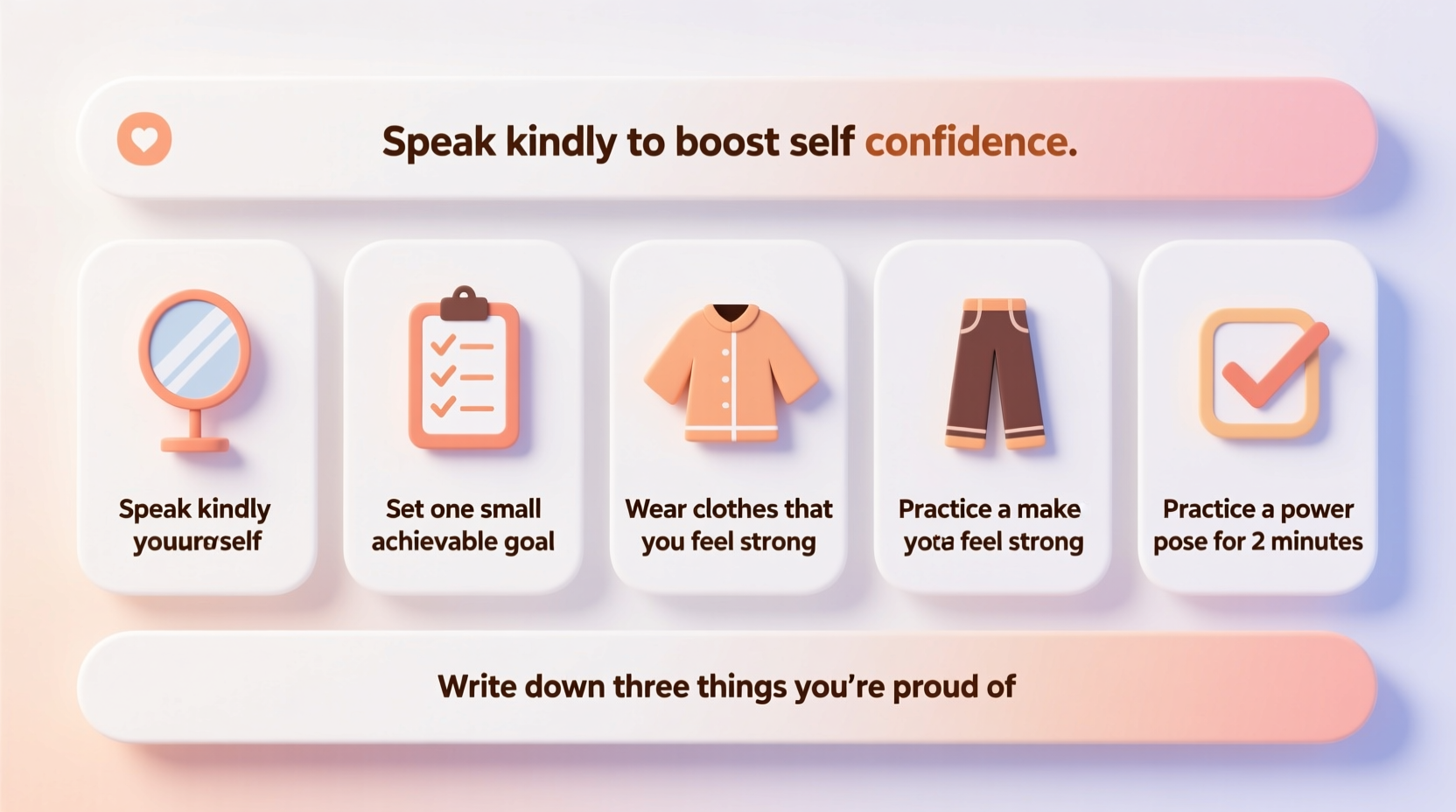
The way you speak to yourself shapes how you see yourself. Most people begin their mornings with thoughts like “I’m not ready,” “I’ll mess this up,” or “I wish I were more like them.” These unconscious scripts erode confidence before the day even begins. Replacing negative self-talk with constructive, affirming language doesn’t require grand declarations—it starts with noticing and redirecting your inner dialogue.
Instead of saying, “I can’t handle this meeting,” try, “I’ve prepared well, and I’ll do my best.” Rather than thinking, “No one will listen to me,” shift to, “My perspective matters, and I have something valuable to contribute.” This isn’t about forced positivity; it’s about fairness. Would you speak to a friend the way you sometimes speak to yourself?
Research shows that self-affirmation activates brain regions associated with self-processing and reward, making it easier to approach challenges with calm and clarity. The key is repetition. Confidence grows when your mind hears evidence—over and over—that you are competent and worthy.
Take Action Before You Feel Ready
Waiting to feel confident before taking action is a trap. Confidence follows behavior, not the other way around. Every time you act despite doubt, you send a message to your brain: “I am someone who shows up.” That single sentence changes everything.
Consider the last time you gave a presentation, started a difficult conversation, or applied for a job you weren’t sure you’d get. Chances are, you didn’t feel fully confident going in—but afterward, you felt more capable. That’s because action builds evidence, and evidence builds confidence.
“We don’t become brave by feeling safe. We become brave by doing brave things—even when we’re afraid.” — Dr. Sarah Lin, Cognitive Behavioral Psychologist
You don’t need to overhaul your life overnight. Start small: speak up in a meeting, send that email you’ve been avoiding, or introduce yourself to someone new. Each act proves to yourself that you can handle discomfort—and survive it. Over time, those moments accumulate into an unshakable sense of self-trust.
A 7-Day Action Challenge
- Day 1: Make one decision without second-guessing (e.g., what to eat, what to wear).
- Day 2: Ask a question in a group setting.
- Day 3: Compliment someone sincerely.
- Day 4: Share an opinion, even if it differs from others’.
- Day 5: Say “no” to a request that doesn’t align with your priorities.
- Day 6: Do something slightly outside your comfort zone (e.g., try a new route, join a short online class).
- Day 7: Reflect on your progress and acknowledge your courage.
This challenge works because it focuses on behavior, not feelings. By the end of the week, you’ll have collected seven pieces of evidence that you are capable, assertive, and resilient—regardless of how you initially felt.
Maintain Confident Body Language—Even When You Don’t Feel It
Your posture, eye contact, and gestures influence how others perceive you—and, more importantly, how you perceive yourself. Studies in embodied cognition show that physical expressions of confidence can actually generate the internal feeling of confidence, even when it wasn’t there before.
Standing tall, keeping your shoulders back, and making steady eye contact aren’t just signals to others—they’re signals to your own nervous system. They tell your brain, “I belong here. I am safe. I am in control.”
| Confident Behavior | Impact on Mindset | How to Practice Daily |
|---|---|---|
| Upright posture | Increases testosterone, reduces cortisol (stress hormone) | Check posture every hour; adjust while sitting or walking |
| Sustained eye contact | Builds trust and presence in conversations | Hold gaze for 3–5 seconds during interactions |
| Open gestures (uncrossed arms) | Encourages openness and reduces defensiveness | Consciously relax arms during meetings or social chats |
| Speaking at a moderate pace | Signals composure and clarity | Pause before responding; avoid rushing words |
You don’t need to perform confidence perfectly. Just practice it deliberately for a few minutes each day. Stand in a power pose for two minutes before a stressful event. Walk into a room like you belong there—even if your heart is racing. Over time, your body will teach your mind what confidence feels like, and eventually, it will start to believe it.
Track Small Wins Relentlessly
Most people overlook their progress because they only notice big milestones. But confidence thrives on recognition of effort and incremental growth. When you fail to acknowledge your wins, your brain defaults to focusing on what went wrong.
Create a “Win Log”—a notebook or digital document where you record at least one accomplishment each day. It doesn’t matter how small:
- “Spoke up in a team call.”
- “Finished a task I’d been procrastinating on.”
- “Handled a difficult situation calmly.”
- “Took a break when I needed it instead of pushing through exhaustion.”
Reviewing this log weekly reinforces a powerful identity: “I am someone who takes action and makes progress.” This shifts your self-concept from “I’m not confident” to “I’m becoming more confident every day.”
Mini Case Study: From Hesitation to Leadership
Maya, a junior project coordinator, often stayed quiet in meetings, convinced her ideas weren’t valuable. She began tracking small wins: “Shared a suggestion in Slack,” “Asked for clarification without apologizing,” “Volunteered to lead a 15-minute agenda item.”
After four weeks, she reviewed her log and realized she had contributed in 12 different ways. That evidence shifted her mindset. She started preparing talking points before meetings and volunteered to present a monthly update. Within three months, her manager noted her increased presence and promoted her to team lead.
Maya didn’t wait for confidence to arrive. She built it—one tiny action at a time.
Surround Yourself with Confidence-Boosting Influences
Confidence isn’t developed in isolation. The people you spend time with, the media you consume, and the environments you inhabit either lift you up or drain you. If your daily inputs constantly highlight perfection, comparison, or criticism, your self-worth will suffer—even if you’re unaware of it.
Be intentional about your influences:
- Follow social media accounts that inspire growth, not envy.
- Limited time with chronically negative or dismissive people.
- Seek out mentors or peers who model quiet confidence—not arrogance.
- Listen to podcasts or read books that normalize struggle and resilience.
“Confidence is contagious. Spend enough time around people who believe in themselves, and you’ll start believing in yourself too.” — James Reed, Executive Coach and Author of *The Clarity Principle*
You don’t need to cut people out of your life dramatically. Simply adjust your exposure. Mute accounts that make you feel inadequate. Schedule regular coffee chats with someone who encourages you. Curate your world to reflect the kind of person you’re becoming.
Do’s and Don’ts of Social Influence
| Do | Don’t |
|---|---|
| Engage with content that celebrates progress over perfection | Compare your behind-the-scenes to someone else’s highlight reel |
| Ask trusted friends for honest feedback | Seek validation from people who undermine your efforts |
| Attend events or groups aligned with your growth goals | Stay in environments where you consistently feel small |
Frequently Asked Questions
Can confidence really be built through small actions?
Yes. Neuroplasticity—the brain’s ability to reorganize itself—means that repeated behaviors create new neural pathways. Small, consistent actions rewire your brain to associate yourself with competence and courage. Over time, these behaviors become automatic, and confidence becomes your default state.
What if I try these actions and still don’t feel confident?
Feelings follow action, but they may lag behind. Trust the process. Focus on completing the behavior, not the emotional response. Many people report feeling little change at first, then notice a shift after 3–4 weeks. Keep track of your actions—you’ll see progress even when you don’t feel it yet.
How long does it take to see results?
Most people notice subtle changes within two to three weeks of consistent practice. Significant shifts typically occur within 6–8 weeks. Like building muscle, confidence requires repetition and patience. The key is consistency, not intensity.
Simple Daily Confidence Checklist
To help you integrate these strategies, here’s a practical checklist you can use every day:
- Write 3 positive self-statements upon waking
- Perform one small act of courage (speak up, send a message, etc.)
- Practice confident body language for 5+ minutes
- Log at least one win, no matter how minor
- Limit exposure to negative or comparison-driven content
Use this list as a foundation. After a month, review what’s working and adjust accordingly. The goal isn’t perfection—it’s progress.
Conclusion: Confidence Is a Practice, Not a Prize
Confidence isn’t reserved for the naturally gifted, the extroverted, or the fearless. It’s available to anyone willing to show up consistently, act with intention, and recognize their own growth. The smallest daily actions—choosing kind self-talk, standing tall, speaking up once, logging a win—are the bricks that build unshakeable self-belief.
You don’t need permission to feel confident. You earn it through action. Start today. Pick one habit from this article and commit to it for the next seven days. Notice what happens when you stop waiting and start doing. Over time, you won’t just feel more confident—you’ll be more confident, simply because you’ve proven to yourself, again and again, that you can.




 浙公网安备
33010002000092号
浙公网安备
33010002000092号 浙B2-20120091-4
Comments
No comments yet. Why don't you start the discussion?