
A Christmas light tunnel transforms a simple front-yard walkway into an immersive holiday experience—inviting neighbors, delighting children, and creating photo-worthy moments that last through the season. Unlike static wreaths or inflatable figures, a well-built light tunnel offers depth, motion, and dimension. Yet many DIYers abandon the idea after encountering sagging frames, tangled wires, or safety concerns. This guide distills field-tested methods used by professional display builders and municipal lighting coordinators into a practical, scalable blueprint. It covers structural integrity, electrical safety, weather resilience, and aesthetic balance—not just “how to hang lights,” but how to engineer joy that withstands wind, rain, and repeated seasonal use.
Why Structural Integrity Matters More Than Light Count
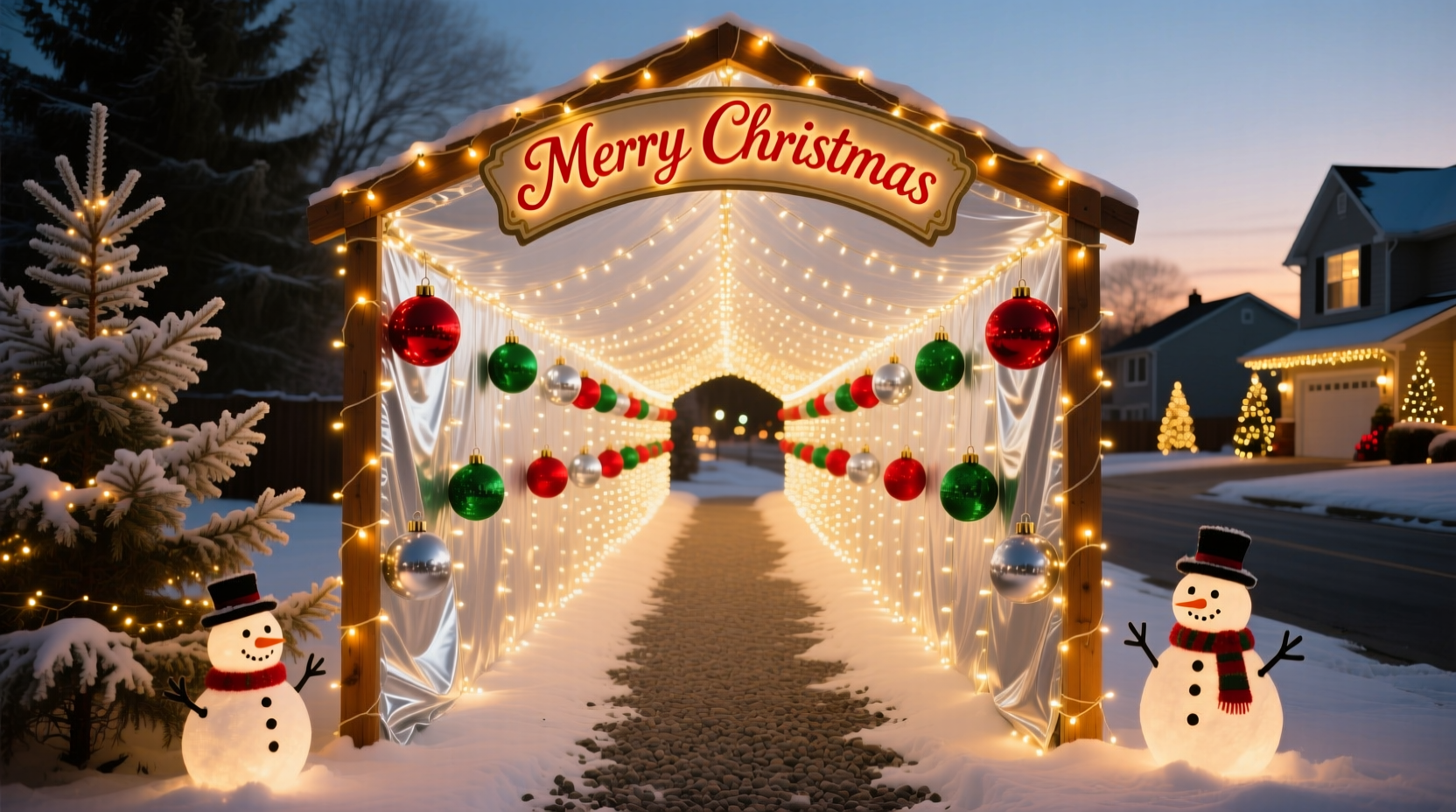
A light tunnel’s magic lies in its form: a gently arched canopy of illumination that guides visitors from sidewalk to porch. But without proper framing, even premium LED strings will droop, tangle, or detach mid-season. The frame isn’t scaffolding—it’s the skeleton of the experience. Most failures stem not from poor lights, but from under-engineered supports. PVC pipe is popular for its affordability and flexibility, yet standard ¾-inch Schedule 40 PVC lacks lateral rigidity in spans over 6 feet. In winds exceeding 25 mph—which occur routinely in November and December across much of the U.S.—unbraced PVC arches flex visibly, causing lights to slide downward or snap off connectors.
Professional installers use one of two proven approaches: hybrid steel-reinforced PVC or galvanized EMT conduit. EMT (Electrical Metallic Tubing) is lightweight, rust-resistant, and bends smoothly with a hand bender. Its 1¼-inch diameter provides 3.2× the torsional strength of ¾-inch PVC at the same span length. Crucially, EMT accepts standard electrical hangers and zip-tie mounting brackets without drilling or adhesive—preserving material integrity year after year.
Step-by-Step Build Timeline (6–8 Hours Total)
- Day 1, Morning (1.5 hrs): Measure your walkway width and desired tunnel height (minimum 7 ft clearance). Mark centerline and arch spacing (every 36–42 inches for stability).
- Day 1, Afternoon (2 hrs): Cut and bend frame components. For a 5-ft-wide tunnel, use five 1¼-inch EMT pieces bent to 72-inch radius arcs (height at peak: 96 inches). Pre-drill mounting holes at base and apex.
- Day 2, Morning (1.5 hrs): Install anchors and secure arches. Use adjustable turnbuckles between adjacent arches at mid-height to prevent sway.
- Day 2, Afternoon (2 hrs): String lights using the “spiral-wrap” method: begin at one base, wrap upward in consistent 6-inch vertical intervals, then reverse direction on the descent. Secure every 3rd wrap with UV-rated nylon zip ties (not plastic).
- Final Check (30 mins): Test all circuits with a GFCI outlet tester; verify no bare wire exposure; confirm ground-fault protection on all extension cords.
Electrical Safety & Circuit Management
Overloading circuits remains the top cause of outdoor light failures—and fire hazards. A typical 15-amp residential circuit supports only 1,440 watts at 80% continuous load. Each 100-light LED string draws 4.8–6.5 watts. That means a single circuit can safely power 220–300 lights. But tunnels require layered lighting: outline arches, fill interior planes, and often add ground-level accent strings. Exceeding capacity causes voltage drop—dimming lights at the end of long runs—and overheating at outlets and splices.
The solution isn’t more outlets—it’s intelligent segmentation. Divide your tunnel into three independent zones: left arch face, right arch face, and floor-to-peak fill. Power each via separate GFCI-protected outlets on different household circuits. Use heavy-duty 12-gauge extension cords rated for outdoor use (look for “W-A” or “SJTW” designation), never daisy-chained. For runs over 50 feet, upgrade to 10-gauge to minimize voltage loss. Always plug cords into outlets—not power strips—outdoors.
| Component | Recommended Spec | Why It Matters |
|---|---|---|
| Light Strings | UL-listed, end-to-end connectable (max 210 ft per run) | Non-UL lights lack temperature-rated insulation and fail unpredictably in cold/wet conditions. |
| Extension Cords | 12-gauge, SJTW-rated, 25 ft max per cord | Thicker gauge prevents overheating; SJTW indicates oil- and weather-resistance. |
| Controllers | Wi-Fi-enabled, 3-channel (for independent zone timing) | Enables staggered fade-ins, motion-triggered sequences, and remote troubleshooting. |
| Grounding | 10-ft copper-clad ground rod + 6 AWG bare copper wire | Required by NEC Article 250 for all permanent outdoor displays; prevents shock hazard during storms. |
Real-World Case Study: The Oakwood Avenue Tunnel (2023 Season)
In suburban Cincinnati, homeowner Marcus T. built a 24-foot-long tunnel spanning his 6-foot-wide brick walkway. His first attempt—using ¾-inch PVC and bargain-bin lights—lasted 11 days before high winds collapsed two arches and severed 17 connections. For the 2023 rebuild, he consulted local electricians and adopted EMT framing with reinforced concrete footings set 18 inches deep. He installed a dedicated 20-amp GFCI circuit routed from his garage panel, eliminating reliance on porch outlets. Lights were grouped by color temperature (2700K warm white for arches, 4000K cool white for interior fill) and programmed to pulse gently at 3-second intervals using a LOR S3 controller. The result? Zero failures across 47 days of operation—including three ice storms and sustained 32 mph gusts. Neighbors reported increased foot traffic; the city featured it in its “Holiday Lights Tour” brochure.
“Most DIY tunnels fail not from poor design—but from treating them as temporary decor. They’re semi-permanent structures. Treat the frame like a fence post and the wiring like home circuitry.” — Derek Lin, Lead Installer, Lumina Displays (12+ years commercial holiday lighting)
Do’s and Don’ts: Critical Installation Practices
- DO use stainless-steel hose clamps (not zip ties alone) to secure arch bases to ground stakes—prevents rotational slippage in freeze-thaw cycles.
- DO space light strings 4–6 inches apart vertically along arches to avoid “hot spots” and ensure even luminance.
- DO install a manual cutoff switch within 3 feet of your main GFCI outlet—required by NFPA 70E for rapid de-energization during maintenance.
- DON’T bury extension cords directly in soil—even rated ones degrade from moisture and root pressure. Use rigid PVC conduit buried 18 inches deep for permanent runs.
- DON’T mix incandescent and LED strings on the same circuit. Their differing resistive loads cause erratic dimming and premature controller failure.
- DON’T rely on adhesive hooks or suction cups for arch-to-ground connections. Temperature swings above 40°F or below 20°F compromise bond integrity instantly.
Frequently Asked Questions
How do I prevent snow accumulation from collapsing the tunnel?
Snow load is manageable with proper slope and material choice. Maintain a minimum 15° pitch on arches (achieved by setting rear stakes 4 inches lower than front stakes). Use smooth-surface EMT instead of textured PVC—snow slides off polished metal faster. For regions averaging >12 inches of snowfall, add a third horizontal support beam at 60% height to break up surface area and reduce drift buildup.
Can I leave the tunnel up year-round?
Not recommended. UV exposure degrades PVC and silicone wire jackets within 6–8 months. Even UV-stabilized EMT coatings fade, reducing corrosion resistance. LEDs themselves last 25,000+ hours, but outdoor-rated controllers and transformers typically carry only 2–3 year warranties. Dismantle within 10 days of New Year’s Day, clean all components with diluted vinegar solution, and store frames horizontally in a dry garage—never stacked vertically, which induces permanent bowing.
What’s the most cost-effective way to achieve a “twinkling” effect?
Avoid expensive proprietary controllers. Instead, use programmable LED strings with built-in memory chips (e.g., Twinkly or NOMA Smart). These self-contain sequencing logic and sync via Bluetooth—no hub required. For under $120, you can outfit a 20-ft tunnel with three independent 100-light strands, each running unique animations (chase, fade, sparkle) simultaneously. The effect reads as professional-grade without complex wiring.
Conclusion: Build Once, Illuminate for Years
A Christmas light tunnel isn’t about spectacle alone—it’s about intentionality. Every arch bent, every wire secured, every circuit verified reflects care for your home, your community, and the quiet joy of shared light in winter’s longest nights. You don’t need a contractor’s license or a warehouse of gear. You need precision in measurement, respect for electrical codes, and patience with assembly. Start small: build a 10-foot version this year. Document your process. Note where tension was uneven, where connections loosened, where brightness faltered. Next season, refine—not replace. That’s how backyard displays evolve into neighborhood landmarks. Your tunnel won’t just glow. It will anchor tradition. It will welcome strangers like family. And when January arrives, you’ll pack away more than lights—you’ll store confidence, competence, and the quiet pride of having built something beautiful, by hand, for others to walk through and remember.




 浙公网安备
33010002000092号
浙公网安备
33010002000092号 浙B2-20120091-4
Comments
No comments yet. Why don't you start the discussion?