
In an age where clutter competes with calm, many are redefining holiday decor through simplicity. The minimalist Christmas tree—stripped of tinsel, baubles, and figurines—relies entirely on light to create atmosphere, depth, and warmth. This approach isn’t about what’s missing; it’s about what remains: pure ambiance, architectural form, and intentional design. By focusing solely on lighting, you transform the tree into a sculptural centerpiece that glows with quiet elegance. Whether your style leans Scandinavian, industrial, or contemporary, a light-only tree can anchor your space with sophistication and serenity.
The Philosophy Behind a Minimalist Light-Only Tree
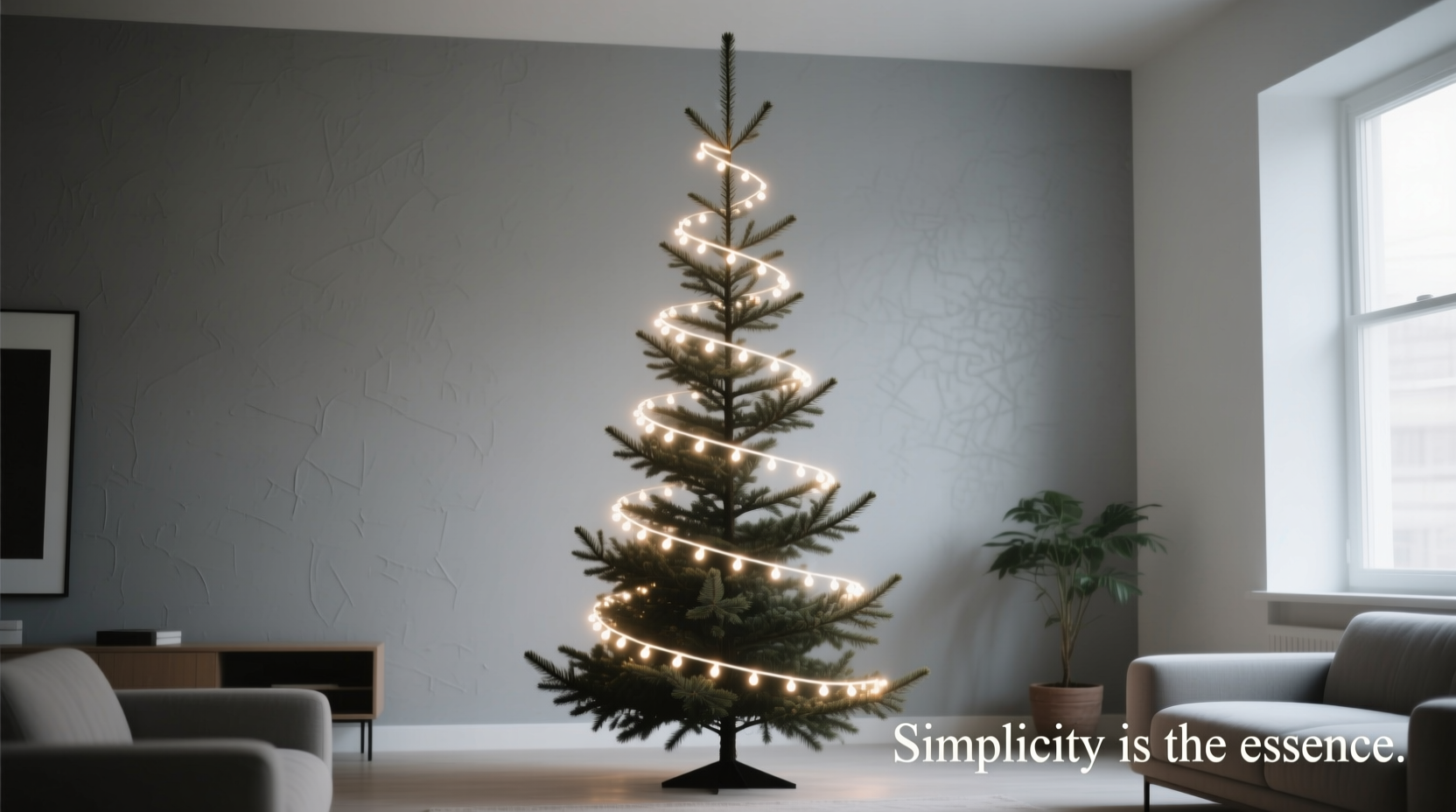
Minimalism in holiday decor is not austerity—it’s refinement. It’s choosing fewer elements with greater intention. A tree adorned only with lights removes visual noise, allowing the natural shape of the tree and the quality of illumination to take center stage. This method emphasizes contrast, shadow, and rhythm over ornamentation. The result is a calming presence that complements modern interiors without overwhelming them.
Designers like Tadao Ando and John Pawson have long championed the emotional power of light in empty spaces. In the same way, a minimalist Christmas tree uses strategic lighting to evoke warmth and celebration without physical excess. It’s especially effective in small apartments, open-plan living areas, or homes where traditional decorations feel too heavy or chaotic.
“Light is the most powerful decorative element we have. When used with restraint, it creates emotion without clutter.” — Clara Nguyen, Interior Designer & Author of *Stillness in Design*
Choosing the Right Tree Structure
The foundation of a successful light-only tree is its form. Since there are no ornaments to distract or add volume, the silhouette becomes critical. You want a tree with clean lines, balanced proportions, and enough density to support even light distribution.
Fir, spruce, and certain artificial trees with tiered branching patterns work best. Look for species or models with symmetrical layering—this allows lights to cascade in rhythmic patterns rather than appearing random or sparse. For a truly minimalist aesthetic, consider a potted Norfolk Island pine or a slim-profile artificial tree in matte green or white.
Avoid overly bushy or irregular trees, as they can cause shadows and uneven glow. If using an artificial tree, ensure branch tips are flexible enough to allow precise light placement but rigid enough to hold their position once arranged.
Step-by-Step Guide to Stringing Lights with Purpose
Lights are no longer just accents—they are the entire decoration. How you place them determines whether the tree feels dynamic or dull. Follow this sequence for professional-level results:
- Select the right type of lights. Use warm white LED string lights (2700K–3000K color temperature) for a soft, inviting glow. Avoid cool white or multicolor unless intentionally part of a monochromatic scheme.
- Determine light count. As a rule of thumb, use 100 lights per foot of tree height. A 6-foot tree needs approximately 600 bulbs. Higher density ensures continuity and eliminates dark zones.
- Begin at the base. Start wrapping from the bottom third of the trunk, securing the plug near the stand for easy access. This prevents dangling cords later.
- Work inward, not just outward. Instead of draping lights only along outer branches, gently guide strands deep into the core. This creates depth and prevents a hollow appearance when viewed from the side.
- Follow a spiral path upward. Move in a clockwise or counterclockwise spiral, maintaining consistent spacing (about 4–6 inches between wraps). Use twist ties or clear clips to secure strands to inner branches—never staple or pinch wires.
- Layer multiple strands. For richer illumination, use two sets of lights: one tightly wrapped for structure, another loosely draped for texture. Slight variation in bulb size (e.g., mini + fairy lights) adds dimension.
- Test incrementally. Plug in each strand as you go to catch dead bulbs or connection issues early.
Resist the urge to cover every inch. Strategic negative space lets the light breathe and enhances perception of glow. Think of it like shading in drawing—the contrast defines the form.
Types of Lights and Their Effects
Not all lights serve the same purpose. Understanding their characteristics helps you craft the desired mood.
| Light Type | Best For | Avoid If |
|---|---|---|
| Warm White LEDs (Fairy Lights) | Soft ambient glow, intimate settings | You need high visibility or bright sparkle |
| Candle-Flicker Bulbs | Mimicking real flames, romantic atmosphere | Seeking uniform brightness or modern precision |
| Twinkle Mode (Slow Pulse) | Adding subtle movement without distraction | Preferring stillness or cinematic minimalism |
| Clear Incandescent Mini Lights | Vintage warmth, classic glow | Concerned about heat or energy efficiency |
| Net Lights (Front-Facing Only) | Flat wall trees or dense coverage | Using a full 3D tree needing depth |
For a true minimalist effect, stick to one mode—steady-on or slow-pulse—and avoid flashing, chasing, or rainbow sequences. These disrupt the meditative quality central to minimalism.
Real Example: A Brooklyn Loft Transformation
In a converted warehouse loft in Williamsburg, designer Maya Lin replaced her family’s traditional ornament-heavy tree with a 7-foot Fraser fir lit exclusively with 700 warm white micro LEDs. She used two layers: 500 tightly spiraled for structure, and 200 randomly threaded deeper into the canopy to simulate internal radiance.
“I wanted the tree to feel like it was growing from within,” she explained. “No distractions. Just light emerging from darkness.” She placed the tree against a raw brick wall with no skirt, stand, or surrounding gifts—only a black metal planter holding the trunk. The effect drew guests closer, not because it was flashy, but because it felt intentional.
After the holidays, she saved all materials in a labeled bin: lights wound on a cardboard spool, planter cleaned and stored. Total setup time next year? Under 45 minutes.
Essential Tips for Longevity and Safety
A minimalist tree may look effortless, but it requires careful planning—especially regarding electrical safety and maintenance.
- Always use UL-listed lights rated for indoor use.
- Never overload outlets; use a surge-protected power strip.
- Check each strand for frayed wires or broken sockets before installation.
- If using a real tree, water daily to reduce fire risk—even with LED lights.
- Unplug lights when leaving the house or sleeping.
Checklist: Building Your Minimalist Light-Only Tree
Follow this concise action list to ensure success:
- Choose a tree with strong symmetry and moderate density
- Calculate needed lights (100 bulbs per foot of height)
- Select warm white, steady-on or slow-pulse LEDs
- Prepare tools: twist ties, cord clips, spare bulbs, ladder
- Start wiring from the base, working upward in a spiral
- Layer lights for depth—some surface, some internal
- Test each strand during installation
- Position tree where it can be seen from key viewpoints
- Use a timer (6–8 hours per night) for consistency and safety
- Store lights properly after the season for reuse
FAQ
Can I use colored lights and still keep it minimalist?
Yes, but sparingly. A single hue—such as amber, soft blue, or rose—can work if used uniformly and paired with a neutral environment. However, true minimalism favors monochrome schemes. White or warm white maintains clarity and avoids sensory competition.
Won’t a tree with only lights look bare or incomplete?
It depends on context. In a busy room, it might seem underdone. But in a thoughtfully composed space—with muted walls, simple furniture, and intentional lighting—it reads as deliberate and refined. Perception shifts when viewers understand that the absence of ornaments is the design.
How do I make the tree festive without ornaments?
Festivity comes from atmosphere, not objects. Pair the tree with ambient music, candlelight nearby (battery-operated for safety), and seasonal scents like pine or vanilla. The experience matters more than visual saturation.
Final Thoughts: Less Is More, Especially at Christmas
A minimalist Christmas tree built with only lights challenges the notion that holidays must be loud, bright, and crowded with symbols. Instead, it invites pause, reflection, and presence. It proves that beauty often resides in reduction—not in adding more, but in revealing what already exists beneath the surface.
This holiday season, consider letting light speak for itself. Choose one tree, one tone, one moment of stillness. Build something that doesn’t shout, but glows. In doing so, you may find that simplicity doesn’t diminish celebration—it deepens it.




 浙公网安备
33010002000092号
浙公网安备
33010002000092号 浙B2-20120091-4
Comments
No comments yet. Why don't you start the discussion?