
Minimalism at Christmas isn’t about scarcity—it’s about intentionality. It’s choosing presence over pressure, meaning over mass, and quiet elegance over visual noise. In a season saturated with glitter, blinking lights, and endless “must-have” decor, a 10-ornament tree stands as a quiet act of resistance—and a profound invitation to reconnect with what matters. This approach doesn’t require expensive heirlooms or designer pieces. It asks only for clarity of purpose, thoughtful curation, and respect for negative space. Done well, a ten-ornament tree feels generous, grounded, and deeply personal—not sparse, not bare, but *full* in its restraint.
The Philosophy Behind Ten: Why Fewer Ornaments Deepen the Experience
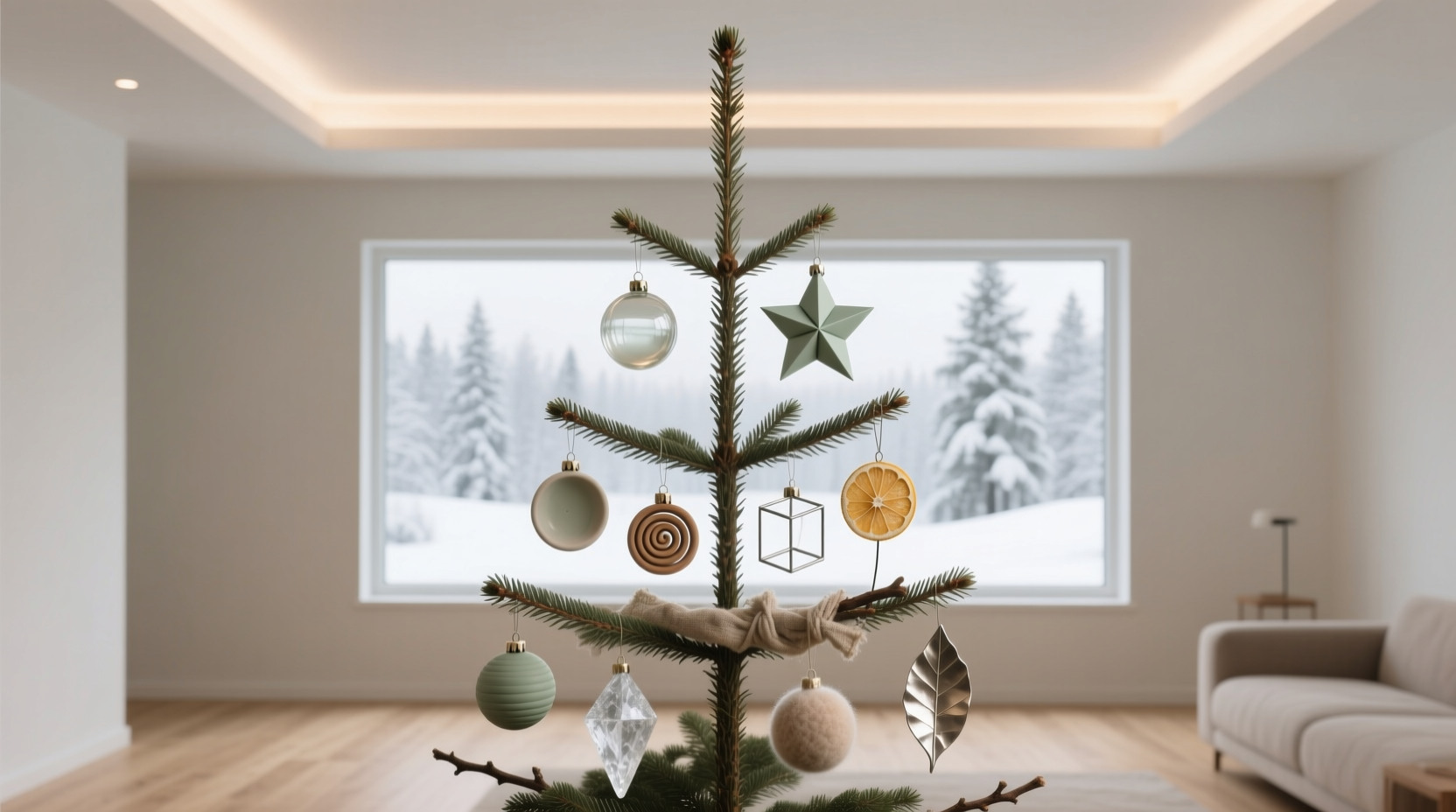
Most households hang between 30 and 100 ornaments—a number that often reflects habit, social expectation, or the accumulation of years rather than conscious choice. Research in environmental psychology shows that visual clutter increases cognitive load and elevates stress hormones like cortisol. During December, when schedules tighten and emotional bandwidth narrows, a tree that demands less mental processing becomes a sanctuary—not a decoration. Ten ornaments is not arbitrary: it’s a threshold where each piece can be seen, remembered, and appreciated without competition. It’s enough to suggest rhythm and balance, yet few enough to invite pause and recognition.
This practice also reshapes our relationship with tradition. Instead of repeating inherited patterns—“We always put the angel on top, then the red balls, then the candy canes”—a 10-ornament tree invites you to ask: What do I want this tree to say this year? Is it gratitude? Resilience? A tribute to someone lost? A celebration of new beginnings? The constraint of ten forces specificity—and specificity cultivates authenticity.
The Ten-Ornament Framework: A Balanced Composition System
A successful minimalist tree relies on composition—not just count. Think of the tree as a living canvas: height, depth, density, and contrast matter more than symmetry. The ten-ornament framework distributes pieces across five functional zones to create visual harmony and dimensional interest. This isn’t rigid—it’s architectural scaffolding for intuition.
| Zone | Number of Ornaments | Purpose & Placement Guidance |
|---|---|---|
| Anchor (Top) | 1 | A single, meaningful topper—e.g., a hand-thrown ceramic star, a woven wool motif, or a vintage brass crescent. Must sit cleanly at the apex without drooping or obscuring branch structure. |
| Rhythm (Vertical Axis) | 3 | Placed along the central trunk line—at approximately ⅓, ½, and ⅔ height. These establish vertical cadence. Use similar materials (e.g., matte wood, raw linen-wrapped spheres) but vary subtle details: grain direction, knot placement, or natural imperfections. |
| Counterpoint (Asymmetrical Balance) | 2 | Positioned deliberately off-center—one slightly lower left, one higher right—to introduce gentle tension and organic flow. Avoid mirroring. These should contrast the rhythm ornaments in material or scale (e.g., a smooth black stone beside a knotted jute sphere). |
| Depth (Interior Layer) | 2 | Tucked deep into the tree’s inner branches—not visible head-on, but revealed from side angles. These add mystery and dimension. Ideal candidates: matte glass baubles in deep forest green or charcoal, or small dried citrus slices sealed with beeswax. |
| Gesture (Grounding Element) | 2 | Placed low—within the bottom 12 inches—but not on the stand. One near the front left base, one toward the back right. These “anchor” the eye downward, preventing the tree from feeling top-heavy. Consider natural elements: river-smoothed stones wrapped in copper wire, or miniature pinecones dipped in matte white clay slip. |
This distribution creates asymmetry with equilibrium—a hallmark of mature minimalism. It avoids the sterility of perfect symmetry while rejecting chaotic randomness. Each zone serves a distinct visual function, ensuring the tree reads as intentional, even from across the room.
Curating Your Ten: Selection Criteria That Matter More Than Aesthetics
Selecting ten ornaments isn’t about shopping—it’s about editing. Begin by gathering everything you own that could conceivably belong on a tree: heirlooms, handmade pieces, nature finds, thrifted curiosities. Then apply these non-negotiable filters—each designed to elevate meaning and cohesion.
- Material Integrity: Every piece must be made from natural, tactile, or time-honored materials—wood, stone, wool, unglazed ceramic, raw brass, dried botanicals, or hand-blown glass. Avoid plastic, synthetic glitter, or anything with a “new” chemical smell. Minimalism honors substance over surface.
- Emotional Resonance: Each ornament must carry a clear, quiet story—either personal (“This was carved by my grandfather the year I was born”) or universal (“This pinecone fell from the old oak behind our first home”). If you can’t articulate its resonance in one sentence, it doesn’t make the cut.
- Color Discipline: Choose one dominant hue (e.g., charcoal), one secondary (e.g., oatmeal), and one accent (e.g., iron oxide red)—all drawn from nature’s palette. No neon, no metallics unless they’re unlacquered brass or aged copper. Test your palette by laying all ten on a white sheet: if any piece “jumps out” discordantly, replace it.
- Scale Variation: Include at least three distinct sizes—small (under 2”), medium (2.5”–3.5”), and large (4”–5”). But avoid extremes: nothing smaller than a walnut or larger than a grapefruit. Scale diversity creates visual rhythm without hierarchy.
- Textural Dialogue: Ensure at least four contrasting textures: smooth (stone), nubby (wool), porous (unglazed clay), and fibrous (dried reed or raffia). Texture carries weight in minimal compositions—more than color or shape.
“True minimalism isn’t subtraction—it’s distillation. You don’t remove meaning; you concentrate it until it glows.” — Lena Voss, Designer and Author of Quiet Objects: Meaning in Material Restraint
A Real Example: How Maya Built Her Ten-Ornament Tree After Loss
Maya, a graphic designer and mother of two, spent her first Christmas after her father’s passing surrounded by his collection of 87 ornaments—many fragile, many sentimental, all emotionally overwhelming. The sheer volume felt like grief made visible: dense, suffocating, impossible to navigate. She decided to build a new tradition—not to erase memory, but to honor its essence.
She began by photographing every ornament, then wrote one sentence beside each describing its origin or feeling. From those notes, ten emerged organically: her father’s pocket watch (re-purposed as a hanging piece, face inward), a ceramic dove he’d painted for her wedding, three river stones collected on family hikes, two hand-stitched linen stars made by her daughters, a single preserved magnolia leaf pressed in beeswax, and a small brass bell he’d rung each Christmas Eve. She chose matte charcoal and warm oat tones—colors found in the wool blanket he always kept draped over his armchair.
The result wasn’t “less” Christmas—it was Christmas clarified. Her children now touch the watch and talk about Grandpa’s steady hands. They place the magnolia leaf low on the tree and remember how he’d point out seasonal shifts from their porch swing. The ten pieces hold space for absence and presence simultaneously. As Maya told me: “Before, I felt like I was guarding memories. Now, I’m tending them.”
Your Step-by-Step Build Timeline (60 Minutes Total)
Set aside one focused hour. No multitasking. Play quiet instrumental music or silence—whatever supports presence.
- Prep (10 min): Fluff your tree branches outward and upward. Remove all existing ornaments, lights, and garlands. Wipe dust from branches with a dry microfiber cloth. Plug in lights—but use warm-white, non-blinking LEDs only. Drape evenly, focusing on inner branches first to create ambient glow—not outline.
- Curate & Arrange (20 min): Lay your ten ornaments on a clean surface in order of placement: Top → Rhythm (3) → Counterpoint (2) → Depth (2) → Gesture (2). Hold each in your hand. Does it feel substantial? Does its story still resonate? If doubt lingers, set it aside and choose another. This is your final edit.
- Anchor & Rhythm (10 min): Place the topper first—centered, secure. Then place the three rhythm ornaments along the central axis, stepping back after each to assess vertical flow. Adjust spacing until it feels like breathing—not mechanical, but organic.
- Add Counterpoint & Depth (10 min): Place the two counterpoint ornaments deliberately off-axis—don’t rush. Walk around the tree. Does one side feel heavier? Shift gently. Then tuck the two depth ornaments deep into interior branches where light catches them subtly from the side—not head-on.
- Ground & Refine (10 min): Place the two gesture ornaments low, near the base. Stand back 6 feet. Squint. Does the tree feel anchored? Does light move through it—or stop at the surface? Make no more than three adjustments. Then walk away for five minutes. Return. If it still feels calm, complete, and quietly joyful—you’re done.
Frequently Asked Questions
Can I use lights with a 10-ornament tree—and how many?
Absolutely—and lights are essential. Use 100–150 warm-white LED mini-lights for a standard 6–7 ft tree. String them densely on inner branches first to create a soft, luminous core, then lightly wrap outer tips. The lights become the “atmosphere”; the ten ornaments are the “characters.” Never use multicolor or blinking lights—they fracture focus and undermine minimalism’s calm.
What if I have more than ten meaningful ornaments?
Rotate them seasonally. Create a “meaning archive”: photograph each, note its story and year, and store carefully in acid-free boxes. Select ten fresh ones each December based on your current life chapter. Last year’s ten remain honored—but this year’s speak to where you are now. This practice turns accumulation into evolution.
Do I need a specific tree type for this to work?
No—but real trees enhance the effect. Their irregular branching, subtle scent, and organic texture support the philosophy. If using artificial, choose one with varied tip density (not uniform PVC) and muted green tones—not bright emerald. Avoid frosted or snow-dusted varieties; they compete with ornament texture. A slim profile (e.g., Nordmann fir or Fraser pine silhouette) also reinforces vertical rhythm.
Conclusion: Your Tree Is Not Decor—It’s a Declaration
A 10-ornament Christmas tree is never really about the ornaments. It’s about the space you leave open—for breath, for memory, for quiet conversation, for the unspoken love that gathers in rooms when visual noise recedes. It’s about trusting that meaning doesn’t require volume, that beauty thrives in restraint, and that joy can be concentrated—not diluted—by limitation. You don’t build this tree to impress. You build it to remember your own capacity for discernment, for slowness, for choosing what nourishes over what merely fills.
So this December, resist the pull of excess. Unbox your ten with care. Hang each one as an act of attention—not obligation. Stand back. Breathe. Notice how the light falls differently now. How the room feels wider. How your shoulders soften. That is the gift of minimalism: not less, but more of what truly sustains.




 浙公网安备
33010002000092号
浙公网安备
33010002000092号 浙B2-20120091-4
Comments
No comments yet. Why don't you start the discussion?