
For city dwellers in studio apartments, converted lofts, or 300-square-foot micro-units, the traditional Christmas tree presents a paradox: it’s the emotional centerpiece of the season, yet its footprint, assembly complexity, and post-holiday storage demands feel increasingly incompatible with compact urban life. A 7-foot pre-lit fir may dominate your living room, block access to the fire escape landing, and leave no room for a proper dinner table—or even a yoga mat. The solution isn’t skipping tradition; it’s reimagining it. Modular Christmas trees—designed not as monolithic objects but as intentional, stackable, adaptable systems—offer spatial intelligence without sacrificing warmth, ritual, or aesthetic integrity. This approach treats the tree not as furniture you accommodate, but as architecture you design *with*.
Why Modularity Solves the Urban Holiday Dilemma
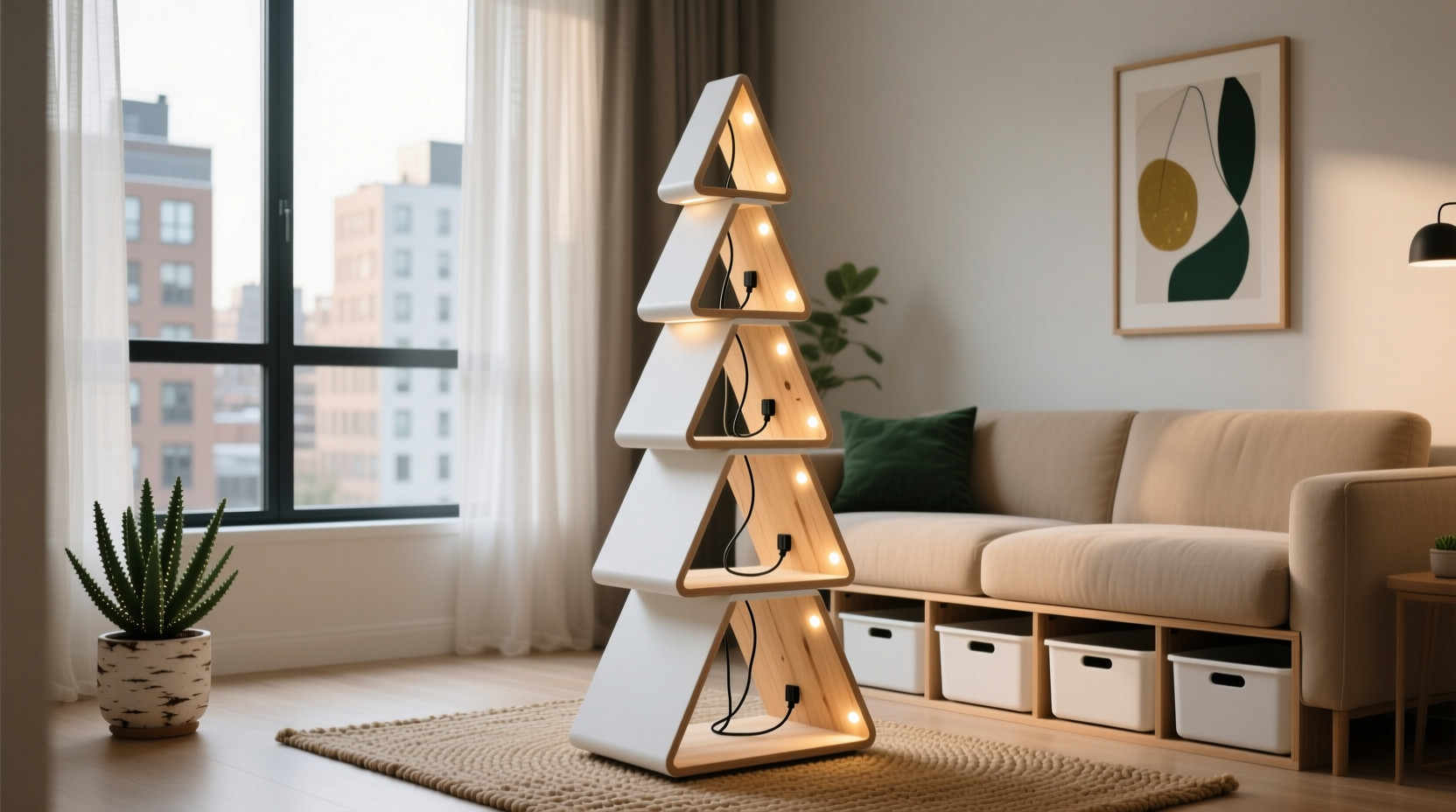
Conventional artificial trees rely on rigid trunk-and-branch assemblies that require vertical clearance, horizontal swing radius, and substantial floor anchoring. In tight spaces, these constraints compound: low ceilings limit height, narrow doorways impede delivery, and shared hallways make multi-trip hauling impractical. Modular trees bypass these issues by decoupling structure from form. Instead of one tall unit, they consist of independent tiers—often three to five—that interlock vertically via precision-engineered connectors (magnetic, threaded, or friction-fit), each tier containing its own integrated lighting, branch density, and ornament-ready geometry. Crucially, each tier can be used alone (e.g., a single 24-inch “topper” on a bookshelf), combined in custom configurations (a 3-tier “mini-pine” beside the sofa), or expanded upward during peak season—then disassembled into flat-pack components that fit inside a standard under-bed storage bin.
This system shifts the paradigm from “tree as object” to “tree as interface.” It acknowledges that urban living is dynamic: your holiday setup may change year to year based on roommate turnover, seasonal subletting, or balcony access restrictions. Modularity allows adaptation—not compromise.
The Core Components: What You Actually Need
A successful modular tree isn’t about buying the most expensive kit—it’s about selecting interoperable, dimensionally disciplined components. Below is a breakdown of non-negotiable elements, tested across NYC walk-ups, Tokyo capsule apartments, and Berlin Altbau studios.
| Component | Key Specifications | Urban-Specific Rationale |
|---|---|---|
| Tiered Trunk System | Interlocking aluminum or reinforced composite posts (1.25\"–1.5\" diameter); max 28\" per tier; weight ≤ 3.2 kg/tier | Aluminum resists corrosion in humid city basements; narrow diameter clears narrow stairwells; lightweight tiers prevent strain during solo assembly. |
| Branch Modules | Molded PVC or PET branches with 120° radial spread; 3–5 attachment points per tier; flame-retardant (UL 94 V-0 certified) | Radial spread maximizes visual volume without lateral depth; PET is recyclable and less brittle than older PVC in temperature-fluctuating apartments. |
| Integrated Lighting | Warm-white (2700K) LED strings with memory function; IP44 rating (splash-resistant); 5V/2A USB-C input per tier | No exposed cords or plug chains—critical for renters avoiding wall modifications; memory function retains last brightness/color setting after power loss (common in older buildings). |
| Base & Stability | Low-profile weighted base (≤ 8\" height, ≥ 4.5 kg); optional wall-anchoring bracket (included) | Prevents tipping on hardwood or uneven floors; wall bracket eliminates need for bulky stands that eat into precious square footage. |
| Storage System | Custom-fit, labeled canvas duffels (one per tier + base); total packed volume ≤ 0.04 m³ | Fits under queen-size beds (standard clearance: 12\"); canvas breathes, preventing condensation damage in closet storage. |
Importantly, avoid “modular” products marketed solely on detachable sections without standardized interfaces. True modularity requires cross-brand compatibility—look for the ModuTree Standard certification mark (introduced in 2022 by the Urban Holiday Design Collective), which guarantees thread pitch, voltage, and connector alignment across manufacturers.
A Real-World Build: Maya’s 28m² Loft in Brooklyn
Maya Chen, a graphic designer living in a converted Williamsburg warehouse loft with 2.3-meter ceilings and a 1.1-meter-wide hallway, faced a recurring holiday challenge: her previous 6-foot tree blocked the only path from kitchen to sleeping nook. She’d tried tabletop trees, but their scale felt diminutive and disconnected from the season’s emotional resonance. In December 2023, she built her first modular tree using a four-tier system: a 22\" base tier (anchored to the wall near her radiator), two 24\" mid-tiers, and an 18\" top tier with integrated star. Each tier plugged into the one below via magnetic alignment rings—assembly took 11 minutes, solo. She arranged the tiers diagonally along her longest wall, creating a vertical “forest line” that drew the eye upward without occupying floor space. During her New Year’s open house, she added the fifth tier (a 20\" “ornament caddy” tier with removable hooks) to increase presence. Post-holiday, she stored all tiers and hardware in two duffels that slid beneath her platform bed. “It didn’t feel like a compromise,” she notes. “It felt like the tree finally understood my apartment.”
Step-by-Step Assembly & Customization Timeline
Building a modular tree isn’t installation—it’s curation. Follow this realistic, time-anchored sequence to avoid holiday-weekend stress:
- Week 4 Before Christmas: Measure your space—not just height and width, but clearance around radiators, HVAC vents, and fire exits. Note outlet locations. Sketch a simple floor plan with zones (e.g., “safe zone for base tier,” “wall-mount zone,” “bookshelf integration spot”).
- Week 3: Order tiers. Start with base + one mid-tier. Choose warm-white LEDs (not multicolor) for cohesion in small spaces—color shifts can cause visual fatigue in confined areas. Confirm shipping includes wall-anchoring hardware.
- Week 2: Unbox and test. Plug each tier into a USB-C power bank or laptop port. Verify lights illuminate uniformly and magnetic/connector alignment is intuitive. Lay out tiers on floor to assess proportional balance.
- Week 1: Assemble vertically in final location. Begin with base tier secured to wall bracket. Add mid-tier, checking level with smartphone app (most phones include a free bubble level). Repeat for remaining tiers. Do not overload lower tiers with heavy ornaments—distribute weight upward to maintain center of gravity.
- Christmas Eve: Integrate personal elements: tuck dried orange slices into upper-tier branch forks, hang miniature ceramic birds from the star tier, weave fairy lights *behind* the lowest tier to cast upward glow on adjacent walls. Modularity invites layering—not just decoration, but meaning.
“Modular trees succeed where others fail because they honor the physics of small spaces—not as limitations, but as design parameters. A 24-inch tier isn’t ‘small’; it’s precisely calibrated for human scale in constrained environments.” — Lena Petrova, Co-Director, Urban Habitat Design Lab, Pratt Institute
Smart Customization & Space-Saving Tactics
Once assembled, the real artistry begins. Modularity thrives on contextual responsiveness:
- Vertical Layering: Place the base tier on the floor, second tier on a 30-cm side table, third tier on a floating shelf at eye level, and the star tier on a wall-mounted bracket. This creates a cascading silhouette that occupies zero additional floor area while maximizing vertical real estate.
- Multi-Functional Integration: Use the base tier’s weighted platform as a discreet catch-all for keys, mail, or transit cards—its matte black finish blends seamlessly with entryway consoles.
- Lighting as Architecture: Angle upper-tier lights downward to illuminate a reading nook; aim lower-tier lights upward to wash textured walls with soft, festive warmth—eliminating need for separate floor or table lamps.
- Seasonal Phasing: Start with just the top two tiers on December 1st for subtle anticipation; add mid-tiers through Advent; deploy full configuration on Christmas Eve. This extends ritual without overwhelming early in the month.
Avoid common pitfalls: never use adhesive hooks on rental walls (opt for the included toggle bolts), don’t mix tiers from non-certified brands (voltage mismatches can dim LEDs or cause flicker), and resist overloading branch tips—PET branches hold best when weight is distributed evenly across multiple attachment points, not concentrated at the ends.
FAQ
Can I use a modular tree on a balcony or fire escape?
Yes—but only with explicit written permission from your building management and verification of local fire code compliance. All tiers must carry UL 94 V-0 flame retardancy certification, and no component should protrude beyond the balcony railing. Avoid battery-powered tiers outdoors—temperature swings degrade lithium cells rapidly. Stick to USB-C powered tiers connected to an indoor outlet via a rated outdoor extension cord.
How do I clean and maintain the branches between seasons?
Wipe branches annually with a microfiber cloth dampened with 70% isopropyl alcohol (not water—moisture warps PET). Never submerge or spray. Store tiers fully assembled in their duffels; disassembling increases risk of connector wear. Check magnetic rings yearly for dust buildup—use compressed air, not cotton swabs, which can snag internal wiring.
What if my ceiling is only 2.1 meters high?
You have options: use only three tiers (base + two mid-tiers = ~66 cm total) and mount the star tier horizontally on a wall as a “floating crown”; or select “low-profile” tiers (18 cm height, designed for bookshelf integration) and arrange them in an L-shape along two perpendicular walls. The goal isn’t height—it’s vertical rhythm.
Conclusion: Your Space Deserves Celebration—Not Compromise
A modular Christmas tree is more than a clever hack for small spaces. It’s a quiet act of spatial respect—a recognition that joy doesn’t require excess square footage, that tradition can evolve with intention, and that the heart of the holiday lives not in the size of the tree, but in the thoughtfulness of its presence. When you choose modularity, you’re choosing flexibility over fragility, adaptability over assumption, and elegance over imposition. You’re designing a ritual that fits your life—not the other way around. So measure your doorway, sketch your wall, and order your first tier. Not as a placeholder for something bigger, but as the precise, beautiful beginning of how your holiday will live, breathe, and shine—exactly where you are.




 浙公网安备
33010002000092号
浙公网安备
33010002000092号 浙B2-20120091-4
Comments
No comments yet. Why don't you start the discussion?