
Most families replace their artificial Christmas tree every few years—either because it’s worn out, too small for the space, or no longer fits the evolving aesthetic of the home. But what if your tree could grow *with* your family? Not just in sentiment, but in literal height, structure, and shared meaning? A modular Christmas tree is more than a clever engineering project—it’s a physical timeline of childhood, a tactile heirloom built incrementally, where each new section represents another year of laughter, growth, and quiet family rituals. Unlike disposable decor, this approach merges sustainability with emotional resonance: the base branch set installed when your child was three becomes the foundation for the towering 7-foot centerpiece they help assemble at twelve. It’s not about perfection—it’s about intentionality, adaptability, and the quiet power of designing traditions that evolve, rather than expire.
Why Modularity Makes Sense—Beyond Convenience
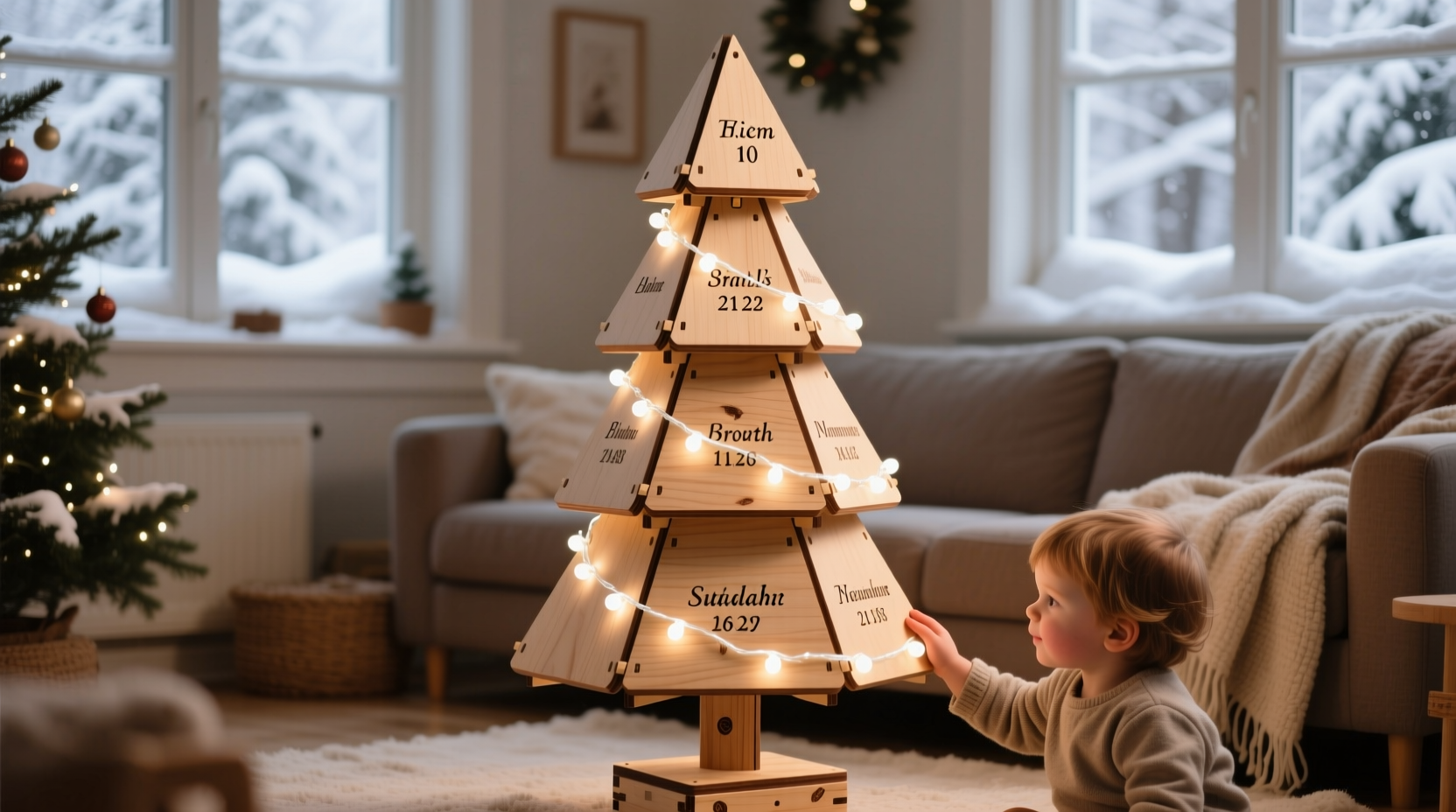
Modular design in holiday decor responds to two often-overlooked realities: children’s rapid physical development and the shifting spatial needs of family life. A toddler can’t safely reach ornaments above four feet—but by age eight, they’re eager to hang lights on the upper tiers. A studio apartment demands a compact 4.5-foot tree; a growing family in a suburban home may need six or seven feet within five years. Traditional one-piece trees force compromise: buy too tall and risk instability and visual imbalance for young children; buy too short and face replacement pressure before the tree is even worn out.
Modularity solves this by decoupling function from form. Each tier is structurally independent yet interlocking—designed to accept additional segments without compromising balance, wiring integrity, or visual harmony. This isn’t just scalability; it’s anticipatory design. As interior designer and family ritual specialist Lena Torres observes:
“The most enduring holiday traditions aren’t the ones we preserve unchanged—they’re the ones we *adapt* with care. A modular tree teaches children that growth isn’t about discarding the past, but building upon it. That lesson echoes far beyond December.”
Crucially, modularity also supports longevity. If a single branch section sustains damage—say, from an over-enthusiastic pet or accidental bump—it can be replaced individually, not wholesale. No more tossing an entire $300 tree because one lower ring lost its shape. And because components are standardized, replacements remain available for years, not just seasons.
Core Design Principles: Stability, Scalability, and Seamlessness
A successful modular tree rests on three non-negotiable pillars. Ignore any one, and the system fails—not just aesthetically, but functionally and emotionally.
1. Central Load-Bearing Column
The spine of the tree must be rigid, vertically aligned, and rated for cumulative weight. Avoid telescoping poles meant for lightweight decorations. Instead, use a 1.25-inch diameter aluminum or powder-coated steel pole with internal threading (M10 or larger) and locking collars at each junction. This column bears all structural load—not the branches—and allows precise height calibration (e.g., +12 inches per segment).
2. Interchangeable Branch Carriers
Branches don’t attach directly to the pole. Instead, each tier uses a circular carrier ring—a sturdy, injection-molded ABS plastic or reinforced composite ring with evenly spaced, spring-loaded clamps. These rings slide onto the central column and lock into place via a keyed groove system (preventing rotation) and a thumb-screw collar. Each ring holds 8–12 branch arms, which plug in like USB connectors—no tools required. This ensures consistent spacing, uniform density, and effortless reconfiguration.
3. Harmonized Aesthetic Language
Every component—from pole finish to branch tip texture—must share the same visual DNA. Choose matte-black or brushed-nickel pole finishes, paired with branch wires wrapped in PVC matching the trunk’s undertone (e.g., warm charcoal, not cool gray). Needle clusters should follow the same taper profile and density across tiers: 180–220 tips per foot, with inner branches slightly shorter than outer to create natural layering. This prevents the “stacked look” that undermines believability.
Building Your First Tier: The Foundation Year (Ages 0–3)
Your inaugural tier sets the emotional and structural tone. This isn’t just “the baby’s first tree”—it’s the generational anchor point. Keep it intentionally modest: 3.5 feet tall, with a wide 24-inch base for stability and low center of gravity. Use soft, rounded-tip branches (no sharp wire ends) and avoid lights in this tier entirely—safety first, symbolism second.
Materials list for Tier 1:
- Central column (36\" length, pre-threaded top/bottom)
- Base stabilizer plate (12\" diameter, weighted with 4 lbs of sand-filled steel insert)
- Carrier ring #1 (24\" diameter, 8 clamps)
- 8 branch arms (24\" length, 180 tips each, matte-green PVC wrap)
- Velcro strap kit (for securing branches during storage)
Assembly takes under 15 minutes: bolt the base plate to the column, slide on Carrier Ring #1 at the 12\" mark (measured from base), tighten thumb screws, then click in branches clockwise. Store all components in a labeled, flat-sided bin—never stacked vertically—to prevent warping.
This tier serves dual purposes: it’s safe for crawling infants and toddlers learning cause-and-effect (“push branch → light flickers”), and it establishes the ritual cadence. Each December, involve your child in placing the first ornament—a handprint clay star, a photo bauble, or a simple wooden initial. Store that ornament with Tier 1’s components. It stays with the foundation—always.
Yearly Expansion: A Step-by-Step Growth Timeline
Growth isn’t arbitrary. It’s choreographed to match developmental milestones, safety thresholds, and family capacity. Follow this proven sequence:
- Year 2 (Child turns 3): Add Tier 2—another 36\" column segment and Carrier Ring #2 at 24\" above Tier 1. Introduce 12 low-voltage LED mini-lights (battery-operated, 3V) strung only on Tier 2 branches. Let child help wind lights slowly, counting aloud.
- Year 3 (Child turns 4): Install Tier 3 (same specs). Now integrate a simple light controller: a 3-channel timer that illuminates Tier 1 at dusk, Tier 2 at 6 p.m., Tier 3 at 7 p.m.—creating a gentle “light rise” effect. This teaches sequencing and anticipation.
- Year 4 (Child turns 5): Upgrade to AC-powered lights with integrated dimmers. Add a motion sensor to Tier 1: when child walks past, Tier 1 glows softly—reinforcing ownership and presence.
- Year 5+ (Ages 6–12): Add one 12\" segment annually. At age 8, introduce a rotating top tier with a slow-spin motor (5 RPM max) and fiber-optic star. By age 12, the tree reaches 78\" (6.5 feet)—tall enough for full family visibility, yet stable enough for teens to help assemble unassisted.
Each expansion includes a “Tier Ceremony”: a 10-minute ritual where the family gathers, reviews photos from last year’s tree, places one new ornament representing growth (e.g., a book charm at age 6, a soccer ball at age 9), and tightens the new collar together. This transforms construction into legacy-building.
Real Example: The Chen Family’s 7-Year Tree Journey
In Portland, Oregon, the Chen family began their modular tree in 2017 with newborn Leo. Their Tier 1 was a compact 3.2-foot base—just enough to hold three handmade felt ornaments. By 2019, Leo was 2 and insisted on “helping” wind lights around Tier 2. His mother filmed him concentrating fiercely, tongue poking out, wrapping a single strand 17 times before giving up. That clip now plays on a digital frame beside the tree each year.
In 2021, during remote learning, Leo and his 6-year-old sister Maya designed Tier 3’s color scheme: deep forest green branches with copper-toned lights, echoing their backyard cedar trees. They painted the carrier ring’s center medallion with non-toxic metallic paint—a detail visible only when viewed from below, like looking up through real boughs.
By 2023, at age 6, Leo assembled Tier 4 solo—checking torque with a calibrated wrench (a gift from his engineer father). Last December, he stood back, looked up at the 66-inch tree, and said, “It’s almost as tall as me. Next year, it’ll be taller.” His parents didn’t correct him. They knew the math: Tier 5 would hit 78\". And Leo would be 7.
Their tree isn’t flawless—Tier 2’s left clamp loosened last season, requiring a $4 replacement part ordered online. But that repair became its own story: Leo watched the video tutorial, fetched the tool, and held the collar steady while his dad tightened it. The tree didn’t just grow taller. It grew richer.
Smart Storage & Maintenance: Preserving the System for Decades
A modular tree’s longevity hinges on how you store it—not how you display it. Poor storage warps carriers, dulls finishes, and corrodes connections. Follow this protocol religiously:
| Component | Storage Method | Frequency | Risk of Neglect |
|---|---|---|---|
| Central column segments | Vertical in padded PVC sleeves, suspended from closet rod | Annually, post-January 2 | Bending, thread wear, misalignment |
| Carrier rings | Flat in acid-free cardboard trays, separated by silicone sheets | After each season | Warping, clamp spring fatigue |
| Branch arms | Coiled loosely in breathable cotton bags, labeled by tier/year | Within 48 hours of disassembly | Tip breakage, PVC cracking, tangle damage |
| Light strings & controllers | On labeled spools, in static-free bins with silica gel packs | After testing functionality | Short circuits, dimmer failure, connector corrosion |
Test every component before storage: plug in lights, rotate carriers, flex branches. Discard anything showing micro-fractures, discoloration, or inconsistent resistance. Document everything in a simple spreadsheet—tier number, purchase date, warranty expiry, replacement part codes. This isn’t bureaucracy; it’s stewardship.
FAQ: Practical Questions from Real Families
Can I mix tiers from different brands or years?
No. Even minor variations in column threading pitch (e.g., M10 x 1.25 vs. M10 x 1.5) or carrier ring groove depth will compromise load distribution and create dangerous wobble. Stick to one manufacturer’s ecosystem—or commit fully to a custom-engineered system from the start. Retrofitting is rarely cost-effective.
What if my child loses interest in decorating by age 10?
That’s expected—and built into the design. Shift focus from ornament placement to system stewardship: let them calibrate light timers, inventory spare parts, or sketch ideas for next year’s top-tier accent (e.g., a kinetic snowflake or sound-reactive base). Ownership evolves. The tree remains theirs, even when their engagement changes form.
How much does a quality modular system cost upfront?
Expect $295–$420 for Tier 1 (3.5 ft). Each subsequent tier adds $85–$130. Over seven years, total investment averages $820–$1,150—less than replacing three mid-tier artificial trees ($350–$500 each) and avoiding disposal fees. Factor in 15+ years of use, and the ROI shifts from financial to familial.
Conclusion: Your Tree Is Already Growing
You don’t need to wait for next holiday season to begin. The modular Christmas tree isn’t defined by its height—it’s defined by its intention. The decision to build something that expands with your child’s curiosity, their reach, their voice in family decisions—that choice starts now. It starts with measuring your entryway, researching column load ratings, or sketching a simple carrier ring on scrap paper. It starts with saving the first ornament your child makes, knowing it belongs to Tier 1, forever.
This isn’t about crafting the perfect tree. It’s about rejecting disposability in favor of devotion—devotion to time well spent, to memories made tangible, to the quiet pride of watching something you built together rise, year after year, toward the ceiling and into the future. Your child won’t remember the exact height of the tree at age 5. But they’ll remember standing beside you, tightening a collar, hearing the soft *click* of a branch locking into place—the sound of something enduring, something theirs.




 浙公网安备
33010002000092号
浙公网安备
33010002000092号 浙B2-20120091-4
Comments
No comments yet. Why don't you start the discussion?