
Planning a concrete slab project—whether for a patio, garage floor, or foundation—requires more than just measuring space and calling a contractor. Accurate cost estimation is essential to avoid budget overruns and ensure your project stays on track. Many homeowners and DIY builders underestimate the total expense because they overlook hidden factors like site preparation, reinforcement, and regional pricing differences. This guide breaks down every cost component involved in pouring a concrete slab, helping you create a realistic budget from start to finish.
Understanding the Core Components of Concrete Slab Costs
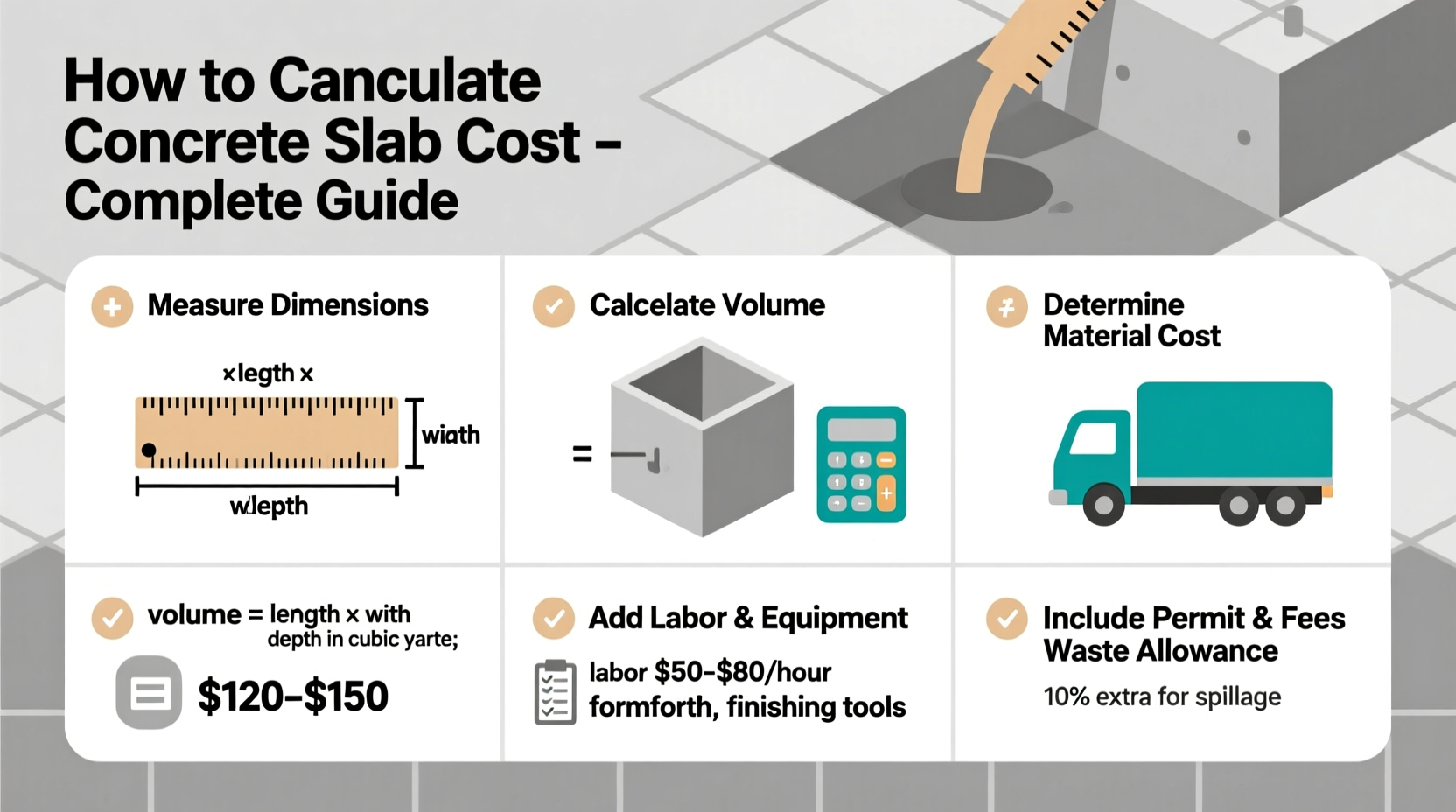
The total cost of pouring a concrete slab isn’t just about the price of concrete. It’s a combination of material, labor, site work, finishing, and additional structural elements. Each phase contributes significantly to the final bill. To estimate accurately, you must account for:
- Concrete mix volume and type
- Labor for excavation, forming, pouring, and finishing
- Site preparation (grading, compaction, drainage)
- Reinforcement (rebar, wire mesh)
- Vapor barriers and insulation (if needed)
- Permits and inspections
- Equipment rental or subcontractor fees
Ignoring any of these can lead to unexpected expenses. For example, failing to include compaction costs may result in future settling and cracking, leading to costly repairs.
Step-by-Step Guide to Calculating Your Slab Cost
Follow this sequence to build an accurate estimate:
- Determine the slab dimensions: Measure length, width, and desired thickness (typically 4 inches for patios, 6 inches for driveways).
- Calculate cubic yards of concrete: Multiply length × width × depth (in feet), then divide by 27 (since 1 cubic yard = 27 cubic feet).
- Select concrete mix type: Standard mix (3,000 psi) vs. high-strength (4,000+ psi) affects cost per yard.
- Estimate labor costs: Labor typically ranges from $3 to $10 per square foot depending on complexity.
- Add site preparation costs: Excavation, grading, and base material (gravel) are often overlooked.
- Include reinforcement and vapor barrier: Wire mesh or rebar adds $0.50–$2 per sq ft; vapor barriers cost $0.15–$0.30 per sq ft.
- Factor in finishing and curing: Basic broom finish vs. stamped or colored concrete changes pricing.
- Add contingency (10–15%): Always reserve extra funds for unforeseen issues like poor soil or weather delays.
Example Calculation: 20x20-Foot Driveway Slab
| Item | Details | Cost Estimate |
|---|---|---|
| Concrete (6\" thick) | 20 × 20 × 0.5 = 200 cu ft → 7.4 cu yds | $1,110 ($150/cu yd) |
| Labor | Pouring, finishing, cleanup | $1,600 ($4/sq ft) |
| Excavation & Grading | 6-inch depth, debris removal | $600 |
| Gravel Base | 4 inches compacted, 10 tons @ $50/ton | $500 |
| Reinforcement | Wire mesh across entire area | $200 |
| Vapor Barrier | 6-mil poly sheeting | $80 |
| Formwork | Wood or metal edges | $150 |
| Contingency (10%) | Miscellaneous adjustments | $424 |
| Total Estimated Cost | $4,664 |
Regional and Seasonal Pricing Variations
Concrete prices vary widely by region due to transportation costs, local labor rates, and material availability. For instance, ready-mix concrete averages $120–$180 per cubic yard nationwide, but urban areas like New York or San Francisco often exceed $200. Rural regions may offer lower prices but charge more for delivery beyond a certain radius.
Season also impacts cost. Contractors are busiest in spring and summer, which can drive up labor prices and reduce scheduling flexibility. Winter pours require additives or heated enclosures to prevent freezing, adding $1–$3 per square foot to the budget.
“Accurate estimating starts with knowing your local market. A cubic yard of concrete in Texas might cost half as much in transport as one in Vermont.” — Mark Reynolds, Civil Estimator with 20 years in commercial construction
Common Mistakes That Inflate Budgets
Even experienced DIYers make errors that increase costs unnecessarily. Avoid these pitfalls:
- Underestimating base material needs: A weak gravel base leads to cracking and future repair costs.
- Skipping vapor barriers on interior slabs: Moisture infiltration can damage flooring and promote mold.
- Choosing decorative finishes without planning: Stamped or stained concrete requires skilled labor and sealing, doubling surface costs.
- Ignoring permit requirements: Unpermitted work can fail inspection, requiring demolition and repouring.
- Not accounting for slope and drainage: Poor water runoff damages adjacent structures and voids warranties.
Mini Case Study: Homeowner Saves $1,200 with Smart Planning
Jamie, a homeowner in Ohio, planned a 24x30-foot garage addition slab. Her initial quote came in at $8,500. Instead of accepting it, she requested a detailed breakdown and researched each line item. She discovered the contractor included unnecessary rebar where wire mesh would suffice, and the gravel estimate was 30% higher than needed.
After negotiating and sourcing her own vapor barrier, Jamie revised the scope and hired a different crew. The final cost: $7,300—a savings of $1,200 without sacrificing quality. Her key insight? “Ask for every number separately. You’d be surprised what’s padded.”
Budget Checklist for Pouring a Concrete Slab
Use this checklist before finalizing your budget:
- ✅ Measure slab area and thickness
- Confirm dimensions in feet and convert depth to decimal feet (e.g., 6\" = 0.5')
- ✅ Calculate concrete volume in cubic yards
- (L × W × D) ÷ 27
- ✅ Get 3 itemized contractor quotes
- Compare labor, materials, and prep separately
- ✅ Include excavation and base materials
- Don’t assume \"level ground\" means no digging
- ✅ Decide on reinforcement method
- Mesh for light use, rebar for heavy loads
- ✅ Factor in vapor barrier and insulation
- Critical for indoor slabs or cold climates
- ✅ Add 10–15% contingency
- For soil issues, weather, or design changes
- ✅ Verify permit requirements
- Contact local building department early
Frequently Asked Questions
How much does a 20x30 concrete slab cost on average?
A 20x30-foot slab (600 sq ft) at 6 inches thick requires about 11 cubic yards of concrete. With average labor and prep, total costs range from $4,500 to $7,500, depending on region and finish type.
Can I pour concrete myself to save money?
Yes, for small projects like patios, DIY can save $1,000–$2,000 in labor. However, improper mixing, finishing, or curing can lead to cracks and structural failure. For large or load-bearing slabs, professional help is strongly recommended.
Does insulation under a slab really matter?
Yes, especially in cold climates. Insulation reduces heat loss, prevents frost heave, and protects against moisture. Rigid foam boards (R-10 to R-20) under the slab improve energy efficiency and long-term durability.
Final Thoughts: Build Confidence Through Preparation
Calculating the true cost of pouring a concrete slab goes far beyond multiplying square footage by a dollar amount. It demands attention to detail, awareness of local conditions, and respect for the unseen elements beneath the surface. By breaking down each cost factor—from cubic yards to compaction—you gain control over your budget and avoid last-minute surprises.
Whether you're working with a contractor or managing the project yourself, clarity and preparation are your strongest tools. Use the steps, checklist, and examples in this guide to build not just a slab, but confidence in your planning process.




 浙公网安备
33010002000092号
浙公网安备
33010002000092号 浙B2-20120091-4
Comments
No comments yet. Why don't you start the discussion?