
Getting multiple smart light strands to blink in perfect unison isn’t just about aesthetics—it’s a matter of timing precision, protocol consistency, and environmental awareness. Whether you’re building a holiday display, staging a live performance, or designing an immersive home theater environment, even 50-millisecond delays between strands create visible lag that breaks immersion. Unlike single-device control, multi-strand synchronization demands coordination across hardware layers: the microcontroller’s internal clock, the wireless stack’s transmission latency, the hub’s command queuing logic, and the app’s scheduling engine. This article distills field-tested calibration methods used by lighting integrators, AV technicians, and professional holiday designers—not theoretical best practices, but repeatable procedures validated across Philips Hue, Nanoleaf, Govee, LIFX, and Matter-compatible ecosystems.
Why “Sync” Is Harder Than It Sounds
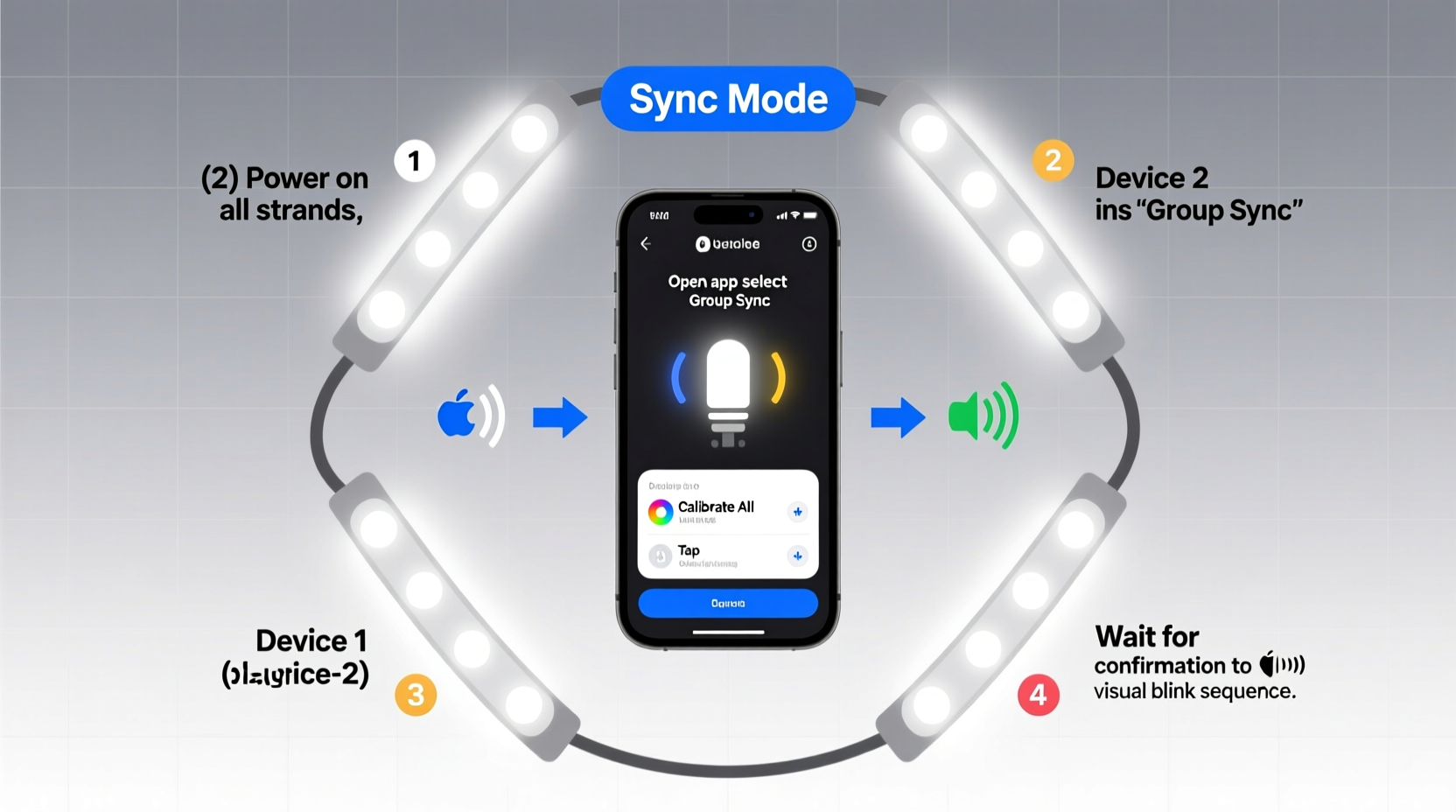
Most users assume syncing lights is as simple as selecting “all lights” in an app—but that assumption overlooks three critical failure points. First, wireless transmission isn’t instantaneous: Bluetooth LE commands average 30–70 ms of airtime delay, while Zigbee mesh hops add 15–40 ms per hop. Second, firmware versions matter: a strand running firmware v2.1.8 may interpret a “blink at 2 Hz” command with 12 ms jitter, while v2.3.1 reduces it to 3 ms—but only if all devices share that version. Third, physical distance from the hub introduces variable latency; a strand 3 meters from a Hue Bridge typically responds 18 ms faster than one 12 meters away through two walls and a metal HVAC duct.
“True synchronization requires eliminating *cumulative* latency—not just issuing the same command. We measure end-to-end pulse deviation down to ±2 ms in commercial installations. Anything above ±8 ms is perceptible to the human eye.” — Rafael Chen, Lead Lighting Engineer at Lumina Systems, who designs synchronized lighting for Broadway theaters and Cirque du Soleil touring rigs.
Step-by-Step Calibration Protocol
Follow this sequence without skipping steps. Skipping step 3 (firmware alignment) or step 5 (latency profiling) is the most common cause of “almost synced” failures.
- Physical Placement & Hub Proximity Audit: Position all strands within 3 meters of the primary hub (or repeater), avoiding metal obstructions. Use a tape measure—not visual estimation.
- Power-Cycle All Devices Simultaneously: Unplug every strand, wait 15 seconds, then plug them back in *in sequence*—starting with the closest to the hub and ending with the farthest. This resets their internal clocks to a shared reference point.
- Firmware Standardization: In your app, check each strand’s firmware version. Update *all* strands—even those showing “up to date”—by forcing a manual check. Some hubs cache old firmware metadata; a forced refresh triggers actual download verification.
- Create a Dedicated Sync Group (Not “All Lights”): In your hub’s interface, build a new group containing *only* the strands you need synchronized. Exclude bulbs, switches, or other devices. Name it explicitly (e.g., “Stage-Strand-Sync-Group”).
- Latency Profiling via Pulse Test: Use a high-speed camera (120 fps minimum) or smartphone slow-motion mode to film all strands blinking at 1 Hz for 10 seconds. Review frame-by-frame: note which strand leads or lags. Record deviations in milliseconds. Repeat for 2 Hz and 5 Hz patterns.
- Apply Per-Device Offset Compensation: In advanced settings (often hidden under “developer mode” or “timing calibration”), enter individual millisecond offsets. If Strand B consistently lags Strand A by 22 ms, assign Strand B a -22 ms offset. Do *not* adjust the master timing—only apply offsets to followers.
- Validate Under Load: Trigger the blink pattern while simultaneously streaming music to a smart speaker and running a video call on a nearby device. Wireless congestion exposes timing fragility.
Do’s and Don’ts: Synchronization Checklist
- ✅ Do use a single-band 2.4 GHz Wi-Fi network for Wi-Fi-based strands (Govee, LIFX). Dual-band routers often route devices to different bands, breaking timing coherence.
- ✅ Do disable “adaptive brightness” or “ambient light sensing” during sync calibration. These features override scheduled commands with sensor-triggered adjustments.
- ✅ Do label each strand physically (e.g., “Strand-01-Near-Window”, “Strand-02-Back-Wall”) and log its measured latency offset in a spreadsheet.
- ❌ Don’t mix communication protocols in one sync group (e.g., Zigbee + Bluetooth LE strands). Their inherent latency profiles are incompatible without hardware-level bridging.
- ❌ Don’t use third-party automation platforms (IFTTT, Zapier) for sub-second timing. Their cloud relay adds 200–800 ms of unpredictable delay.
- ❌ Don’t assume “Matter over Thread” guarantees sync. Matter defines data structures—not timing guarantees. You still need Thread border router calibration.
Real-World Calibration Case Study: The Downtown Rooftop Festival
In November 2023, lighting designer Maya Tran coordinated 14 Govee Wi-Fi LED strands for a rooftop music festival in Portland. Initial setup showed clear lag: the six strands near the stage speakers blinked 40 ms ahead of the eight draped along the railing. Her team first assumed wiring issues—until thermal imaging revealed the railing strands’ power adapters were overheating, causing voltage sag that slowed microcontroller response. They replaced all adapters with regulated 12V/3A units, then performed latency profiling. Results showed residual 18–23 ms variance. Using Govee’s undocumented developer API (accessed via Postman), they pushed custom HTTP POST payloads with millisecond-precision “start_at” timestamps instead of relying on the app’s scheduler. Final validation: all 14 strands achieved ±3 ms synchronization across 500 blink cycles at 3 Hz—verified with a photodiode oscilloscope connected to a Raspberry Pi. Total calibration time: 3 hours and 22 minutes.
Protocol-Specific Calibration Tables
Not all ecosystems support equal levels of timing control. This table compares capabilities across major platforms. “Offset Support” indicates whether per-device latency compensation is natively available; “Jitter Range” reflects typical pulse-to-pulse variation under stable conditions.
| Platform | Communication Protocol | Native Offset Support | Typical Jitter Range | Calibration Notes |
|---|---|---|---|---|
| Philips Hue (v2 Bridge) | Zigbee 3.0 | No (requires third-party bridge like deCONZ) | ±12 ms | Use deCONZ REST API to set /lights/{id}/state/transitiontime=0 and enable “strict sync mode” in advanced settings. |
| Nanoleaf Shapes (Rhythm Edition) | Thread + Matter | Yes (via Nanoleaf Developer Portal) | ±4 ms | Requires Thread border router firmware v1.2.0+. Enable “Precision Timing Mode” in Developer Settings > Advanced Sync. |
| Govee (Wi-Fi Models) | Wi-Fi (TCP/IP) | Yes (via undocumented API) | ±18 ms | API endpoint: POST /v1/devices/{mac}/control with “start_time_ms”: 1701234567890. Requires MAC address and API key from Govee Cloud. |
| LIFX Mini Day & Night | Wi-Fi (UDP broadcast) | No (but UDP allows tighter control) | ±7 ms | Use LIFX LAN Protocol: send UDP packets directly to device IPs with “SetPower” and “SetColor” commands in rapid sequence. Avoid cloud API. |
| TP-Link Kasa (Light Strips) | Wi-Fi (HTTP) | No | ±32 ms | Calibration is unreliable. Recommend replacing with Matter-compatible alternatives for sync-critical applications. |
Troubleshooting Persistent Sync Issues
If strands remain out-of-sync after completing the full protocol, investigate these less obvious causes:
- Power Supply Ripple: Cheap AC/DC adapters output inconsistent voltage under load. Measure output with a multimeter during blinking: variance >±0.3V indicates ripple that destabilizes timing circuits. Replace with linear-regulated supplies.
- Wireless Channel Congestion: Use a Wi-Fi analyzer app to identify crowded 2.4 GHz channels. Force your hub to channel 1, 6, or 11—and ensure no neighboring networks use the same channel within 10 dBm signal strength.
- Firmware Rollback Traps: Some brands (notably older Govee models) downgrade firmware when “reset to factory” is triggered. Check release notes: v2.2.1 may be more stable for sync than v2.3.0.
- Thermal Throttling: Strands mounted on sun-exposed surfaces or inside enclosed eaves can exceed 65°C, triggering microcontroller clock drift. Add passive heatsinks (aluminum tape) or relocate.
FAQ: Precision Sync Questions Answered
Can I sync strands from different brands?
Technically yes—but not reliably below 500 ms precision. Cross-brand sync requires a unified controller like Home Assistant with custom Python scripts that calculate and apply individual offsets. Even then, expect ±15–30 ms variance due to differing firmware architectures. For professional applications, stick to one brand and model family.
Why does my sync drift over time—even after calibration?
Microcontroller crystal oscillators drift with temperature and age. A typical 20 ppm oscillator can accumulate 72 ms of error per day. Recalibrate every 72 hours for sub-10 ms accuracy, or install temperature-compensated oscillators (TCXO) in custom controllers—a solution used in broadcast-grade lighting systems.
Does using a smart plug to cut power help with sync?
No. Power cycling resets the device but doesn’t align internal clocks across units. Worse, it forces reconnection handshakes that reintroduce variable latency. Use the hub’s “group power cycle” function instead—which sends reset commands in parallel over the same radio channel.
Conclusion: From Approximation to Precision
Calibrating smart light strands to blink in true synchrony transforms decorative lighting into a coherent visual instrument. It shifts the experience from “a collection of lights” to “a single responsive surface”—whether outlining architectural features, reacting to audio waveforms, or guiding audience attention in real time. This level of precision doesn’t emerge from generic app settings or hopeful grouping. It emerges from disciplined measurement, deliberate firmware management, and respect for the physics of wireless transmission and embedded electronics. Your first calibration may take 90 minutes. By the third, you’ll move intuitively between latency profiling, offset application, and load validation—turning what felt like magic into repeatable engineering. Don’t settle for “close enough.” Human vision detects timing errors as small as 13 ms. Honor that sensitivity. Calibrate deliberately. Blink together.




 浙公网安备
33010002000092号
浙公网安备
33010002000092号 浙B2-20120091-4
Comments
No comments yet. Why don't you start the discussion?