
Streaming YouTube from your phone to your TV should be effortless. Yet, when WiFi stutters, buffers, or disconnects entirely, the experience turns frustrating. Whether you're watching a tutorial, sharing vacation clips, or enjoying a movie night, a shaky connection can ruin the moment. The good news: you don’t need stable WiFi to cast YouTube. Several reliable alternatives bypass wireless networks altogether, offering smoother, more consistent performance. This guide explores practical, tested methods to mirror or play YouTube content from your smartphone directly to your TV—without relying on WiFi.
Why WiFi Isn’t Always the Best Option for Casting
WiFi is convenient, but it’s far from perfect. Interference from walls, appliances, or multiple connected devices can degrade signal strength. Distance from the router, outdated firmware, or network congestion during peak hours often leads to buffering, audio lag, or failed casting attempts. According to a 2023 FCC report, nearly 34% of U.S. households experience intermittent WiFi issues that affect streaming quality.
Additionally, Chromecast and similar devices require both the phone and TV to be on the same network. If your phone connects via mobile data while your TV relies on WiFi, casting fails. In such cases, alternative solutions become not just useful—but essential.
“WiFi-dependent casting is inherently fragile. For uninterrupted viewing, direct connections like HDMI or Bluetooth are far more reliable.” — Dr. Alan Reyes, Network Systems Engineer at StreamLogic Labs
Wired Solutions: The Most Reliable Way to Cast Without WiFi
When stability matters most, nothing beats a physical connection. Wired methods eliminate interference, latency, and authentication hurdles. Here are the top options:
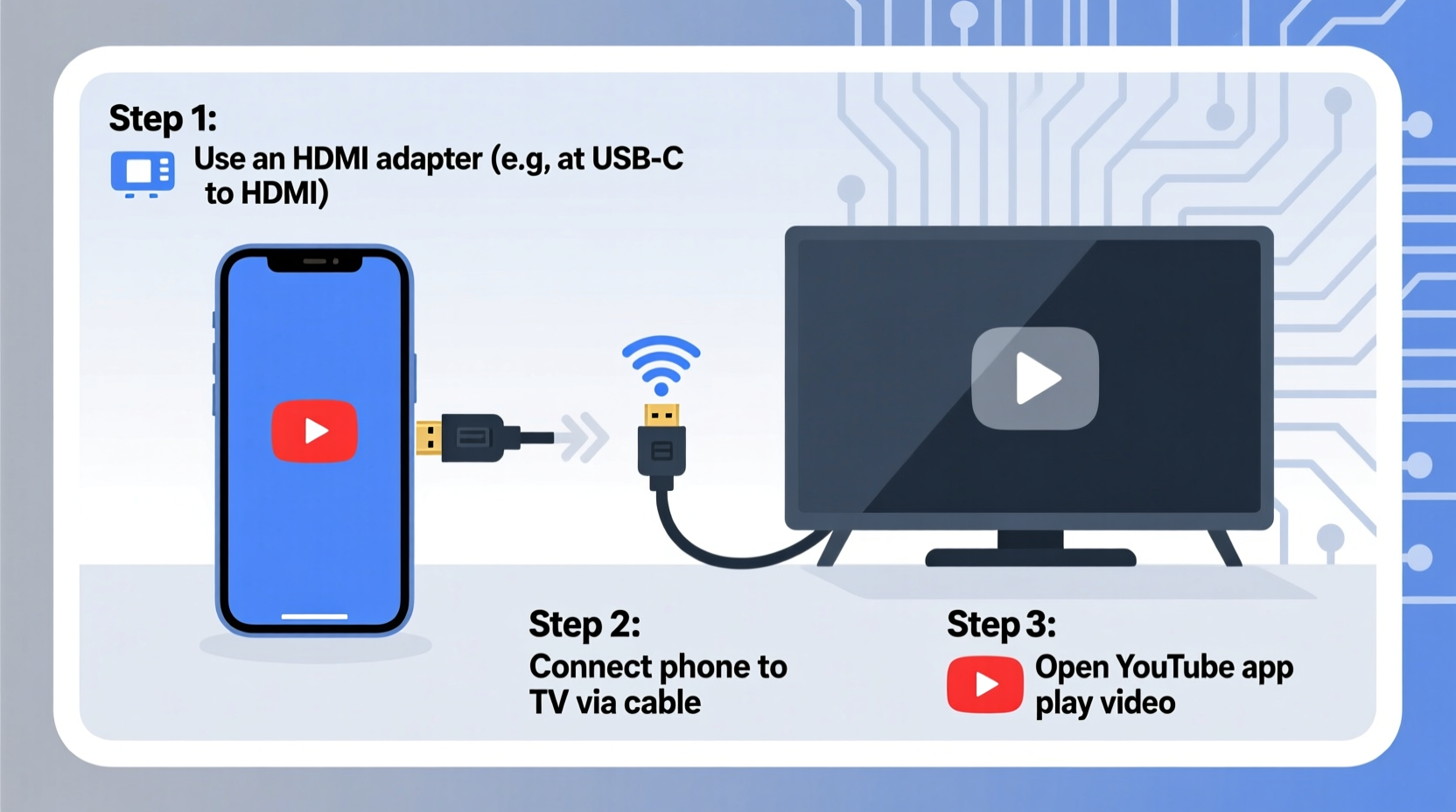
1. Use an MHL or USB-C to HDMI Adapter
If your Android phone supports MHL (Mobile High-Definition Link) or has a USB-C port with DisplayPort Alt Mode, you can connect it directly to your TV using an adapter and an HDMI cable.
- Check if your phone supports video output via USB-C or MHL (most Samsung Galaxy models from S8 onward, Google Pixel series, and select OnePlus devices do).
- Purchase a compatible USB-C to HDMI adapter (ensure it doesn’t require external power unless necessary).
- Connect one end to your phone and the other to an available HDMI port on your TV.
- Switch your TV input to the corresponding HDMI source.
- Open YouTube on your phone—the screen will mirror automatically.
2. Use an iPhone with Lightning to HDMI Adapter
For iPhone users, Apple offers an official Lightning Digital AV Adapter. It works seamlessly with all modern iPhones and iPads.
- Plug the Lightning end into your iPhone.
- Connect an HDMI cable from the adapter to your TV.
- Select the correct HDMI input on your TV.
- Unlock your iPhone and open YouTube—your screen appears instantly on the big display.
No internet connection is needed on the TV side. Your phone uses cellular data or cached videos, making this ideal for travel or unreliable networks.
Bluetooth and Local Network Alternatives
While Bluetooth doesn’t support video streaming directly, it plays a role in enabling local casting when WiFi is unstable. These hybrid approaches combine device pairing with offline capabilities.
Using Screen Mirroring via Built-in Smart TV Features
Many modern smart TVs (Samsung, LG, Sony) offer built-in screen mirroring through Miracast or proprietary protocols like Samsung Smart View. These operate on a peer-to-peer basis—no router required.
- On your TV, navigate to Settings > Screen Sharing or Input > Screen Mirroring.
- Enable the feature and ensure it's set to \"Visible to All Devices.\"
- On your Android phone, go to Settings > Connected Devices > Connection Preferences > Screen Mirroring.
- Your TV should appear in the list. Tap to connect.
- Once linked, open YouTube and play any video—the stream runs over a direct wireless link, independent of your home WiFi.
This method creates a temporary hotspot between devices, avoiding network congestion. However, initial pairing may take up to 30 seconds, and some older phones lack Miracast support.
Offline YouTube Playback with Local File Transfer
YouTube Premium allows downloading videos for offline viewing. Combine this with file transfer to play content directly on your TV.
- Download desired videos in the YouTube app using a strong connection beforehand.
- Connect your phone to your TV via USB cable (if supported) or transfer files to a USB drive.
- Use your TV’s media player app to browse and play the downloaded video files.
Note: Downloaded YouTube videos are encrypted and can only be played within the YouTube app. To bypass this, consider legal screen recording tools for personal archival (check local copyright laws).
Alternative Hardware Options for Seamless Casting
Investing in the right hardware eliminates dependency on WiFi entirely. These devices create isolated networks or accept direct inputs.
Dongles That Create Independent Networks
Devices like the Microsoft Wireless Display Adapter or certain Miracast dongles establish a direct link between your phone and TV. They function as standalone receivers, not requiring internet access.
- Plug the dongle into your TV’s HDMI port.
- Power it via USB (usually included).
- Activate screen mirroring on your phone.
- Select the dongle from the list of available displays.
These adapters typically deliver lower latency than WiFi-based casting and work even when your router is down.
Using a Portable Media Player
A microSD card or USB flash drive loaded with pre-downloaded YouTube content (via permitted means) can be played directly on many smart TVs. While not “casting” per se, it achieves the same goal: playing YouTube-style content on a large screen without network reliance.
Step-by-Step Guide: Cast YouTube Without WiFi in 5 Minutes
Follow this quick timeline to get YouTube on your TV without touching your router.
- Minute 0–1: Gather equipment—HDMI cable, compatible adapter (USB-C/Lightning), and power source.
- Minute 1–2: Connect the adapter to your phone and HDMI cable to the TV.
- Minute 2–3: Power on the TV and switch input to the correct HDMI channel.
- Minute 3–4: Unlock your phone; the screen should mirror automatically.
- Minute 4–5: Open YouTube, play a video, and adjust volume via TV remote.
Total time: under five minutes. No passwords, no network selection, no troubleshooting.
Comparison Table: Methods to Cast Without WiFi
| Method | Setup Time | Video Quality | Phone Battery Impact | Best For |
|---|---|---|---|---|
| USB-C/HDMI Adapter | 3–5 min | Up to 4K | High (requires charging) | Home use, presentations |
| Lightning to HDMI | 2–4 min | 1080p | High | iOS users, travelers |
| Miracast/Mirror Mode | 1–3 min | 720p–1080p | Medium | Wireless convenience |
| USB Drive + Offline Video | 5+ min (transfer time) | Depends on file | None | Long-term storage |
| Miracast Dongle | 2 min | 1080p | Low | Frequent casters |
Real-World Example: Family Movie Night Without Internet
The Patel family planned a weekend movie night at their countryside cabin, where WiFi was spotty and mobile data limited. They wanted to show YouTube-sourced classic cartoons to their kids. Instead of risking a failed Chromecast session, they used a USB-C to HDMI adapter with their Android phone. Earlier, they had downloaded the videos over LTE. Upon arrival, they connected the phone to the cabin’s smart TV, selected HDMI 2, and started playback—all within four minutes. No network was involved. The children enjoyed uninterrupted viewing, and the parents avoided technical stress.
This scenario highlights how preparation and the right tools make WiFi-independent casting not only possible but preferable in low-connectivity environments.
Common Mistakes to Avoid
- Assuming all USB-C ports support video output: Some budget phones lack DisplayPort Alt Mode. Verify compatibility before purchasing an adapter.
- Ignoring power needs: Screen mirroring increases power draw. Always plug your phone into a charger during extended sessions.
- Using unformatted drives: A USB stick not formatted to FAT32 or exFAT may not be readable by your TV.
- Expecting Bluetooth to transmit video: Bluetooth is for audio only. Do not rely on it for screen mirroring.
Frequently Asked Questions
Can I cast YouTube to my TV without any cables?
Yes, if your TV and phone support Miracast or built-in screen mirroring. These technologies create a direct wireless connection without using your home WiFi network. Ensure both devices are compatible and have the feature enabled in settings.
Do I need YouTube Premium to cast offline videos?
You don’t need YouTube Premium to cast live streams or online videos, but downloading videos for offline playback requires a Premium subscription. Once downloaded, they can be viewed without internet, though only within the YouTube app unless transferred legally via other means.
Why won’t my TV detect my phone during screen mirroring?
This usually happens due to incompatible standards or disabled settings. Confirm that your TV supports Miracast (for Android) or AirPlay (for iPhone). Restart both devices, ensure they’re close together, and check for firmware updates. Also, disable any active VPNs or firewalls on your phone.
Final Checklist Before You Cast
- ✅ Verify your phone supports video output (MHL, DisplayPort over USB-C, or Lightning AV).
- ✅ Charge your phone or connect it to power.
- ✅ Test the HDMI cable and adapter beforehand.
- ✅ Download videos in advance if internet will be unavailable.
- ✅ Set your TV to the correct HDMI input source.
- ✅ Disable battery-saving modes that may interrupt screen sharing.
Conclusion: Take Control of Your Streaming Experience
WiFi should enhance your viewing—not dictate it. By leveraging wired connections, peer-to-peer mirroring, and offline content, you gain full control over how and where you watch YouTube. These methods are faster, more stable, and often simpler than battling router settings or signal drops. Whether you're teaching a class, hosting guests, or relaxing off-grid, the ability to cast without WiFi is a game-changer.




 浙公网安备
33010002000092号
浙公网安备
33010002000092号 浙B2-20120091-4
Comments
No comments yet. Why don't you start the discussion?