
Choosing the right vacuum cleaner is more than just a matter of suction power or brand preference—it’s about matching the tool to your lifestyle, home layout, and cleaning expectations. With advancements in smart home technology, robot vacuums have surged in popularity, offering hands-free convenience. Yet, traditional upright vacuums remain a staple in many homes for their deep-cleaning performance. Deciding between the two isn’t always straightforward. Each has strengths and limitations that become apparent only when aligned with real-world usage.
This guide breaks down the key factors—cleaning effectiveness, time investment, cost, maintenance, and home environment—to help you make an informed decision. Whether you're a busy professional, a pet owner, or someone who values thorough weekly cleanings, understanding these differences will lead you to the right choice.
Cleaning Performance: Power vs. Precision
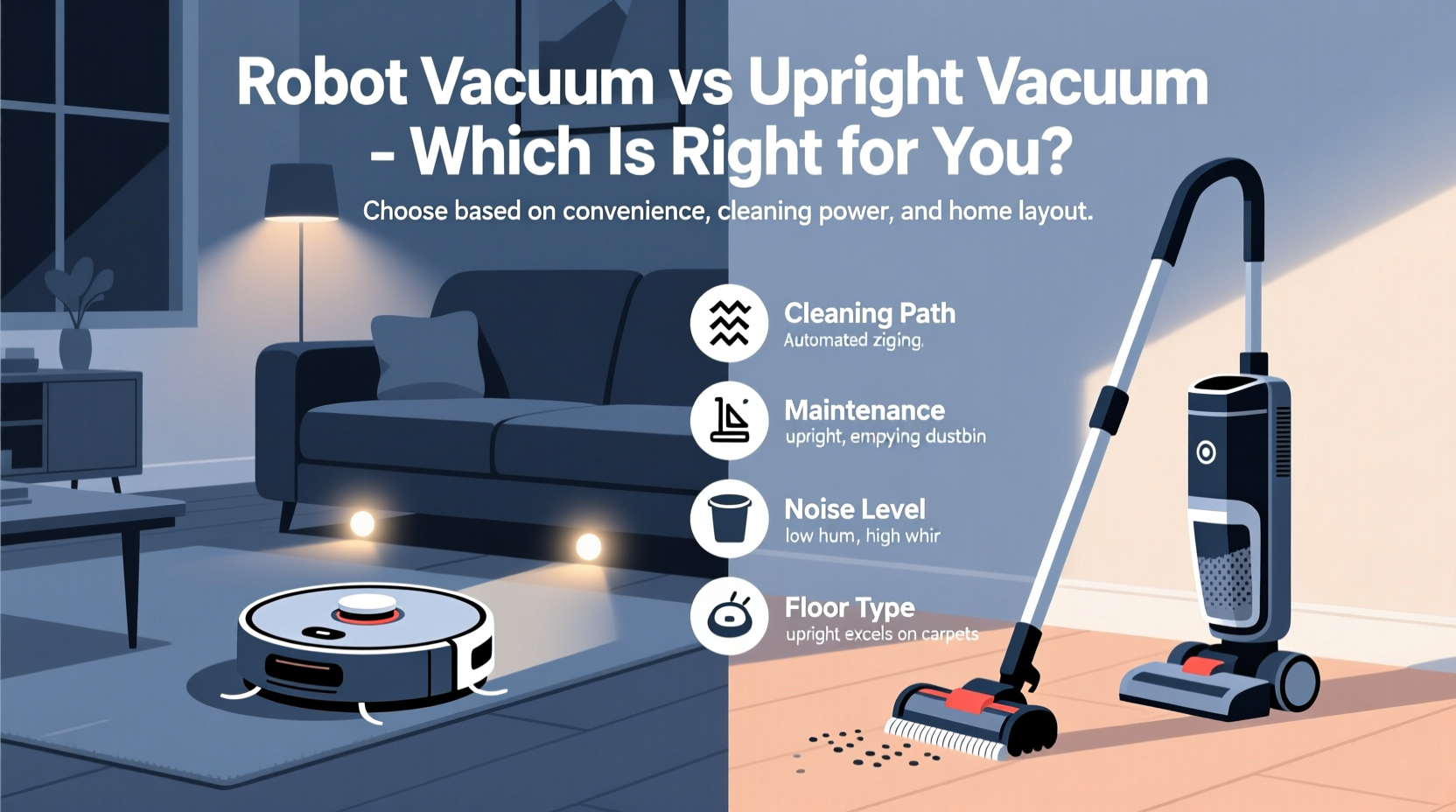
The most critical factor in any vacuum decision is how well it cleans. Upright vacuums typically offer stronger suction, larger dust bins, and better agitation through rotating brush rolls. These features make them ideal for deep-cleaning carpets, removing embedded pet hair, and tackling high-traffic areas. Most uprights also come with height adjustments, allowing them to transition smoothly between carpet and hard floors.
Robot vacuums, on the other hand, prioritize automation over raw power. While modern models have improved significantly—with some offering suction levels rivaling mid-tier uprights—they still struggle with deep pile rugs, corners, and edges. Their compact size limits bin capacity and brush roll design, often requiring multiple passes to achieve comparable results.
That said, robot vacuums excel in consistency. They can run daily, preventing dirt buildup before it becomes visible. This proactive approach reduces the need for intensive weekly cleanings. For homes with mostly hard flooring and light debris, this daily maintenance can outperform weekly deep cleans by an upright.
Lifestyle & Time Considerations
Your schedule plays a major role in determining which vacuum suits you best. If you work long hours, travel frequently, or simply dislike cleaning, a robot vacuum offers unmatched convenience. Set it on a schedule, and it runs autonomously—returning to its dock, recharging, and resuming if needed. Many models integrate with voice assistants and apps, allowing remote control and monitoring.
Upright vacuums require active involvement. You must push them room to room, empty the bin, and store them after use. While this gives you full control over coverage and pressure, it demands time and physical effort. For those who prefer a methodical, one-and-done cleaning session each week, this may be acceptable—or even satisfying.
Consider your household dynamics. Families with young children or frequent guests benefit from the constant upkeep of a robot vacuum. A quick 20-minute cycle after dinner can clear crumbs and tracked-in dirt before they settle. In contrast, retirees or stay-at-home individuals might find the ritual of using an upright vacuum manageable and even therapeutic.
“Automation doesn’t replace cleaning—it redistributes it. Robot vacuums shift effort from time to setup and oversight.” — Dr. Lena Patel, Home Efficiency Researcher at MIT Smart Living Lab
Home Layout & Obstacle Management
Not all homes are robot-friendly. Open floor plans with minimal clutter allow robot vacuums to navigate efficiently. However, homes with tight furniture arrangements, dark rugs (which sensors sometimes misread), dangling cords, or numerous thresholds may cause navigation issues. Some robots get stuck, miss spots, or require frequent resets.
Upright vacuums handle complex layouts with ease. You control direction, speed, and reach. Need to clean under a low coffee table? Tilt and glide. Dealing with stairs? Most uprights come with hose attachments for stairs and upholstery. Robots, meanwhile, cannot climb stairs and often avoid narrow spaces unless guided by virtual walls or app-defined zones.
Modern robot vacuums use LiDAR or camera-based mapping to learn your floor plan over time. Higher-end models remember multiple levels and adapt routes accordingly. But even advanced systems struggle with dynamic environments—like toys left on the floor or chairs moved after mapping.
| Factor | Robot Vacuum Suitability | Upright Vacuum Suitability |
|---|---|---|
| Open floor plan | High | Medium |
| Multiple rooms with doors | Low-Medium (requires door management) | High |
| Stairs | None (cannot climb) | High (with hose attachment) |
| Furniture with low clearance | Low (may get stuck) | High (user-controlled) |
| Pet-heavy environment | Medium (daily pickup helps) | High (superior deep clean) |
Cost, Maintenance, and Longevity
Initial price is just one part of the equation. Robot vacuums range from $200 for basic models to over $1,000 for flagship units with self-emptying docks, mopping functions, and AI navigation. Uprights vary too—from $80 budget models to $500 premium versions with HEPA filters and advanced filtration.
However, ongoing costs differ significantly. Robot vacuums require regular maintenance: cleaning brushes, replacing filters every 2–3 months, and occasionally swapping batteries or sensors. Self-emptying bases add convenience but introduce another mechanical component that can fail. Repair options are limited, and many manufacturers discourage third-party fixes.
Uprights are generally easier and cheaper to maintain. Bags (in bagged models) or bins are simple to replace. Belts and brushes are user-replaceable, and most parts are widely available. With proper care, a quality upright can last 8–10 years. Robot vacuums, especially lower-tier ones, often degrade within 3–5 years due to battery wear or software obsolescence.
Step-by-Step Decision Guide
Follow this five-step process to determine which vacuum aligns best with your needs:
- Assess Your Flooring Type
Do you have mostly carpet? Choose an upright. Mostly hardwood/tile? A robot vacuum may suffice. - Evaluate Your Cleaning Frequency
If you want daily light cleaning with minimal effort, lean toward a robot. If you prefer one thorough weekly session, go upright. - Map Your Home Layout
Walk through each room. Are there tight spaces, stairs, or cluttered areas? Robots struggle in complex setups. - Consider Pet and Allergy Factors
Pets mean more hair and dander. Uprights with HEPA filters capture allergens more effectively. Robots with mopping can help reduce tracked-in pollutants. - Set a Realistic Budget
Factor in not just purchase price, but expected lifespan and replacement part costs. A $300 robot may cost more over time than a $200 upright used for a decade.
Real-World Example: The Martinez Family
The Martinez family lives in a 1,800-square-foot suburban home with two dogs, a toddler, and hardwood floors throughout except for area rugs in the living room and bedrooms. Both parents work full-time, and weekends are packed with activities. They initially bought a mid-range upright vacuum but found themselves putting off cleaning due to lack of time.
After six months of accumulating dust bunnies and dog hair, they invested in a robot vacuum with a self-emptying base. They scheduled it to run every evening at 8 PM. Within a week, they noticed less visible debris and fewer allergy symptoms in their child. While the robot missed tight corners and couldn’t handle deep rug cleaning, they kept the upright for bi-weekly deep cleans. The combination gave them the best of both worlds: daily maintenance without sacrificing thoroughness.
Their experience highlights a growing trend: hybrid use. Rather than choosing one or the other, many households now use a robot for routine upkeep and an upright for periodic deep cleaning.
Common Myths Debunked
- Myth: Robot vacuums are just toys.
Reality: High-end models use advanced sensors, multi-surface brushes, and smart routing to deliver real cleaning value—especially on hard floors. - Myth: Uprights are outdated.
Reality: Modern uprights include lightweight designs, HEPA filtration, swivel steering, and cordless options. They remain the gold standard for deep carpet cleaning. - Myth: One size fits all.
Reality: No single vacuum type works perfectly for every home. The best choice depends on your specific environment and habits.
FAQ
Can a robot vacuum replace an upright completely?
In homes with mostly hard flooring, light shedding, and disciplined clutter management, a high-end robot vacuum with mopping and strong suction can serve as a primary cleaner. However, for homes with carpets, pets, or heavy debris, most users still rely on an upright for weekly deep cleaning.
Do robot vacuums work well on carpets?
They can handle low- to medium-pile carpets effectively, especially newer models with adaptive suction. But they lack the brush roll aggression and sustained suction of uprights, making them less effective on high-pile or heavily soiled carpets.
Are upright vacuums worth it if I already have a robot?
Yes, if you value deep cleaning. Think of the robot as a maintenance tool and the upright as a restoration tool. Using both extends the life of your floors and improves indoor air quality.
Checklist: Choosing Your Vacuum
- ☐ Identify primary floor types (carpet, hardwood, tile)
- ☐ Note presence of pets or allergy sufferers
- ☐ Measure room sizes and identify obstacles (stairs, clutter, thresholds)
- ☐ Determine available storage space for equipment
- ☐ Decide on preferred cleaning frequency (daily vs. weekly)
- ☐ Set a total cost-of-ownership budget (including filters, bags, repairs)
- ☐ Research models with strong customer support and part availability
- ☐ Consider hybrid solution: robot for daily upkeep + upright for deep cleans
Conclusion
The choice between a robot vacuum and a regular upright isn’t about which is “better” overall—it’s about which is better for you. Technology has expanded our options, but it hasn’t eliminated the value of human-driven, powerful cleaning. Robot vacuums bring convenience and consistency, ideal for modern, fast-paced households. Upright vacuums deliver unmatched cleaning depth, especially on carpets and in challenging environments.
By evaluating your home’s layout, your schedule, and your cleaning priorities, you can move beyond marketing hype and select the tool that truly fits your life. And remember—you’re not locked into one option. Many households now enjoy the synergy of both: a robot handling the daily grind and an upright stepping in when real power is needed.




 浙公网安备
33010002000092号
浙公网安备
33010002000092号 浙B2-20120091-4
Comments
No comments yet. Why don't you start the discussion?