
Lighting transforms a Christmas tree from a festive prop into a focal point—a living sculpture of warmth, memory, and intention. Yet many shoppers default to tradition or impulse: “We’ve always used red-and-green,” or “Clear looks more elegant.” But impact isn’t about preference alone—it’s about alignment. Alignment between your tree’s structure and texture, your room’s color palette and lighting conditions, your family’s emotional associations with the season, and the specific visual effect you want to evoke: luminous depth? Nostalgic cheer? Modern serenity? Or layered theatricality? Choosing between clear and colored lights isn’t binary—it’s contextual. This guide cuts through seasonal clichés with actionable criteria grounded in lighting science, interior psychology, and real-world decorating experience.
Understanding the Core Visual Differences
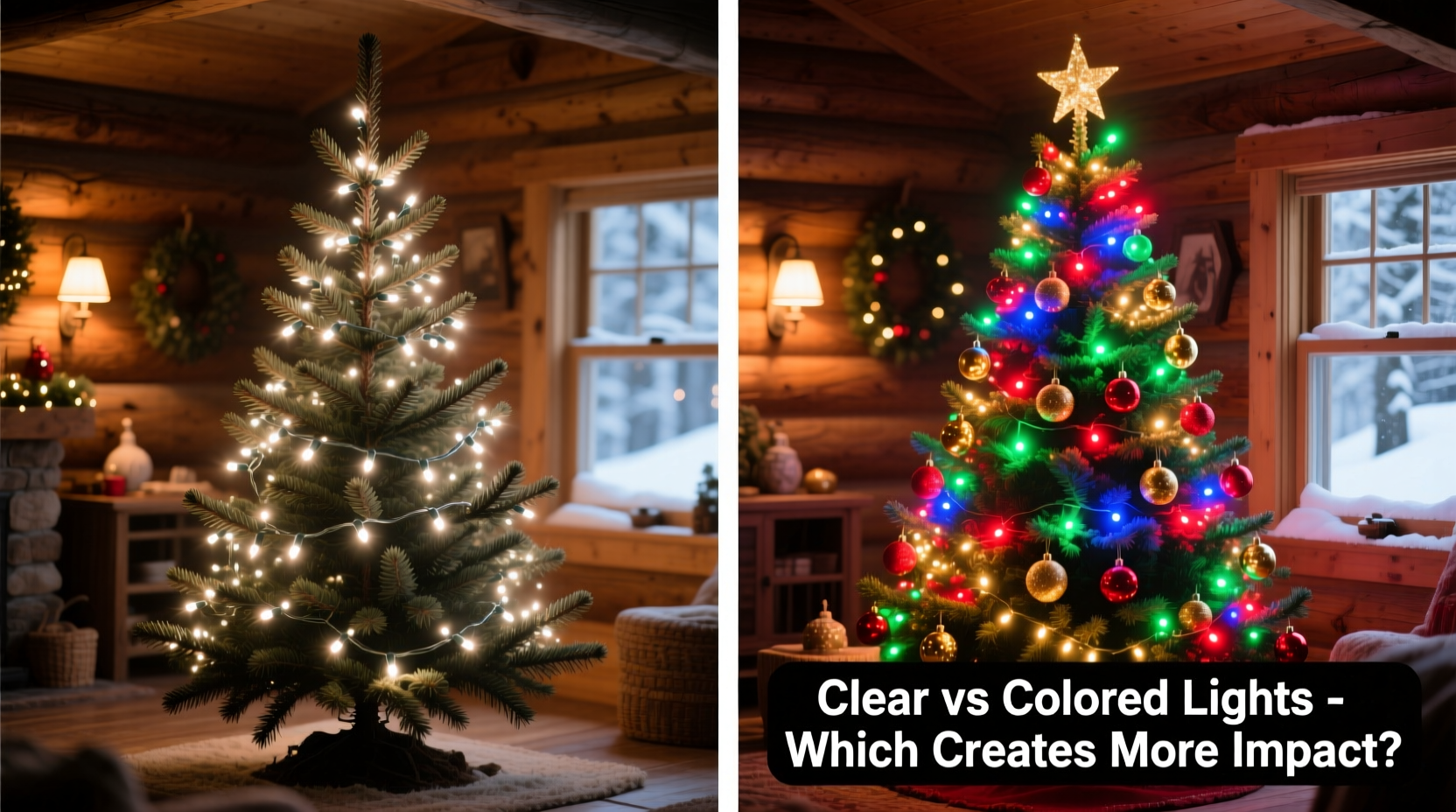
Clear (often called “white” or “warm white”) lights emit light without pigment filtration. Most modern clear LEDs produce a soft, candle-like glow—typically 2200K–2700K color temperature—mimicking incandescent warmth. Colored lights, by contrast, use dyed lenses or RGB diodes to project saturated hues: classic red, green, blue, and yellow—or newer options like violet, amber, or blush pink. The difference isn’t just hue; it’s optical behavior. Clear lights illuminate the tree’s form: needles catch and scatter light, branches recede softly, ornaments reflect with clarity. Colored lights act as discrete points of chromatic emphasis—they draw attention *to themselves*, often competing with ornaments and altering perceived tree color.
This distinction explains why two identical trees, lit identically in wattage and density, can feel radically different: one breathes quietly; the other pulses with rhythm and personality. Impact, then, is measured not in lumens but in perceptual weight—the degree to which the lighting shapes mood, directs gaze, and supports narrative.
Five Decision Factors That Actually Matter
Forget “what’s popular.” Focus instead on these five interdependent variables—each grounded in observable cause and effect:
- Tree Species & Needle Density: A dense Fraser fir holds light differently than an airy Colorado blue spruce. Thick, dark-green needles absorb colored light, muting saturation and creating shadowy pockets. Clear lights, however, bounce off dense foliage, generating even, dimensional glow. Sparse or silvery-blue trees (like Nordmann firs or Serbian spruces) reflect colored light crisply—making reds pop and blues shimmer.
- Room Lighting Environment: Ambient light competes with tree lights. In rooms with cool-toned LED ceiling fixtures (4000K+), warm clear lights create comforting contrast. In dimly lit, warmly lit spaces (e.g., with vintage lamps or candlelight), colored lights risk appearing washed out unless highly saturated. Natural light matters too: a south-facing window floods the tree at noon—clear lights harmonize; bright reds may look garish midday but magical at dusk.
- Ornament Palette & Texture: Metallic ornaments (gold, mercury glass, brushed copper) amplify clear lights with reflective brilliance. Matte ceramic or wood ornaments absorb light—colored lights provide necessary chromatic anchor. Glass baubles with internal glitter thrive under clear lights; those with painted surfaces (e.g., hand-blown folk art) often pair better with complementary colors (cobalt blue lights with white snowflake ornaments).
- Architectural Style & Color Scheme: Modern minimalist interiors (white walls, black furniture, monochrome textiles) gain sophistication from warm white lights—adding warmth without visual clutter. Traditional, cottagecore, or maximalist spaces embrace color as texture. A deep navy wall doesn’t clash with emerald lights—it deepens them. But salmon-pink lights against beige linen sofas can jar unless intentionally echoed elsewhere.
- Emotional Intent & Generational Resonance: Clear lights evoke quiet reverence, nostalgia for candlelit trees, or contemporary calm. Colored lights signal celebration, playfulness, or cultural specificity (e.g., traditional German red/green, Scandinavian blue/white, or LGBTQ+ pride palettes). Consider who gathers around your tree: children respond viscerally to color; elders often associate warm white with childhood memories. Impact includes emotional resonance—not just visual punch.
When Clear Lights Deliver Maximum Impact
Clear lights shine—not literally, but figuratively—when subtlety, cohesion, and luminosity are priorities. They’re not “boring”; they’re architectural. Their strength lies in revealing rather than declaring.
They excel in three scenarios:
- The Ornament-First Tree: When your collection includes heirloom glass, hand-blown spheres, or delicate beaded decorations, clear lights let craftsmanship take center stage. Each ornament becomes a tiny lantern, catching and refracting light without chromatic interference.
- The High-Contrast Interior: In rooms with dark walls (navy, charcoal, forest green), black furniture, or dramatic millwork, clear lights add luminous relief without disrupting tonal harmony. Warm white light reads as “glow,” not “color.”
- The Multi-Layered Lighting Plan: If your tree sits beneath a statement chandelier, beside sconces, or near string lights on mantels or windows, clear tree lights prevent chromatic overload. They integrate seamlessly into a broader ambient scheme—like bass notes anchoring a melody.
Interior designer Lena Ruiz, whose work appears in Architectural Digest’s Holiday Issue, confirms this principle: “Clients assume color adds ‘more.’ Often, it adds noise. Warm white lights on a well-proportioned tree with thoughtful ornament spacing deliver deeper impact because they invite lingering—not distraction.”
When Colored Lights Create Unforgettable Impact
Colored lights command attention—and when chosen with purpose, they tell stories. Their power emerges not from saturation alone, but from strategic placement and intentional limitation.
Three high-impact applications stand out:
- Monochromatic Depth: Using a single rich hue—deep burgundy, forest green, or slate blue—creates immersive atmosphere. Unlike multicolor sets, monochrome avoids visual chaos. It casts subtle ambient tint on nearby walls and surfaces, unifying the space. Particularly effective on tall, narrow trees in entryways or stairwells.
- Accent Layering: Reserve colored lights for specific zones: warm white on the trunk and lower branches, vibrant amber or crimson only on upper third where eyes naturally travel. This mimics natural light fall-off and adds hierarchy.
- Cultural or Narrative Alignment: A tree lit entirely in cobalt blue and silver honors Scandinavian Jul traditions. Red, white, and green lights on a vintage aluminum tree evoke 1950s Americana. Lavender and gold lights support a spiritual or meditative theme. Here, color isn’t decoration—it’s vocabulary.
“Color on a tree works like typography in design: it must serve meaning, not just fill space. One deliberate hue, repeated with consistency, carries more emotional weight than ten haphazard colors.” — Marcus Bell, Lighting Designer & Author of Illuminated Spaces
Practical Comparison: Clear vs. Colored Lights at a Glance
| Criteria | Clear (Warm White) Lights | Colored Lights |
|---|---|---|
| Best For | Elegant, minimalist, traditional, or ornament-centric displays | Festive, thematic, playful, nostalgic, or culturally resonant displays |
| Tree Compatibility | Excels on dense, dark-green firs and pines | Shines on silvery-blue spruces, sparse firs, or artificial trees with matte finishes |
| Ambient Light Harmony | Blends with warm room lighting; reduces glare in bright spaces | Can clash with cool ambient light; best in controlled or dimmed environments |
| Ornament Interaction | Enhances metallic, glass, and crystal ornaments | Complements painted, ceramic, wood, or fabric ornaments |
| Maintenance & Longevity | Less visible dust accumulation; consistent output over years | Dyed lenses may fade with UV exposure; saturation diminishes faster |
Real-World Case Study: The Heritage Home Transformation
In Portland, Oregon, the Chen family inherited a 1928 Craftsman home with original stained-glass windows and oak built-ins. For decades, they’d strung multicolored lights on their Douglas fir—“because that’s what Christmas looked like.” But the effect felt jarring: the vibrant reds and blues clashed with the amber-hued glass, and the tree competed with the fireplace’s warm glow.
Working with local lighting consultant Anya Petrova, they tested alternatives. First, warm white micro-lights—subtle, barely visible wire, 2700K. The result was immediate: the tree glowed like a hearth, reflecting amber light from the windows onto the ceiling. Ornaments—vintage mercury glass and handmade wooden stars—shimmered without chromatic interference.
Then, they added intention: a single strand of deep indigo lights wrapped tightly around the trunk base, echoing the blue in the dining room’s Persian rug. Not decorative—architectural. The indigo grounded the tree visually, tying it to the room’s color story without shouting.
Impact shifted from “a lit tree” to “the heart of the home.” Guests consistently remarked on the “calm energy” and “timeless feeling”—not the lights themselves, but the atmosphere they enabled. The Chens now use this approach annually: clear lights as foundation, one accent color as punctuation.
Your Actionable Lighting Checklist
Before purchasing lights, walk through this six-step checklist—designed to eliminate guesswork:
- ✅ Assess your tree’s silhouette: Is it full and conical (favors clear) or open and irregular (favors colored for visual fill)?
- ✅ Photograph your room at night: Turn off all lights except overheads. Does the space feel warm or cool? Match your light temperature accordingly.
- ✅ Lay out ornaments on a white sheet: Note dominant metal tones (gold/silver/copper) and surface textures (glossy/matte). Metallic + glossy = clear lights win. Matte + ceramic = colored lights gain ground.
- ✅ Identify one emotional goal: “Cozy,” “reverent,” “joyful,” “sophisticated,” “nostalgic.” Clear lights lean toward the first three adjectives; colored lights toward the last two—but context flips this. (A single strand of antique-style red bulbs evokes reverence; neon pink suggests joy.)
- ✅ Check bulb count per foot: For impact, density matters more than color. Aim for 100 bulbs per foot on standard 7–8 ft trees. Skimping on clear lights creates patchiness; oversaturating with colored lights causes visual vibration.
- ✅ Verify dimmability and compatibility: Many smart clear-light strings offer smooth dimming and warm-to-cool shifts—adding flexibility colored sets rarely match. Ensure controllers match your existing ecosystem (e.g., Alexa, Hue Bridge).
FAQ: Addressing Common Lighting Dilemmas
Can I mix clear and colored lights on the same tree?
Yes—but with discipline. Avoid random alternation. Instead, layer intentionally: warm white as base illumination (80% of total lights), then use one saturated color for targeted accents (e.g., red on topmost branches, blue on lower third). Never mix more than two light types. Three creates visual static.
Do LED clear lights really look like old-fashioned incandescents?
Modern high-CRI (Color Rendering Index >90) warm white LEDs closely replicate incandescent warmth and diffusion—especially those labeled “vintage filament” or “candle tip.” Avoid cheap “cool white” LEDs marketed as “white”; they emit harsh 4000K+ light that undermines the cozy effect.
Why do my colored lights look dull after one season?
Dye degradation from heat and UV exposure is common in low-cost colored LEDs. Premium brands use UV-stabilized polycarbonate lenses and efficient thermal management. Also, dust accumulation on colored lenses diffuses saturation—wipe gently with a dry microfiber cloth before storage.
Conclusion: Light With Intention, Not Habit
Choosing between clear and colored Christmas tree lights isn’t about picking a side—it’s about clarifying your vision. A tree lit with purpose becomes more than decoration; it becomes a vessel for meaning. Clear lights offer quiet authority, revealing texture and honoring craft. Colored lights offer expressive voice, anchoring memory and declaring joy. Neither is superior. Both become powerful when selected not as accessories, but as intentional tools in your seasonal storytelling.
This year, pause before the box of lights. Ask not “What do I usually do?” but “What do I want this tree to say—and to whom?” Measure your space, touch your ornaments, recall the light in your grandmother’s parlor or the glow of your first apartment tree. Then choose the light that answers that question—not the one that fills the cart.




 浙公网安备
33010002000092号
浙公网安备
33010002000092号 浙B2-20120091-4
Comments
No comments yet. Why don't you start the discussion?