
Starting a bullet journal can be one of the most rewarding productivity decisions you make. Unlike traditional planners, a bullet journal adapts to your life—not the other way around. But before you begin tracking habits, setting goals, or designing monthly spreads, there’s a crucial first step: choosing the right journal. The wrong notebook can lead to frustration—ink bleeding through pages, difficulty laying flat, or limited space for creativity. For beginners, selecting the ideal journal sets the foundation for consistency, comfort, and long-term success.
A good bullet journal isn’t just about aesthetics; it’s about functionality. It should support your writing, accommodate your preferred tools (like pens or pencils), and withstand daily use. With countless options on the market—from dotted notebooks to customizable planners—it's easy to feel overwhelmed. This guide breaks down the key factors that matter most so you can confidently pick a journal that works with you, not against you.
Understand Your Journaling Style and Needs
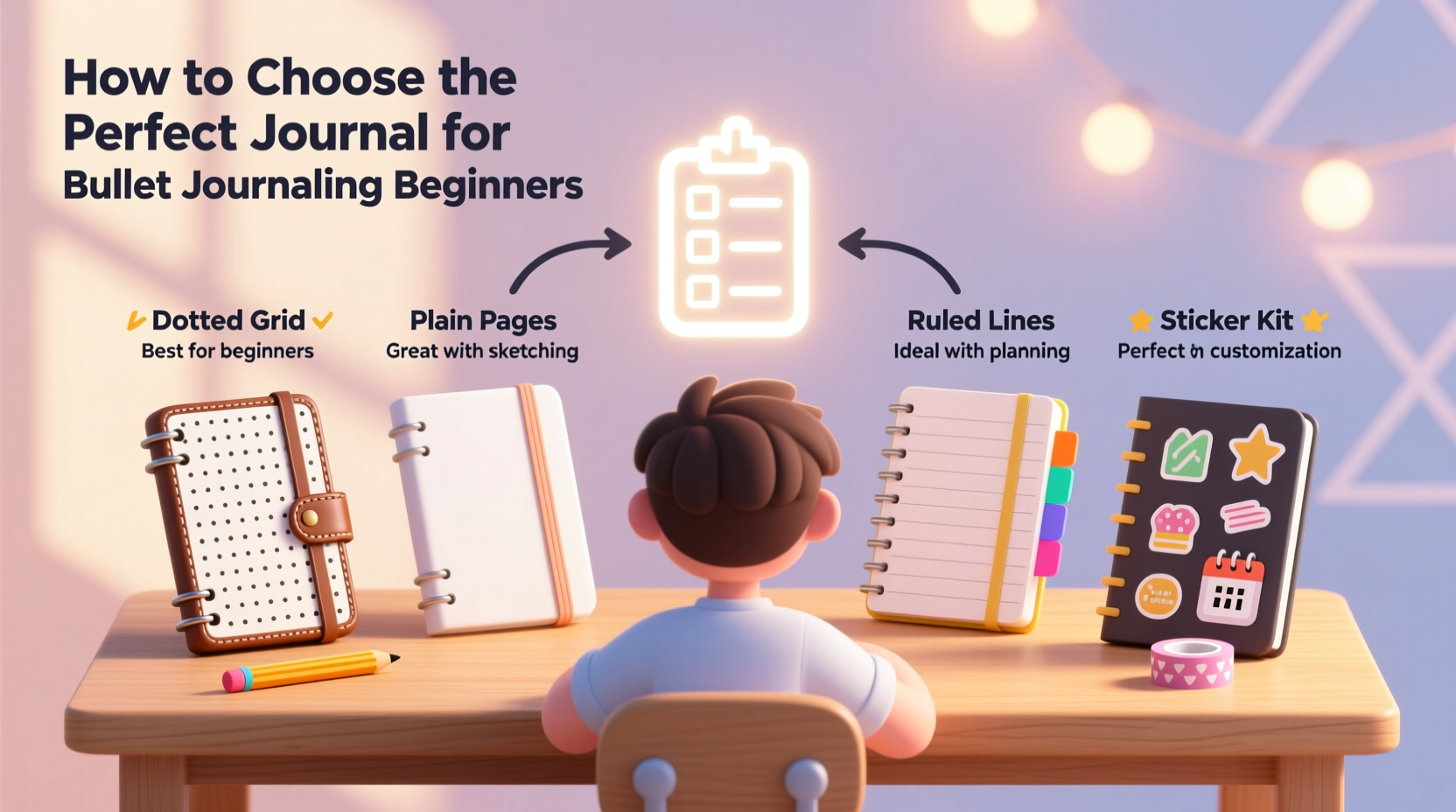
Before examining paper weight or binding types, take a moment to reflect on how you plan to use your bullet journal. Are you aiming for a minimalist system focused on task tracking and quick notes? Or do you envision elaborate spreads with color coding, doodles, and habit trackers? Your intended use will directly influence the type of journal that suits you best.
Some beginners are drawn to artistic expression and may want thick paper that handles markers and watercolor without bleed-through. Others prioritize portability and might prefer a compact A6 or pocket-sized notebook they can carry in a bag. Still, others need structure—a pre-formatted planner won’t work, but clearly defined grids or light dot patterns can help maintain alignment when creating layouts.
Ask yourself:
- Do I write quickly and frequently, or do I prefer detailed, thoughtful entries?
- Will I use fountain pens, brush pens, or standard ballpoints?
- Do I travel often and need something lightweight?
- Am I likely to add stickers, washi tape, or glue-ins?
Answering these questions helps narrow down what features matter most. There is no universal “best” journal—only the best one for *you* at this stage of your journey.
Paper Quality: The Most Important Factor
If there’s one element that makes or breaks a bullet journal experience, it’s paper quality. Poor paper leads to ink bleeding, ghosting (where ink shows through to the other side), and smudging—all of which disrupt flow and discourage regular use. As a beginner, investing in decent paper prevents early frustration and keeps motivation high.
Look for journals labeled as having “thick,” “premium,” or “bleed-resistant” paper. Measured in grams per square meter (gsm), paper weight is a reliable indicator of durability:
| Paper Weight (gsm) | Characteristics | Suitable For |
|---|---|---|
| 60–70 gsm | Thin, prone to bleed-through | Pencil or light pen use only |
| 80–100 gsm | Good resistance, minimal ghosting | Most pens, light markers |
| 120+ gsm | Excellent for wet media | Watercolor, alcohol markers |
Many popular bullet journals, such as the Leuchtturm1917 Medium or Moleskine Cahier, offer 70–85 gsm paper—sufficient for gel pens and rollerballs but risky with heavy ink or highlighters. If you plan to experiment with art supplies, consider brands like Strathmore Visual Journals or Rhodia Webnotebooks, which feature 90+ gsm paper designed for mixed media.
“Paper quality determines how freely you can express ideas. Thin paper limits creativity—if your pen ruins the next page, you’ll hesitate to write boldly.” — Sarah Lin, Analog Productivity Coach
Size and Portability: Finding the Right Fit
Notebook size affects both usability and convenience. While larger journals provide more space, they’re harder to carry. Smaller ones fit in bags but limit layout complexity. The most common sizes for bullet journaling are:
- A6 (4.1 x 5.8 in): Ultra-portable, great for on-the-go jotting, but restrictive for complex spreads.
- A5 (5.8 x 8.3 in): Balanced choice—roomy enough for creativity, still portable. Most recommended for beginners.
- Letter (8.5 x 11 in): Spacious, ideal for large trackers or creative layouts, but bulky for daily carry.
For those new to bullet journaling, A5 is widely considered the sweet spot. It offers ample real estate for weekly logs, future planning, and collections while remaining manageable in backpacks or tote bags. If you're unsure, start with A5—you can always downsize later.
Binding and Lay-Flat Design
A journal’s binding impacts how easily you can write across two-page spreads. Spiral-bound notebooks lay completely flat and allow 360-degree flipping, making them excellent for drawing and uninterrupted layouts. However, they’re less durable and can snag in bags.
Perfect-bound (glued spine) or sewn-bound books look sleeker and last longer but may not open fully. Some high-end notebooks, like Leuchtturm1917, include a ribbon bookmark and elastic closure, with a design that allows near lay-flat use after breaking in.
Consider this trade-off:
- Spiral-bound: Best functionality, lower durability.
- Glued/Sewn-bound: Better longevity, may require pressing to lie flat.
If you value smooth writing across center folds, prioritize lay-flat capability. Many beginners overlook this until they struggle to write in the gutter—the inner margin where pages meet. A notebook that opens well reduces hand strain and improves legibility.
Dot Grid vs. Blank vs. Lined: Which Format Works Best?
The page layout significantly influences how you design your spreads. Bullet journaling relies heavily on customization, and dot grids have become the gold standard for a reason.
- Dot Grid: Offers subtle guidance for aligning boxes, calendars, and tables without overwhelming the page. Dots disappear under drawings or writing, giving flexibility for both structured and freeform layouts.
- Lined: Useful if you mostly write paragraphs, but limits visual planning. Hard to create neat grids or boxes without extra effort.
- Blank: Maximum creative freedom, but challenging to keep layouts neat without a ruler. Best for advanced users or artists.
For beginners, dot grid is overwhelmingly the top recommendation. It supports the core bullet journal method—rapid logging, migration, and indexing—while allowing room to grow into more intricate designs over time.
Step-by-Step Guide to Choosing Your First Journal
Selecting the perfect journal doesn’t have to be overwhelming. Follow this simple five-step process to make a confident decision:
- Define Your Purpose: Will this be primarily for task management, creative expression, or both? Write down your top three uses (e.g., appointments, habit tracking, brainstorming).
- Determine Preferred Size: Based on portability needs, choose between A6, A5, or larger. When in doubt, go A5.
- Test Paper Compatibility: If possible, check reviews or swatch videos showing your favorite pens on the paper. Look for zero bleed-through and minimal ghosting.
- Evaluate Layout Needs: Opt for dot grid unless you have a specific reason to prefer blank or lined.
- Check Functional Features: Look for numbered pages (helps with indexing), a table of contents, and extras like pockets or bookmarks.
Top Recommended Journals for Beginners
Based on performance, availability, and user feedback, here are three highly regarded options for newcomers:
| Journal | Paper (gsm) | Size | Format | Best For |
|---|---|---|---|---|
| Leuchtturm1917 Medium | 80 | A5 | Dot Grid | All-around use, indexing, durability |
| Moleskine Cahier Notebook | 70 | A5 | Dot Grid | Budget-friendly starter option |
| ARC Journal by Kinchaku | 100 | A5/A6 | Dot Grid | Customization, premium feel |
The Leuchtturm1917 stands out due to its 80 gsm bleed-resistant paper, built-in index, and expandable pocket. Its consistent quality has made it a staple in the bullet journal community. Moleskine offers a slightly thinner paper but comes at a lower price point—ideal for testing the waters. The ARC Journal, though pricier, features customizable covers and ultra-durable construction, appealing to those who want a long-term companion.
Real Example: Maya’s Journey from Frustration to Flow
Maya, a university student, started her bullet journaling journey with a basic lined notebook from a dollar store. Excited at first, she quickly grew frustrated—her highlighters bled through pages, the spine cracked after two weeks, and she couldn’t draw straight lines for her class schedule. After abandoning the journal for months, she revisited the idea with guidance from an online community.
This time, she chose an A5 dot-grid Leuchtturm1917 with 80 gsm paper. She tested her favorite Tombow brush pens on a sample sheet first. The difference was immediate: pages stayed intact, layouts looked clean, and she could finally enjoy the process. Within a month, she was consistently updating her tasks, tracking sleep, and even adding small illustrations. “Switching notebooks changed everything,” she said. “It wasn’t the method that failed me—it was the tool.”
Essential Checklist Before You Buy
Use this checklist to ensure your chosen journal meets all critical criteria:
- ✅ Dot grid or suitable layout for planning
- ✅ Paper weight of at least 80 gsm (higher if using markers)
- ✅ Size appropriate for intended use (A5 recommended for starters)
- ✅ Lay-flat or near lay-flat binding
- ✅ Numbered pages for easy indexing
- ✅ Includes a table of contents or space to create one
- ✅ Durable cover material (soft-touch, canvas, or leatherette)
- ✅ Additional features: pocket, bookmark, or pen loop (optional but helpful)
Frequently Asked Questions
Can I use any notebook for bullet journaling?
Technically, yes—but not all notebooks perform well. Standard school notebooks often have thin paper and weak bindings, leading to bleed-through and damage. For a sustainable practice, invest in a notebook designed for frequent writing and creative use.
Should I get a dotted or blank journal as a beginner?
Dotted is strongly recommended. It provides invisible structure for drawing grids, calendars, and boxes, helping maintain neatness without restricting creativity. Blank pages offer freedom but require more precision, which can be discouraging at first.
How much should I spend on my first bullet journal?
You don’t need to spend over $30, but avoid extremely cheap options under $10 unless they’ve been reviewed for quality. A mid-range journal ($15–$22) like Leuchtturm1917 or a Kinbor dot grid offers the best balance of cost and performance for beginners.
Start Strong with the Right Foundation
Your bullet journal is more than a notebook—it’s a personal system for clarity, growth, and intentionality. The right journal empowers that process; the wrong one hinders it. By prioritizing paper quality, size, layout, and functionality, you set yourself up for consistency and enjoyment, not frustration and abandonment.
Take the time to assess your needs, test options, and choose thoughtfully. Whether you go with a trusted classic like Leuchtturm1917 or explore newer brands with innovative features, remember that the best journal is the one you’ll actually use. Once you find it, the rest—indexing, rapid logging, monthly planning—will follow naturally.




 浙公网安备
33010002000092号
浙公网安备
33010002000092号 浙B2-20120091-4
Comments
No comments yet. Why don't you start the discussion?