
Black toenails—medically known as subungual hematoma—are a common but often preventable issue among runners. They occur when repeated pressure or trauma causes blood to pool under the nail, turning it dark and sometimes leading to pain or nail loss. While occasional cases may stem from a single stub or drop, most chronic black toenails are caused by poorly fitting shoes. The root of the problem? Wearing running shoes that are too small, especially in length or width. Choosing the correct running shoe size isn’t just about comfort—it’s a critical step in protecting your feet over the long haul.
Many runners assume their everyday shoe size translates directly to their running shoe size. That’s a misconception that leads to blisters, bruised toes, and yes—black toenails. Running places unique demands on your feet: they swell during activity, shift forward with each stride, and endure thousands of impacts per mile. If your shoes don’t accommodate these changes, your toes will pay the price. This guide breaks down exactly how to select the right running shoe size to protect your toenails, improve performance, and avoid unnecessary discomfort.
Understanding Why Black Toenails Happen
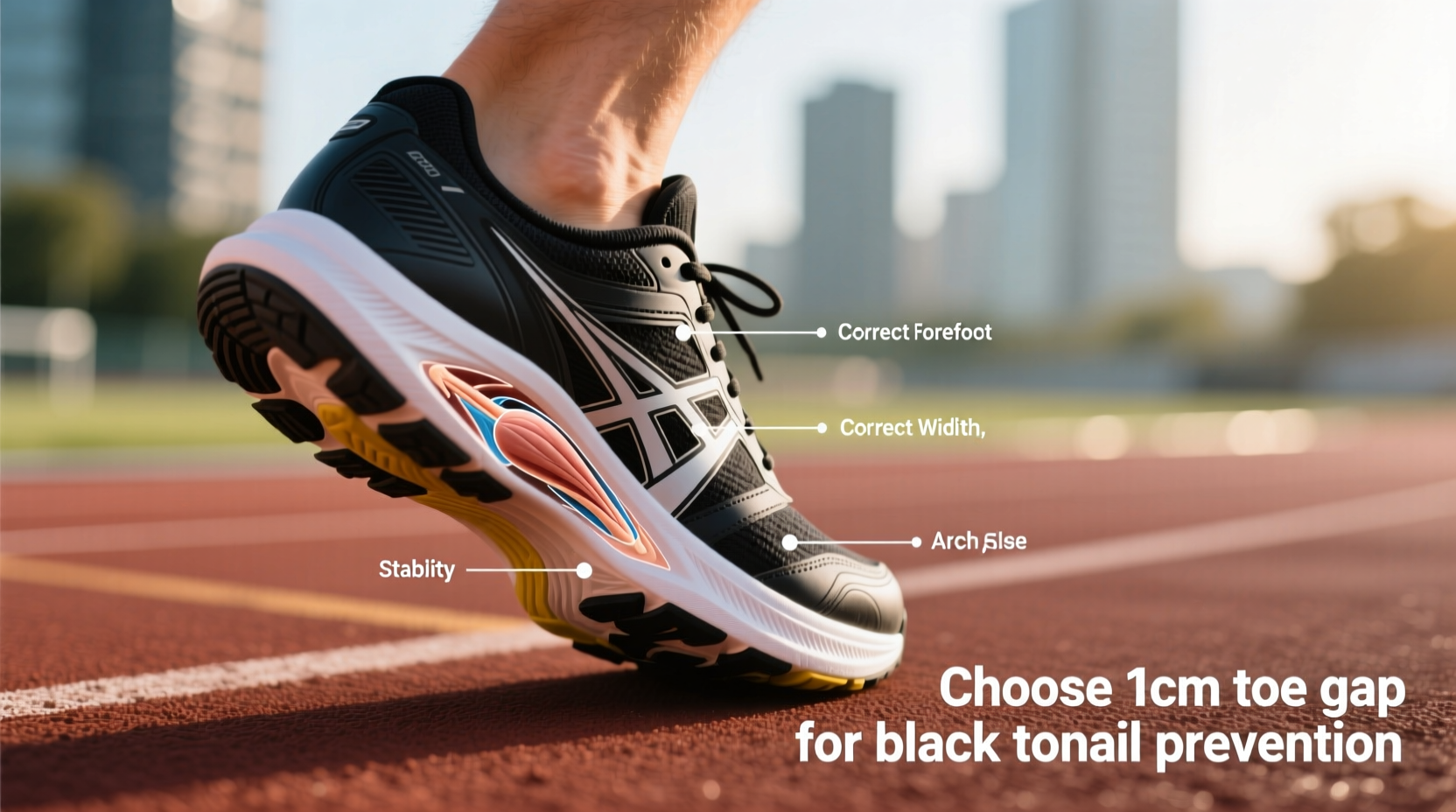
When you run, your foot naturally slides forward with every heel strike. On downhill sections, this motion intensifies. If there isn't enough space between your longest toe and the end of the shoe, your toenail repeatedly bangs into the front of the toe box. Over time, this micro-trauma damages the nail bed, causing bleeding underneath the nail. The result is discoloration—ranging from red to purple to black—and possible detachment of the nail.
Swelling also plays a role. During long runs, feet can expand by half a size or more due to increased blood flow and fluid retention. A shoe that feels snug at the start of a run can become painfully tight by mile eight. Narrow toe boxes squeeze the toes together, increasing lateral pressure that can bruise multiple nails at once. Even minor friction, if repeated over hundreds of strides, can be enough to cause damage.
How to Measure Your Running Shoe Size Accurately
Measuring your foot correctly is the foundation of proper shoe fit. Many runners wear the wrong size simply because they’ve never measured their feet while standing or wearing running socks. Here's how to do it right:
- Measure both feet: Most people have one foot slightly larger than the other. Always size for the longer foot.
- Use a Brannock device or ruler: Stand on a piece of paper with your heel against a wall. Mark the tip of your longest toe (which may not be the big toe). Measure the distance from heel to mark in inches or centimeters.
- Check width: Use a measuring tape around the widest part of your forefoot. Compare this to standard width charts (e.g., B for women, D for men is standard).
- Account for sock thickness: Wear the same type of running socks you plan to use when testing shoes.
- Add 3/8 to 1/2 inch (about 1 cm) of space: This is the ideal toe clearance for running shoes.
For example, if your foot measures 26 cm, you’ll likely need a US men’s size 9 or women’s size 10, depending on the brand. But sizing varies significantly between manufacturers, so never rely solely on numerical size. Always try shoes on and assess fit dynamically.
The Importance of Toe Box Space and Heel Lockdown
Two areas of the shoe are critical: the toe box and the heel. The toe box must allow room for your toes to splay and move without hitting the front. The heel must remain stable to minimize forward slippage.
Aim for about a thumbnail’s width (roughly 3/8” to 1/2”) between your longest toe and the end of the shoe. This gap accommodates foot swelling and forward movement during running. If your finger fits vertically between your heel and the back of the shoe, it’s too loose—but if you can’t slip your index finger behind the heel, it might be too tight.
| Fitting Area | Ideal Fit | Poor Fit Signs |
|---|---|---|
| Toe Clearance | 3/8” to 1/2” gap when laced | Toes touch front when standing or walking |
| Heel Hold | No slipping; minimal movement | Heel lifts with each step |
| Width | Toes lie flat without pinching | Bunions or pinky toe pressed against side |
| Midfoot | Snug but not constricting | Pressure on instep or arch collapse |
Some brands design shoes with engineered toe boxes—wider at the front to allow natural toe splay. These can dramatically reduce pressure on toenails. Brands like Altra, Topo Athletic, and certain models from Hoka and Saucony offer wider forefeet options. If you have wide feet or high arches, consider these variations even if you’re not used to them.
“Runners who experience recurrent black toenails often discover they’ve been wearing shoes that are one full size too short. It only takes 5mm of repeated impact to cause bruising.” — Dr. Laura Chen, Sports Podiatrist
Step-by-Step Guide to Buying the Right Running Shoes
Buying running shoes should be a deliberate process, not a quick transaction. Follow this timeline to ensure optimal fit and long-term foot health:
- Time it right: Shop in the late afternoon or after a short walk to mimic foot swelling during runs.
- Bring your running socks: Wear the same thickness you’ll use during training.
- Visit a specialty running store: Staff can analyze your gait, recommend appropriate models, and measure your feet properly.
- Try multiple sizes and models: Don’t assume your size is consistent across brands. Try at least two sizes in each model—one true to size, one half-size up.
- Walk and jog in them: Most stores have treadmills or rubber floors. Simulate running motion to test heel lock and toe space.
- Check for pressure points: Wiggle your toes. Feel for pinching, rubbing, or numbness.
- Wait before finalizing: Some stores offer trial periods. Run a few miles in new shoes before committing.
Never buy running shoes online without first trying them on in person—unless you’ve already worn that exact model and know the fit. Even then, production batches can vary slightly.
Real Runner Case: From Chronic Black Toenails to Pain-Free Miles
Mark T., a 38-year-old marathoner from Colorado, had struggled with black toenails for years. After every race, he’d lose at least one toenail, usually on his right foot. He assumed it was normal until a podiatrist asked a simple question: “What size are your shoes?”
Mark had been wearing the same size he wore in high school—size 10.5 in a popular brand. After measuring his feet at a specialty running store, he discovered his right foot had grown to a 11.5, with significant widening in the forefoot. The technician showed him how his toes were visibly pressing against the front of the shoe when he stood.
He switched to a size 12 with a wide toe box and began using moisture-wicking socks to reduce internal friction. Within three months, his toenails stopped bruising. His next marathon ended with no black toenails—and a personal best time, thanks to improved comfort and stride efficiency.
“I wasted years thinking black toenails were part of the game,” Mark said. “Turns out, they were just a warning sign I ignored.”
Do’s and Don’ts of Running Shoe Fit
| Do’s | Don’ts |
|---|---|
| Size up if your toes touch the front when standing | Assume your street shoe size equals your running size |
| Choose shoes with a roomy toe box if you have wide feet | Ignore heel slippage—it leads to instability and forward drift |
| Replace shoes every 300–500 miles to maintain cushioning | Keep running in worn-out shoes; collapsed midsoles reduce space |
| Lace shoes properly to secure heel and midfoot | Tie laces too tightly over the top of the foot, cutting off circulation |
| Trim toenails straight across, not rounded | Cut nails too short before long runs |
FAQ: Common Questions About Shoe Fit and Toenail Health
Can I prevent black toenails just by trimming my toenails?
While keeping toenails trimmed straight across and at moderate length helps reduce leverage and pressure, it won’t fix the root cause if your shoes are too small. Trimming alone is not enough—proper shoe fit is essential.
Should I size up in all running shoes?
Not necessarily. Some brands run large, others small. Always fit based on feel and measurements, not assumptions. However, it’s common to need a half-size to full-size larger in running shoes than in casual footwear.
Do blister socks help prevent black toenails?
Specialty running socks with seamless toes and moisture-wicking fibers can reduce friction, but they won’t compensate for inadequate toe space. They’re a helpful addition, not a solution to poor fit.
Final Checklist Before You Buy
- ✅ Feet measured while standing, in running socks
- ✅ Both feet checked—sized for the longer one
- ✅ At least 3/8” space between longest toe and shoe end
- ✅ No heel slippage when walking or jogging
- ✅ Toes can wiggle freely; no side pressure
- ✅ Laces adjusted to secure midfoot without pinching
- ✅ Tested on incline or treadmill if possible
- ✅ Plan to replace shoes every 300–500 miles
Conclusion: Protect Your Toes, Preserve Your Passion
Black toenails aren’t a badge of honor—they’re a signal that something’s wrong. With the right approach to shoe selection, you can eliminate this painful, unsightly condition and keep your feet healthy for the long run. The key lies in accurate measurement, thoughtful fit assessment, and willingness to break free from outdated size assumptions. Your feet swell, shift, and work hard with every mile. Give them the space and support they deserve.
Take the time to get professionally fitted. Try on multiple sizes. Prioritize function over fashion. And remember: the perfect running shoe doesn’t just feel good at rest—it performs flawlessly under motion. Make smart choices today, and your toenails (and your future self) will thank you.




 浙公网安备
33010002000092号
浙公网安备
33010002000092号 浙B2-20120091-4
Comments
No comments yet. Why don't you start the discussion?