
Millions of people experience tooth sensitivity, yet the oral care aisle remains a minefield of exaggerated claims and confusing labels. From “instant relief” promises to celebrity endorsements, marketing can easily overshadow science. Choosing the right toothpaste shouldn’t be about which box looks cleanest or which ad feels most reassuring—it should be about what actually works. The truth is, not all desensitizing toothpastes are created equal, and many rely more on branding than biochemistry. Understanding the active ingredients, regulatory standards, and real-world effectiveness can help you make informed decisions—without paying extra for buzzwords.
Understanding Tooth Sensitivity: Why It Happens
Tooth sensitivity occurs when the protective layers of enamel or cementum wear away, exposing the underlying dentin. Dentin contains tiny tubules that lead directly to the nerve of the tooth. When hot, cold, sweet, or acidic substances reach these tubules, they trigger sharp, temporary pain. Common causes include:
- Aggressive brushing with a hard-bristled toothbrush
- Gum recession due to periodontal disease or aging
- Enamel erosion from acidic foods, beverages, or acid reflux
- Tooth grinding (bruxism)
- Dental procedures like whitening or scaling
While occasional sensitivity may resolve on its own, chronic discomfort requires targeted intervention. This is where desensitizing toothpastes come in—but only if chosen wisely.
Key Active Ingredients That Actually Work
The effectiveness of a toothpaste for sensitive teeth hinges almost entirely on its active ingredients. Unlike regular toothpastes, which focus on plaque removal and fresh breath, desensitizing formulas aim to block pain signals or seal exposed tubules. Here are the scientifically supported compounds you should look for:
- Potassium Nitrate – This ingredient penetrates the dentin tubules and reduces nerve excitability over time. Studies show it takes about 2–4 weeks of consistent use to achieve noticeable relief. It doesn’t work instantly, despite some product claims.
- Stannous Fluoride – More than just a fluoride source, stannous fluoride forms a protective barrier over exposed dentin while also offering antibacterial benefits. It’s particularly effective for people with both sensitivity and gingivitis.
- Arginine + Calcium Carbonate – Found in certain professional-grade formulas, this combination seals open tubules quickly by creating a plug-like layer. Some clinical trials suggest faster results compared to potassium nitrate alone.
- Novamin (Calcium Sodium Phosphosilicate) – A bioactive glass compound that releases calcium and phosphate ions to form a hydroxyapatite-like layer over dentin. It’s less common but shows promise in long-term remineralization.
Fluoride, while essential for overall enamel strength, is not inherently desensitizing unless combined with one of the above agents. Beware of products that list fluoride as their primary \"sensitivity solution\"—this is often a marketing tactic.
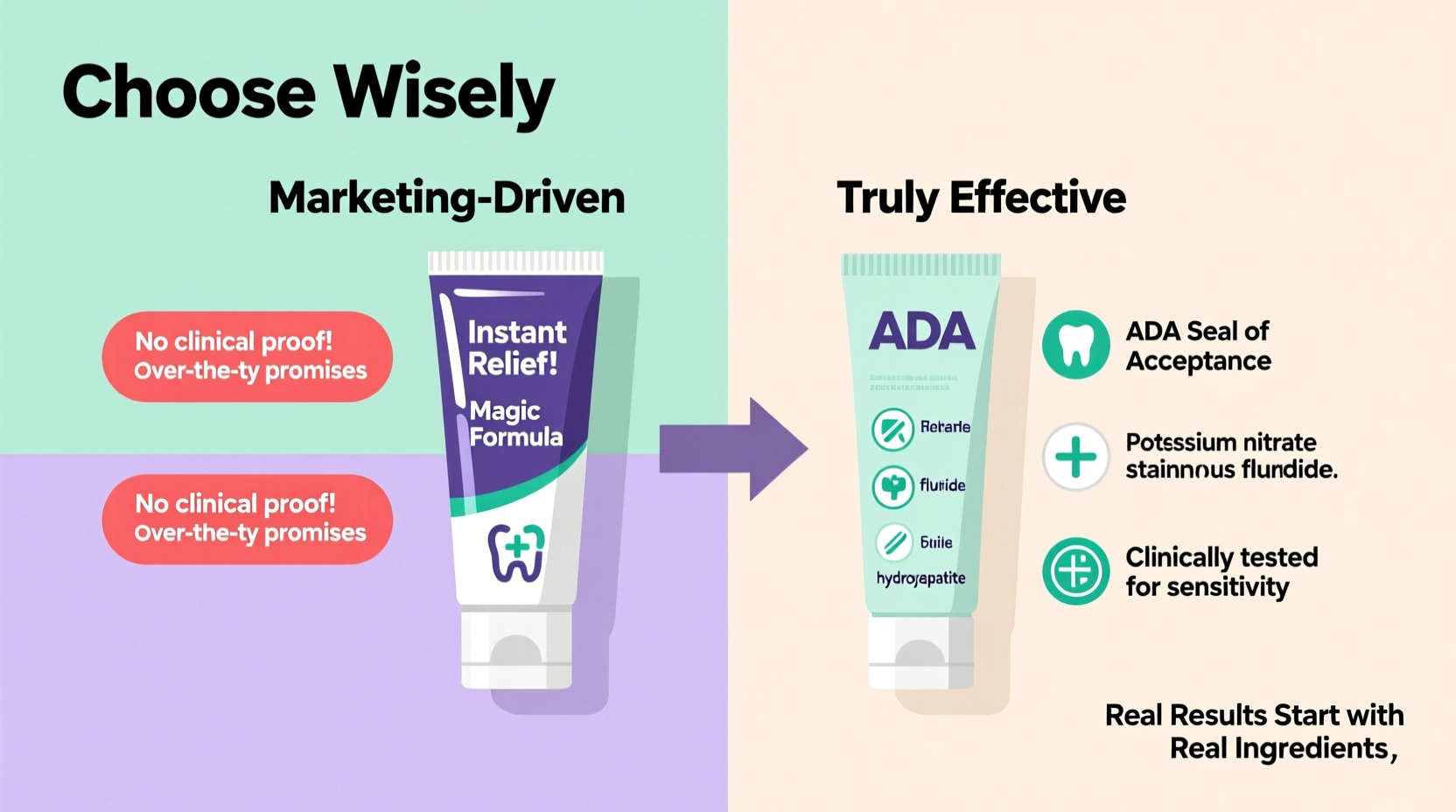
“Look at the active ingredients list, not the front label. Terms like ‘gentle’ or ‘soothing’ don’t mean anything unless backed by potassium nitrate, stannous fluoride, or arginine.” — Dr. Lena Patel, Clinical Dentist and Oral Health Researcher
Avoiding Marketing Traps and Misleading Labels
Oral care brands spend millions crafting messages that sound scientific but lack substance. Here are common tactics used to mislead consumers—and how to see through them:
| Marketing Claim | What It Really Means | What to Look For Instead |
|---|---|---|
| “Instant Relief” | No toothpaste provides true instant relief. Some create a numbing sensation via menthol or eucalyptus, but this doesn’t treat the cause. | Real relief comes after consistent use. Check for proven actives like stannous fluoride. |
| “Natural” or “Herbal Formula” | These terms aren’t regulated. Many natural toothpastes lack fluoride and desensitizing agents. | Focus on efficacy, not trends. Natural ≠ effective for sensitivity. |
| “Dentist Recommended” | This often refers to surveys where dentists recommend a brand among peers—not proof of superior performance. | Check if it’s ADA-approved or has published clinical studies. |
| “Whitening + Sensitive Protection” | Whitening agents like hydrogen peroxide can worsen sensitivity. Dual-purpose formulas may compromise on both fronts. | Use separate products: a desensitizing paste daily and whitening occasionally under supervision. |
| “No Harsh Chemicals” | A fear-based phrase implying safe ingredients are dangerous. Fluoride and potassium nitrate are safe and necessary. | Trust peer-reviewed science, not emotional labeling. |
The American Dental Association (ADA) Seal of Acceptance is one of the few reliable indicators of a product’s safety and efficacy. To earn it, manufacturers must submit clinical data proving their claims. While not all good products carry the seal (due to cost), those that do have undergone independent verification.
Step-by-Step Guide to Choosing the Right Toothpaste
Selecting an effective desensitizing toothpaste doesn’t require guesswork. Follow this evidence-based process:
- Assess Your Sensitivity Pattern – Is it triggered by cold? Sweetness? Brushing? Cold sensitivity often responds better to potassium nitrate, while generalized discomfort may benefit more from stannous fluoride.
- Read the Active Ingredients – Confirm the presence of at least one proven agent: potassium nitrate (typically 5%), stannous fluoride, or arginine-based systems.
- Check for ADA Approval – Visit ada.org or look for the ADA seal on packaging. This ensures third-party validation of claims.
- Avoid Conflicting Additives – Steer clear of sodium lauryl sulfate (SLS), which can irritate gums and increase sensitivity in some individuals. Also avoid high-abrasion formulas if you have receding gums.
- Commit to Consistent Use – Apply the toothpaste twice daily and leave it on for two minutes. Do not rinse immediately after brushing—spit, don’t rinse—to allow active ingredients more contact time.
- Evaluate After 4 Weeks – Real improvement takes time. If no change occurs, switch to a formula with a different active ingredient.
Some people respond better to potassium nitrate, others to stannous fluoride. There’s no universal winner—only what works for your biology.
Mini Case Study: Sarah’s Experience with Sensitivity Relief
Sarah, a 34-year-old teacher from Portland, struggled with severe cold sensitivity for over a year. She tried three different “sensitive” toothpastes, each marketed as “fast-acting” or “gentle.” None helped. Frustrated, she brought the tubes to her dentist, who pointed out that two contained no active desensitizing agents—just fluoride and flavoring. The third had potassium nitrate but was paired with SLS, which likely irritated her exposed root surfaces.
Her dentist recommended switching to a stannous fluoride-based paste without SLS. Sarah used it consistently for four weeks, brushing gently with a soft-bristled brush and avoiding citrus-heavy breakfasts. By week five, her sensitivity dropped from a 7/10 to a manageable 2/10. “I wasted months and $40 on pretty boxes,” she said. “Turns out, the plain tube with the weird aftertaste worked best.”
Sarah’s story highlights a common pattern: consumers trust branding over formulation, then assume the category itself is ineffective when results don’t match expectations.
Checklist: How to Evaluate a Sensitive Toothpaste
Before buying, run through this checklist:
- ✅ Contains a proven active ingredient (potassium nitrate, stannous fluoride, arginine, or Novamin)
- ✅ Free from sodium lauryl sulfate (SLS) if you have gum recession
- ✅ ADA Seal of Acceptance present or backed by published clinical studies
- ✅ Low abrasiveness (RDA value under 70 if available)
- ✅ No exaggerated claims like “instant cure” or “pain vanishes in seconds”
- ✅ Used consistently for at least 4 weeks before judging effectiveness
Print this list or save it on your phone for grocery trips. It eliminates impulse buys based on packaging.
Frequently Asked Questions
Can I use sensitive toothpaste every day?
Yes. Desensitizing toothpastes are designed for daily use. In fact, skipping days reduces their effectiveness. Most contain fluoride and are safe for long-term brushing. Just ensure the formula suits your needs—some stannous fluoride pastes may cause slight staining with prolonged use, which is usually removable with regular cleanings.
Why isn’t my sensitive toothpaste working after two weeks?
Most active ingredients take 3–4 weeks to build up in the dentin tubules. Two weeks is often too soon to expect full relief. Continue using it twice daily, avoid rinsing after brushing, and limit acidic foods. If there’s no improvement by week six, try switching to a different active ingredient.
Is expensive toothpaste better for sensitivity?
Not necessarily. Some premium brands charge more for packaging, scent, or “natural” labeling without improving active content. Generic versions of well-known formulas (like store-brand equivalents of Sensodyne with potassium nitrate) are often identical in composition and far cheaper. Always compare ingredient lists, not price tags.
Conclusion: Make Smart Choices, Not Emotional Ones
Choosing a toothpaste for sensitive teeth doesn’t require loyalty to a brand or belief in flashy claims. It requires attention to detail, patience, and a willingness to ignore marketing noise. The most effective products are often the ones with unglamorous packaging and straightforward labels. What matters is the science behind the tube—not the color scheme or celebrity voiceover in the commercial.
Start today by checking your current toothpaste’s active ingredients. If it lacks potassium nitrate, stannous fluoride, or another proven agent, consider switching. Give any new product a fair trial of at least four weeks. Track your symptoms. Consult your dentist if sensitivity persists. You don’t need to suffer in silence—or waste money on solutions that don’t work.




 浙公网安备
33010002000092号
浙公网安备
33010002000092号 浙B2-20120091-4
Comments
No comments yet. Why don't you start the discussion?