
Boho chic isn’t just an aesthetic—it’s a mindset rooted in authenticity, texture, imperfection, and reverence for craft. When applied to holiday decor, it transforms the traditional Christmas tree from a glittering spectacle into a grounded, soulful centerpiece: one that breathes warmth, tells stories through handmade details, and honors material integrity over mass production. A boho chic tree rejects uniformity. It leans into asymmetry, celebrates raw edges, and invites tactile engagement—think the soft drape of hand-knotted cotton cord, the whisper of dried eucalyptus, the quiet grain of reclaimed walnut. This approach doesn’t require expensive kits or perfect execution. It asks only for intention, patience, and respect for natural materials. What follows is not a rigid formula but a curated framework—tested across three holiday seasons in homes from Santa Fe adobe studios to Portland cedar-shingled bungalows—that empowers you to build a tree that feels like *yours*, not a catalog prop.
Understanding the Boho Chic Ethos (Beyond the Buzzword)
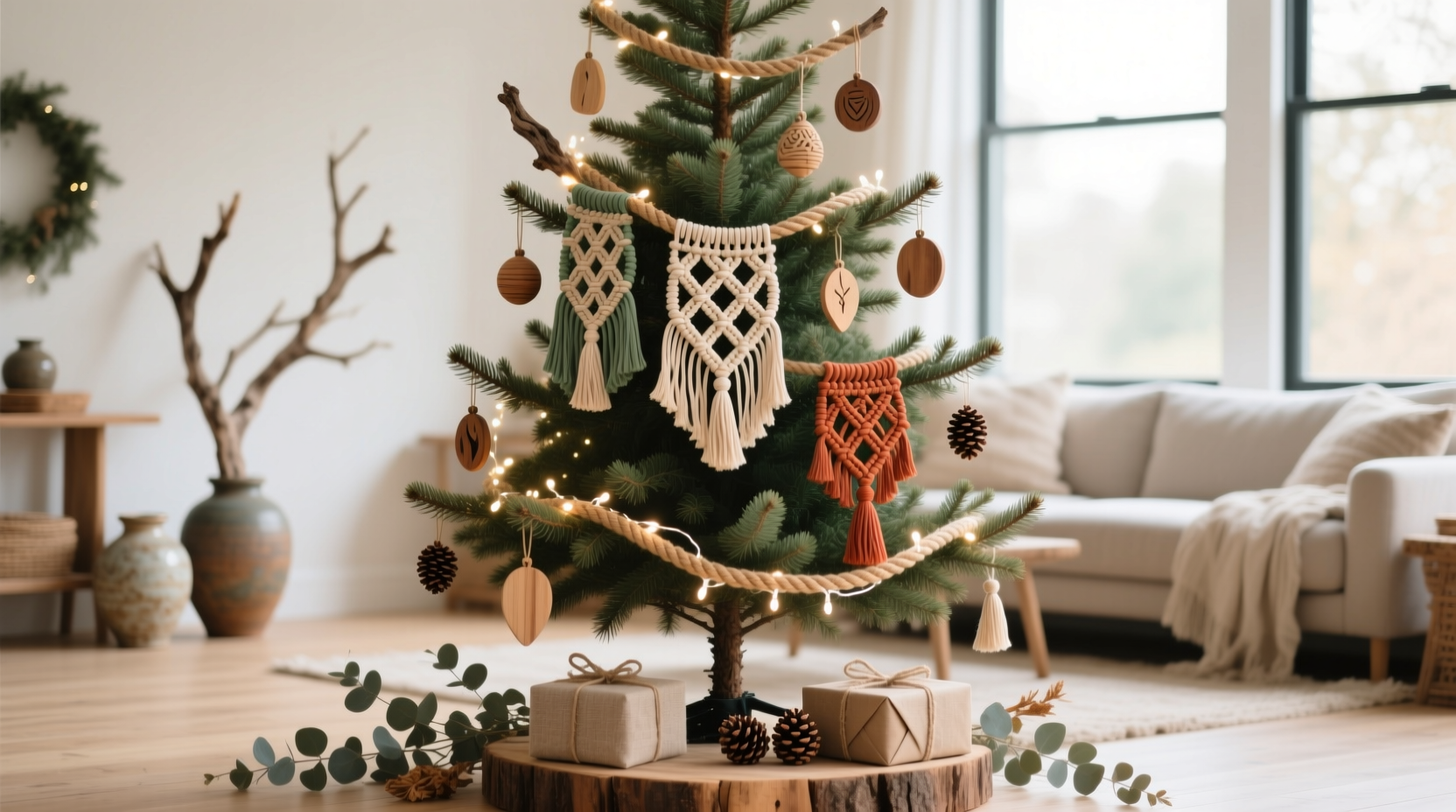
Before selecting twine or sanding a branch, clarify what “boho chic” truly means in practice—not as Instagram shorthand, but as a design philosophy. At its core, boho chic merges the free-spirited eclecticism of bohemian tradition with the refined restraint of modern chic. It values craftsmanship over convenience, organic variation over factory precision, and layered meaning over decorative excess. A successful boho tree avoids visual noise: no blinking LEDs, no mirrored baubles, no plastic berries. Instead, it relies on rhythm—repetition with subtle variation—and contrast—rough against smooth, matte against muted luster, vertical line against soft curve.
This ethos directly informs material choices. Macramé isn’t selected because it’s trending; it’s chosen for its history as a functional folk craft—knots once secured sails and held tools—now repurposed as gentle, textural ornamentation. Wood isn’t used for its polish but for its provenance: a slice of fallen applewood, a salvaged barn beam fragment, or a sand-sculpted driftwood piece carries memory and geography. Even “white space” is intentional—not emptiness, but breathing room where the eye rests and the mind settles.
Curating Your Core Materials: Quality Over Quantity
A boho chic tree thrives on a tight, thoughtful material palette. Resist the urge to accumulate. Instead, invest deeply in fewer, higher-integrity elements. Below is a comparison of essential categories, emphasizing sourcing ethics and functional longevity:
| Category | Recommended Choice | Why It Works | Avoid |
|---|---|---|---|
| Macramé Cord | 3mm unbleached 100% cotton rope (GOTS-certified) | Natural off-white tone complements wood; softens with handling; biodegradable; knots hold securely without slipping | Polyester blends (synthetic sheen, poor knot grip), bleached cotton (harsh, brittle) |
| Wood Accents | Reclaimed hardwood slices (walnut, maple, sycamore) or river-worn driftwood | Each piece has unique grain, age marks, and weight; zero new timber harvest; stable when properly dried | Fresh-cut green wood (warps, cracks), painted MDF shapes (artificial, non-biodegradable) |
| Natural Embellishments | Dried citrus wheels (oven-dried at 200°F for 3–4 hrs), pampas plumes, cinnamon sticks, raw amethyst points | Add scent, subtle color, and organic geometry; fully compostable after holidays | Plastic “dried” flowers, synthetic pinecones, foil-wrapped chocolates (visual clutter, environmental cost) |
| Tree Base & Structure | Unfinished cedar planter box or woven seagrass basket (18–24\" diameter) | Provides earthy foundation; hides stand mechanics; breathable, moisture-resistant material | Glitter-coated stands, mirrored trays (conflicts with matte, organic sensibility) |
Notice the emphasis on *process* and *provenance*. That unbleached cotton wasn’t chosen for “vintage vibes”—it was chosen because its slight irregularity in twist and thickness creates visual depth when knotted. The cedar planter isn’t rustic decoration; its aromatic oils subtly scent the room while its open grain allows airflow around the tree trunk, reducing mold risk. Every element serves dual purpose: aesthetic and functional.
The Step-by-Step Assembly Process
Building the tree is iterative—not linear. Work in layers, stepping back frequently to assess balance and negative space. Allow 3–4 hours total, broken into focused 45-minute sessions with rest in between. Rushing compromises the tactile rhythm essential to boho styling.
- Select & Prep Your Tree: Choose a real Nordmann fir or Fraser fir (superior needle retention, soft texture). Avoid artificial trees—they lack the subtle resin scent and organic variation crucial to the boho feel. Once delivered, make a fresh 1\" cut at the base, place in water immediately, and let it hydrate for 24 hours before decorating. Trim lower branches only where needed for stability in your base.
- Anchor the Foundation: Place the hydrated tree into your cedar planter or seagrass basket. Fill gaps around the trunk with dried moss (reindeer or sheet moss) and small river stones. Tuck in 3–5 cinnamon sticks vertically among the moss for subtle aroma and linear contrast.
- Install Primary Wood Accents: Hang 5–7 wood slices (2.5\"–4\" diameter) using undyed jute twine looped through pre-drilled 1/8\" holes. Vary heights: two low (12–18\" from floor), three mid (3–5 ft), two high (near top third). Space them asymmetrically—avoid horizontal alignment. Let twine tails hang 4–6\" below each slice.
- Add Macramé Elements: Begin with large-scale pieces first. Tie a 24\" double half-hitch macramé pendant (using 4 cords, 3mm cotton) to a strong upper branch. Let it drape naturally—do not force symmetry. Next, add 3–5 smaller macramé ornaments: simple square knots (1.5\"), berry clusters (wrapped cord balls), or minimalist tassels (6\" length). Distribute evenly but irregularly—no two at same height or compass point.
- Layer Natural Textures: Weave dried eucalyptus stems (5–8\" long) horizontally through mid-level branches, letting tips extend 2–3\" beyond branch ends. Tuck 4–6 dried orange wheels behind wood slices or near macramé knots. Nestle raw amethyst points (1–1.5\") into moss at the base, partially covered by trailing ivy vines.
- Final Calibration: Stand back 6 feet. Look for: (a) Three dominant vertical lines (e.g., one macramé pendant, one tall wood slice, one eucalyptus stem); (b) At least two areas of intentional “thinness” (branches left bare); (c) No more than five points of warm light (use battery-operated LED fairy lights with linen-wrapped wires—wrap sparingly, only along 3–4 main branches).
Mini Case Study: The Portland Studio Apartment Tree
In December 2023, Maya R., a ceramicist in Portland’s Alberta Arts District, faced a challenge: her 7-foot potted Norfolk Island pine (a living, non-traditional tree) needed festive treatment—but couldn’t support heavy ornaments or adhesive hooks. Working within strict weight limits (<12 oz total per branch), she adapted the boho chic framework. She sourced 12 thin walnut veneer strips (1/16\" thick, 12\" long) from a local mill’s offcuts, drilling tiny holes and suspending them with nearly invisible fishing line. For texture, she hand-dyed 8 macramé tassels using avocado pits (creating soft blush tones) and hung them from the thinnest outer branches. Instead of moss, she used preserved reindeer lichen—light as air, ethereal gray-green. The result weighed under 8 ounces total, honored her studio’s zero-waste ethic, and became a conversation piece during holiday open studios. “People didn’t ask ‘Where did you buy it?’ They asked, ‘How did you *listen* to the tree?’” she noted. Her success came not from following rules, but from interpreting principles—weight, breath, material honesty—through her specific constraints.
Expert Insight: The Craftsmanship Imperative
“True boho chic emerges when technique serves humility—not perfection. A slightly uneven macramé knot isn’t a flaw; it’s evidence of human hands. A wood slice with a hairline crack isn’t defective; it’s a record of growth and resilience. When we stop editing out these truths, our decor gains soul.” — Lena Torres, Textile Historian & Founder of The Handmade Holiday Collective
Torres’ observation cuts to the heart of sustainable boho styling. Mass-produced “boho” decor fails because it mimics surface traits (tassels! wood!) while erasing the labor, time, and vulnerability embedded in authentic making. Your tree doesn’t need flawless knots or gallery-grade wood grain. It needs your attention—your decision to leave a cord tail unraveled, to let a wood slice sit at a 7-degree tilt, to choose a single imperfect orange wheel over three “perfect” ones. That discernment is the real craft.
FAQ
Can I use faux greenery for a boho tree if I’m allergic to real pine?
Yes—but select wisely. Prioritize high-fidelity options: hand-painted silk eucalyptus stems, molded botanical resin leaves (look for matte, non-glossy finishes), or sustainably harvested preserved boxwood. Avoid plastic PVC garlands or overly shiny polyester. Texture is non-negotiable: run your fingers over samples before buying. If possible, blend 30% real dried lavender or rosemary sprigs for authentic scent and variation.
How do I prevent macramé ornaments from tangling or slipping on branches?
Use a “branch anchor” technique: wrap 6\" of undyed jute twine tightly around the branch *first*, securing it with a square knot. Then tie your macramé ornament’s hanging cord *to that jute anchor*, not directly to the branch. The jute grips bark better than smooth cotton cord and distributes weight. For extra security on smooth-barked trees (like beech), lightly roughen the branch surface with 220-grit sandpaper where the anchor sits.
What’s the most sustainable way to store these elements for next year?
Store macramé in breathable cotton drawstring bags (never plastic) with a sachet of dried lavender to deter moths. Keep wood slices in a cardboard box lined with crumpled kraft paper—never sealed containers, which trap moisture and encourage mold. Store dried citrus and botanicals in amber glass jars with tight lids, kept in a cool, dark cupboard. Inspect all items in October; re-knot any loosened macramé, lightly sand wood edges showing wear, and replace brittle botanicals. This ritual extends life and deepens connection to your pieces.
Conclusion: Your Tree Is a Living Invitation
Your boho chic Christmas tree is never finished—it evolves with each season, each adjustment, each moment you pause to trace the grain of a wood slice or feel the nub of a hand-tied knot. It resists the pressure to perform, to impress, to conform. Instead, it offers quiet generosity: to your guests, who sense calm upon entering the room; to your own nervous system, soothed by natural textures and unhurried rhythm; to the planet, through materials that return gracefully to the earth. This isn’t about achieving a look. It’s about cultivating presence—choosing cotton over plastic, time over speed, story over sameness. So begin not with a shopping list, but with stillness. Feel the weight of a branch. Smell the resin of your tree. Notice how light falls across a knot. Then, with those sensations as your compass, start tying, hanging, and arranging—not to fill space, but to honor it. Your tree will grow more beautiful each year, not despite its imperfections, but because of them.




 浙公网安备
33010002000092号
浙公网安备
33010002000092号 浙B2-20120091-4
Comments
No comments yet. Why don't you start the discussion?