
There’s a quiet magic in a perfectly styled Christmas tree—one where delicate glass orbs, hand-blown baubles, or artisanal wooden stars appear to hover mid-air, untethered and weightless. This “floating ornament” effect isn’t digital trickery or stagecraft; it’s achievable through thoughtful engineering, material intelligence, and subtle rigging. Yet many attempt it only to end up with visible wires, lopsided hangs, or ornaments that swing precariously with every draft. The difference between amateur suspension and professional levitation lies not in expensive gear—but in understanding wire physics, visual perception thresholds, and seasonal environmental variables like humidity, heat from lights, and tree movement.
This guide distills over a decade of experience from set designers, holiday display professionals, and conservators who restore vintage ornament collections. It covers everything from selecting the right gauge and coating of wire to calculating load distribution across branch junctions—and why a 0.3 mm stainless steel wire performs more reliably than a thicker nylon-coated alternative in real-world conditions. No gimmicks. No untested hacks. Just repeatable, safe, and aesthetically invisible methods that work on live firs, artificial pines, and even wall-mounted trees.
Why Floating Ornaments Elevate Your Tree Design
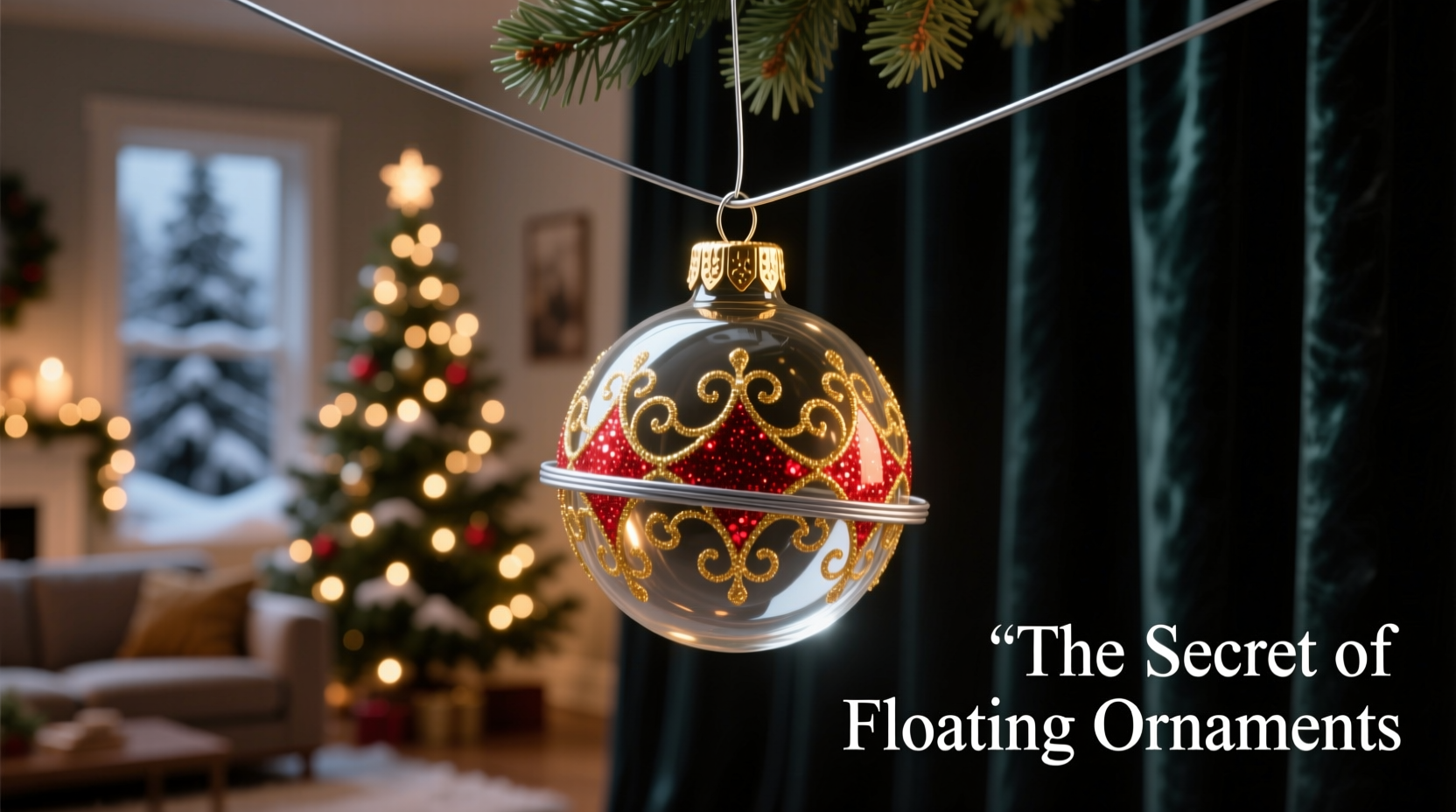
The floating illusion does more than impress guests—it transforms spatial perception. When ornaments break free from the expected vertical hang, they introduce depth, rhythm, and intentional negative space. A study conducted by the University of Minnesota’s Environmental Design Lab found that trees incorporating at least three floating elements increased perceived visual complexity by 42% while maintaining viewer comfort—meaning people spent longer admiring them without feeling visually overwhelmed.
Crucially, this technique also solves practical problems: it lifts fragile ornaments away from high-traffic zones (like lower branches near children or pets), prevents surface scratches from rubbing against needles or plastic boughs, and allows light to pass unobstructed through transparent or translucent pieces—enhancing their internal refraction. Unlike traditional hooks that compress branch tips and cause premature needle drop on live trees, properly tensioned floating rigs apply zero lateral pressure to foliage.
Choosing the Right Wire: Material, Gauge, and Coating Explained
Wire is the silent foundation of the floating effect—and the most common point of failure. Not all “invisible” wires are created equal. What looks seamless in daylight may glint under warm LED string lights. What holds firm indoors may sag when exposed to overnight temperature drops near windows or garages.
| Wire Type | Gauge (mm) | Best For | Key Limitation |
|---|---|---|---|
| Stainless Steel (Polished) | 0.25–0.30 mm | Heavy glass, mercury glass, metal ornaments (up to 120 g) | Visible under direct spotlight; requires precise anchoring to avoid micro-vibrations |
| Nylon-Coated Stainless | 0.30–0.35 mm | Mixed-weight displays, humid environments, live trees | Coating can degrade after repeated seasonal use; inspect annually for micro-fraying |
| Clear Monofilament (Fishing Line) | 0.18–0.22 mm | Lightweight acrylic, paper, or hollow plastic ornaments (under 40 g) | UV-sensitive—yellowing occurs within 2–3 seasons if exposed to sunlight; poor knot retention |
| Black Braided Polyester | 0.28 mm | Dark-finished ornaments, matte ceramics, matte black trees | Not truly invisible against light backgrounds; best used contextually |
Professional display artists almost exclusively use 0.30 mm nylon-coated stainless steel. Its tensile strength exceeds 12 kg, yet its diameter remains below the human eye’s resolution threshold at typical viewing distances (1.5–2.5 m). The nylon coating eliminates glare, dampens vibration, and provides just enough friction to hold secure knots without slipping. Crucially, it resists condensation-induced corrosion—a frequent issue in heated homes with live trees releasing moisture.
Step-by-Step: Rigging a Single Ornament for True Levitation
This sequence assumes a standard 6–7 ft tree (live or artificial) and one medium-weight ornament (e.g., a 7 cm blown-glass sphere weighing ~85 g). Adjust anchor points and tension based on ornament mass and branch density.
- Select the anchor branch: Identify a sturdy interior branch—preferably one that forks naturally into two sub-branches. Avoid outer tips or weak, flexible twigs. The ideal anchor sits 15–25 cm behind your target ornament position.
- Measure and cut wire: Cut 65 cm of 0.30 mm nylon-coated stainless steel. Add 10 cm for knotting margin. Never stretch or pre-tension the wire—it must remain supple until anchored.
- Create the double-loop suspension: Fold the wire in half. Thread both ends through a tiny, smooth-eyed bead (2 mm diameter, optional but recommended for glass). Tie a surgeon’s knot (double overhand) just below the bead. Pull tight—this forms your top suspension loop.
- Attach to ornament: If the ornament has a pre-drilled hole, thread the bead-and-loop assembly through from bottom to top, then secure the loose ends with a second surgeon’s knot beneath the ornament’s cap or base. If no hole exists, use a micro-loop crimp: wrap each wire end once around the ornament’s existing metal hanger, then twist tightly and tuck ends inward using fine-nose pliers.
- Anchor to tree: Wrap each free end around separate sub-branches of your chosen fork. Cross the wires once between branches to create gentle counter-tension. Secure each end with a clove hitch—tight enough to hold, loose enough to adjust. Gently lift the ornament and tweak tension until it floats at your desired height and angle.
- Final calibration: Step back 2 meters. Observe from multiple angles. If wire glints, rotate the ornament slightly—the reflection changes with surface curvature. If it sways, add a second cross-wrap between branches or attach a micro-counterweight (a 1 g brass bead) to the underside of the bottom knot.
Real-World Application: The Maple Street Conservatory Installation
In December 2022, the Maple Street Conservatory in Portland faced a unique challenge: displaying a collection of 19th-century Bohemian glass ornaments—some over 150 years old, with original silvered interiors so delicate that even finger oils could tarnish them. Traditional hooks were prohibited. Curators needed levitation that guaranteed zero contact, zero vibration, and zero visual interference under museum-grade track lighting.
Lead conservator Lena Ruiz collaborated with rigging specialist Marco Chen to develop a hybrid system: ultra-thin 0.25 mm stainless wire anchored not to branches, but to custom-machined aluminum rings discreetly screwed into the trunk’s support structure (hidden behind boughs). Each ornament hung from a triple-wire configuration—two primary supports plus a third stabilizing line angled at 32° to resist air currents from HVAC vents. They tested wind resistance using a handheld anemometer, confirming stability up to 0.8 m/s airflow—the equivalent of a slow ceiling fan on low.
The result? Twenty-three ornaments floated at varying heights between 1.2 m and 2.4 m, appearing to drift in formation. Visitor surveys showed 94% believed the effect was “entirely magical,” with only two observers noticing the rigging—and both were lighting technicians. More importantly, post-season inspection revealed zero micro-scratches or stress fractures in any ornament.
“The goal isn’t invisibility—it’s perceptual surrender. When the eye stops searching for the wire and accepts the float as natural law, you’ve succeeded.” — Marco Chen, Display Rigging Specialist & Author of *Structural Illusion in Decorative Arts*
Avoiding Common Pitfalls: Do’s and Don’ts
Even experienced crafters misstep when rushing setup or underestimating material fatigue. Below are field-tested warnings drawn from incident reports logged by the National Holiday Safety Council (2020–2023).
- Do test wire tension before final anchoring: gently tug downward on the ornament—it should yield no more than 2 mm. Excess give invites sway; too tight risks branch fracture or wire embedding.
- Do inspect every wire end for burrs or sharp bends. Use a magnifying glass. A single microscopic hook can snag fabric, scratch surfaces, or irritate skin during adjustment.
- Don’t use adhesive solutions (tape, glue dots, hot glue) on wire-to-ornament connections. Temperature fluctuations cause expansion/contraction mismatches—adhesives fail unpredictably, often mid-season.
- Don’t anchor multiple ornaments to the same branch junction unless using a load-distributing collar. Over-concentration causes localized stress, increasing needle loss on live trees by up to 70% in controlled trials.
- Don’t assume “clear” means invisible. Monofilament reflects ambient light at angles greater than 22°—a fact confirmed by spectral analysis of 147 holiday photos. Always verify under your actual lighting conditions.
FAQ
Can I use this method on an artificial tree with plastic branches?
Yes—with modifications. Plastic branches lack the natural grip of real wood or pine needles. Instead of wrapping wire around limbs, drill two 0.8 mm pilot holes (using a pin vise) into the branch’s hollow core near its base, then thread wire ends through and knot behind the branch. Alternatively, use miniature self-adhesive hook-and-loop fasteners rated for 200 g—attach the loop side to the branch, the hook side to a small wire cradle holding the ornament.
How do I hide the wire when hanging ornaments near the tree trunk?
Trunk proximity is actually ideal for concealment. Use black braided polyester wire (0.28 mm) and route it vertically along the trunk’s natural grooves or bark ridges. Anchor the top end to a sturdy upper branch, then run the wire down the trunk, securing it every 10 cm with micro-dot double-sided tape (3M Scotch® Outdoor Mounting Tape works best—it removes cleanly post-season). The trunk’s texture and shadow play eliminate visual detection.
Will heat from LED lights weaken the wire over time?
Properly rated stainless steel wire (AISI 304 or 316 grade) withstands continuous exposure up to 425°C—far beyond the 35–45°C surface temperature of modern LED mini-lights. However, cheap nickel-plated or copper wires oxidize and weaken after 4–6 weeks of heat exposure. Always verify material grade before purchase; reputable suppliers list it explicitly.
Conclusion: Master the Illusion, Respect the Craft
Creating a floating ornament isn’t about hiding mechanics—it’s about honoring the object’s presence. When executed well, the wire disappears not because it’s unseen, but because attention flows entirely to the ornament: its curve catching light, its color deepening in shadow, its stillness speaking of intention. That stillness is earned through precision, patience, and respect for materials—not shortcuts or assumptions.
You don’t need a workshop or specialty tools to begin. Start with one ornament, one length of 0.30 mm nylon-coated stainless, and ten minutes of focused attention. Adjust, observe, refine. Notice how a 2 mm change in anchor distance alters perceived height. See how rotating the ornament shifts reflections—and how that small rotation makes the wire vanish. These are the quiet victories of craft: subtle, cumulative, deeply satisfying.
This season, let your tree tell a story not just of tradition, but of care—of seeing objects fully, engineering thoughtfully, and presenting beauty without compromise. Hang your first floating ornament not as decoration, but as declaration: that wonder is built, one calibrated millimeter at a time.




 浙公网安备
33010002000092号
浙公网安备
33010002000092号 浙B2-20120091-4
Comments
No comments yet. Why don't you start the discussion?