
Low light isn’t just about dimming brightness—it’s about sculpting atmosphere. In residential spaces, hospitality settings, and even creative workspaces, the quality of light at reduced intensity defines emotional resonance: whether a room feels like a quiet library at dusk or a sterile waiting area after midnight. String lights—often dismissed as seasonal decor—are among the most versatile tools for low-light mood crafting. Yet their impact hinges almost entirely on one technical variable few consumers consider: correlated color temperature (CCT), measured in kelvins (K). Warm white and cool white string lights don’t merely differ in hue—they trigger distinct physiological responses, alter spatial perception, and interact uniquely with materials, textures, and human circadian rhythms. This article moves beyond marketing labels (“cozy” vs “modern”) to examine how CCT shapes low-light environments in practice—backed by lighting science, interior design principles, and real installation outcomes.
Understanding Color Temperature: Why 2700K Feels Like Candlelight and 6500K Feels Like Midday Sky
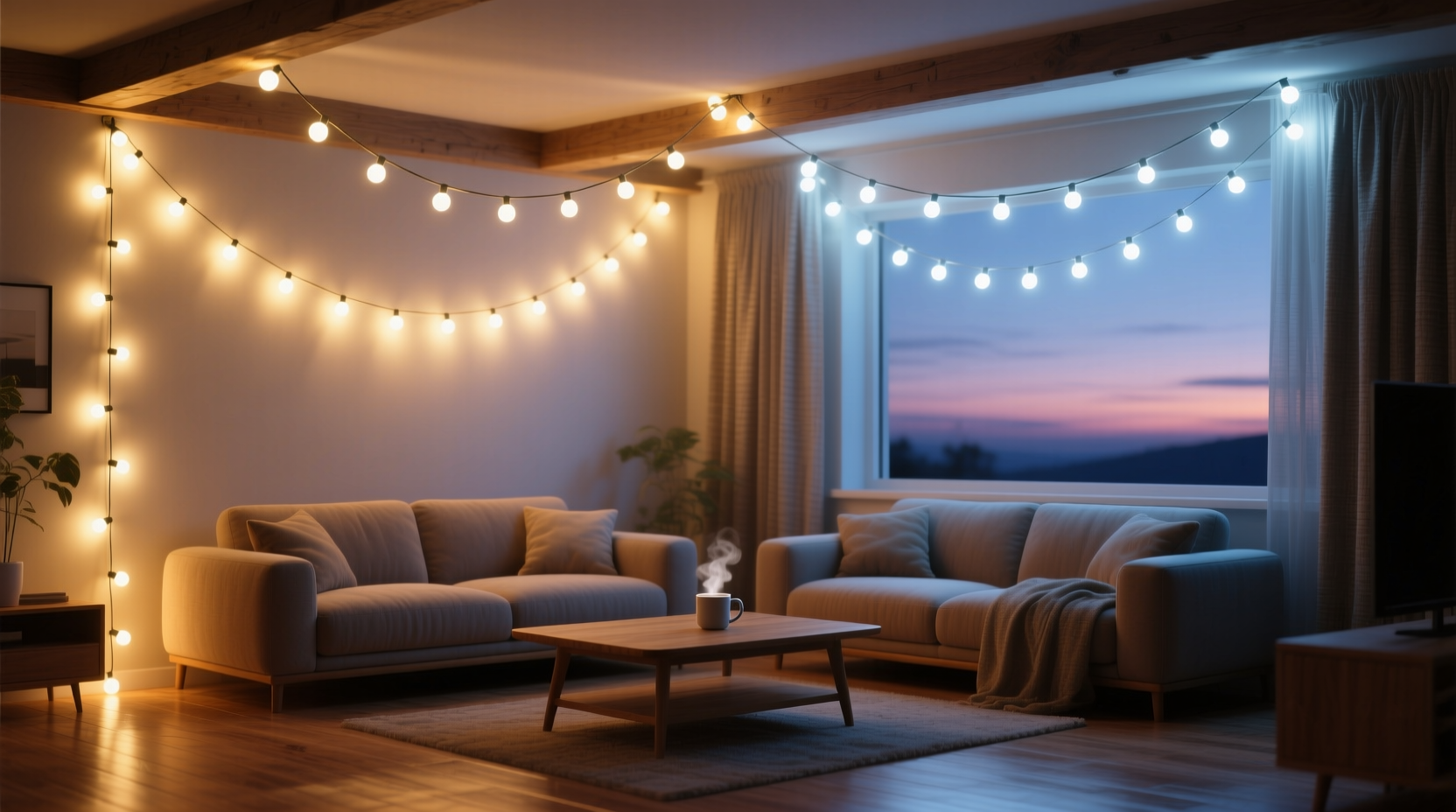
Color temperature describes the visual warmth or coolness of white light—not its actual heat. It’s derived from the color emitted by a theoretical black-body radiator heated to a specific temperature in kelvins. At 2700K, the light approximates an incandescent bulb or candle flame: rich in red and yellow wavelengths, minimal blue. At 6500K, it mirrors overcast daylight: balanced across the spectrum with elevated blue energy. Between them lies a gradient where subtle shifts produce measurable psychological effects. Research published in *Lighting Research & Technology* confirms that light below 3000K increases melatonin production within 45 minutes of exposure—slowing cognitive processing and signaling the body it’s time to wind down. Conversely, light above 5000K suppresses melatonin, heightens alertness, and can disrupt sleep onset when used late in the evening.
This isn’t theoretical. In low-light conditions—where ambient illumination falls below 50 lux—the spectral composition of a light source dominates perception. With little competing light, the eye’s rod cells (responsible for low-light monochrome vision) recede, and cone cells (sensitive to color) become relatively more active. As a result, a 2700K string light doesn’t just look warmer; it feels softer, heavier, and more enveloping. A 5000K string light, even at identical lumen output, reads as sharper, more exposed, and spatially “flatter.” The difference is perceptual, biological, and architectural—not aesthetic preference alone.
How Warm White String Lights Build Low-Light Mood: Texture, Shadow, and Psychological Safety
Warm white string lights (2200–2700K) excel in low-light mood creation because they align with evolutionary cues of safety and rest. Firelight, sunset, and incandescent bulbs all occupy this range—signals the human brain associates with shelter, intimacy, and cessation of activity. When deployed intentionally, they perform three critical functions:
- Softening texture contrast: Warm spectra render skin tones, wood grain, and woven textiles with gentle luminance gradation. Shadows cast are diffused and rounded—not harsh or angular—reducing visual tension.
- Compressing perceived space: Lower CCT light reduces peripheral acuity slightly, encouraging focus on immediate surroundings. This makes large rooms feel cozier and small nooks feel more enveloping.
- Minimizing glare sensitivity: Blue-rich light scatters more in the eye’s lens, especially in aging eyes or low-adapted vision. Warm white light produces less intraocular scatter, allowing viewers to relax without squinting or averting gaze.
Architectural lighting consultant Lena Torres notes, “In hospitality projects, we rarely use anything above 2700K in guest room bedside or ceiling cove lighting—even when clients request ‘brighter’ options. What they actually want is clarity without stimulation. Warm white at low intensity delivers that. Cool white at the same lumen level feels aggressive, not bright.”
Where Cool White String Lights Undermine—and Occasionally Enhance—Low-Light Mood
Cool white string lights (5000–6500K) are frequently misapplied in low-light contexts. Their high blue content creates visual “noise” in dim settings: whites appear stark, shadows turn inky and unforgiving, and surfaces with cool undertones (gray concrete, stainless steel, matte white paint) gain clinical sharpness. Used indiscriminately, they fracture mood rather than support it—evoking fluorescent-lit corridors or emergency lighting rather than intentional ambiance.
Yet cool white has legitimate, mood-conscious applications in low-light design—when deployed with precision and purpose:
- Task-accent lighting: A single cool-white string behind a kitchen counter or under a studio desk provides localized visual clarity without flooding the entire space. Its contrast helps distinguish edges and details during focused activity.
- Seasonal or thematic contrast: In winter gardens or Nordic-inspired interiors, a deliberate cool-white string against snow-draped branches or pale birchwood creates serene, crystalline stillness—a different kind of calm, rooted in clarity rather than warmth.
- Biological rhythm alignment: For early-rising households or home offices used pre-sunrise, a 5000K string light at 30–50 lux mimics natural dawn light, gently suppressing melatonin and supporting alertness without artificial jolt.
The key is intentionality. Cool white fails as ambient low-light mood lighting—but succeeds as a strategic accent or functional tool when isolated, shielded, and contextually justified.
Practical Application: A Step-by-Step Guide to Installing Mood-Appropriate String Lights
Creating low-light mood isn’t about choosing a bulb—it’s about integrating light into architecture and behavior. Follow this sequence for reliable results:
- Map your baseline ambient light: At night, turn off all overhead and task lighting. Use a light meter app (or observe with unaided eyes) to identify existing light sources: streetlights through windows, hallway spill, digital displays. Note where light pools and where darkness is absolute.
- Define the mood objective: Is the goal relaxation (e.g., bedroom reading nook), social connection (e.g., covered patio), or focused calm (e.g., meditation corner)? Relaxation favors 2200–2400K; social warmth leans toward 2700K; focused calm may use 3000K only if paired with ample warm-toned indirect light.
- Select placement based on light behavior: Warm white light loses intensity rapidly over distance and is easily absorbed by dark fabrics or matte walls. Place strings within 1.5 meters of key surfaces (e.g., draped over a headboard frame, wrapped around a bookshelf edge, suspended 30 cm above a dining table). Avoid placing cool white strings where they’ll reflect directly into seating areas.
- Layer intensities: Use dimmers or smart plugs to run warm white strings at 20–40% brightness. Never operate cool white strings at full power in living zones—cap at 30% and pair with at least one warm-toned light source (e.g., a 2700K floor lamp) to balance spectral output.
- Test and refine at night: Install and observe for 15 minutes in actual use conditions. Does the light draw attention to clutter? Does it make faces look sallow or washed out? Does it compete with or complement your primary light source? Adjust spacing, brightness, or CCT before finalizing.
Comparison Table: Warm White vs Cool White String Lights in Low-Light Scenarios
| Feature | Warm White (2200–2700K) | Cool White (5000–6500K) |
|---|---|---|
| Mood Association | Intimacy, comfort, nostalgia, restfulness | Crispness, alertness, sterility, detachment |
| Best Placement for Mood | Behind furniture, along ceiling perimeters, wrapped around bed frames, inside glass jars | Under shelves, inside clear acrylic displays, along architectural lines (e.g., stair railings), behind translucent panels |
| Shadow Quality | Soft, blurred edges; gradual fade | Hard, defined edges; abrupt transition |
| Impact on Skin Tones | Flattering, adds luminosity and warmth | Can emphasize pallor, veins, or fatigue; often unflattering |
| Circadian Impact (Evening Use) | Supports natural melatonin rise; promotes sleep readiness | Suppresses melatonin; delays sleep onset by up to 90 minutes |
Real-World Case Study: Transforming a Drafty Loft Bedroom
Maya, a graphic designer in Portland, lived in a converted industrial loft with soaring ceilings, exposed brick, and single-pane windows. Her bedroom occupied a corner with minimal wall space for lamps and suffered from both cold drafts and oppressive nighttime brightness from nearby streetlights. She initially installed 5000K string lights along the ceiling beams hoping for “modern elegance.” Instead, the space felt like a hospital observation room—cold, echoey, and emotionally barren.
She replaced them with 2400K filament-style LED string lights, running them in a loose zigzag pattern along the underside of the lowest ceiling beam (just above her bed), then draping a second strand vertically behind a sheer linen curtain to diffuse streetlight glare. She added a simple 2700K plug-in wall sconce with fabric shade beside her reading chair. Within one week, her sleep latency decreased from 45 minutes to under 20. Guests consistently remarked that the room “felt like sinking into a warm blanket”—even though air temperature hadn’t changed. Crucially, Maya reported improved focus during evening creative work: the absence of blue-rich light reduced eye strain without sacrificing visual clarity for sketching.
This outcome wasn’t magic—it was spectral alignment. The 2400K strings provided enough photopic (cone-based) vision for navigation and detail work, while their amber dominance signaled biological rest. The layered placement avoided direct glare and created dimensional depth—turning architectural austerity into atmospheric richness.
FAQ: Addressing Common Low-Light Lighting Questions
Can I mix warm white and cool white string lights in the same room?
Yes—but only with strict hierarchy and separation. Use warm white as the dominant ambient layer (≥80% of total string light length) and cool white as a narrow, directional accent (e.g., a single 2-meter strand under a shelf). Never interlace them or place them within 1 meter of each other. Mixed CCT in close proximity creates visual dissonance, undermining mood coherence.
Do LED string lights labeled “dimmable” work reliably with all dimmer switches?
No. Many inexpensive LED string lights require trailing-edge (ELV) dimmers—not standard leading-edge (TRIAC) models—to avoid flickering, buzzing, or premature failure. Check the manufacturer’s compatibility list before purchasing. For true low-light control, prioritize strings with built-in memory dimming or smart-home integration (e.g., Matter-compatible) rather than relying on wall dimmers alone.
Why do some warm white strings look orange or pink instead of golden?
Color rendering index (CRI) and R9 (saturated red) values determine fidelity. A 2700K string with CRI < 80 will distort warm tones—making wood look muddy or skin appear jaundiced. For authentic warmth, select strings rated CRI ≥ 90 and R9 ≥ 90. These render reds, oranges, and browns accurately, preserving the richness low-light mood depends on.
Conclusion
Creating low-light mood isn’t decorative—it’s physiological, architectural, and deeply human. Warm white string lights between 2200K and 2700K aren’t “softer” by accident; they resonate with our oldest biological rhythms, soften visual aggression, and invite presence. Cool white strings aren’t inherently wrong—they’re tools requiring surgical precision, deployed not for ambiance but for function, contrast, or circadian alignment. The difference between a space that soothes and one that unsettles often comes down to 1000 kelvins—and the intention behind them. Stop choosing lights by name. Start selecting by number. Measure your space, define your mood, and install with awareness. Your nervous system—and your guests—will feel the difference immediately.




 浙公网安备
33010002000092号
浙公网安备
33010002000092号 浙B2-20120091-4
Comments
No comments yet. Why don't you start the discussion?