
A Memory Lane Christmas tree transforms your holiday centerpiece into a living archive—a tactile, visual narrative of family milestones, quiet joys, and generational continuity. Unlike traditional ornament-heavy trees, this concept centers on personal history: each photo tells a story, each frame holds intention. It’s not about perfection or polish; it’s about presence. Families who adopt this tradition report deeper holiday conversations, renewed intergenerational connection, and a tangible sense of legacy that lingers long after the tinsel is packed away. Done thoughtfully, it becomes more than decoration—it becomes ritual.
Why This Tradition Resonates Now More Than Ever
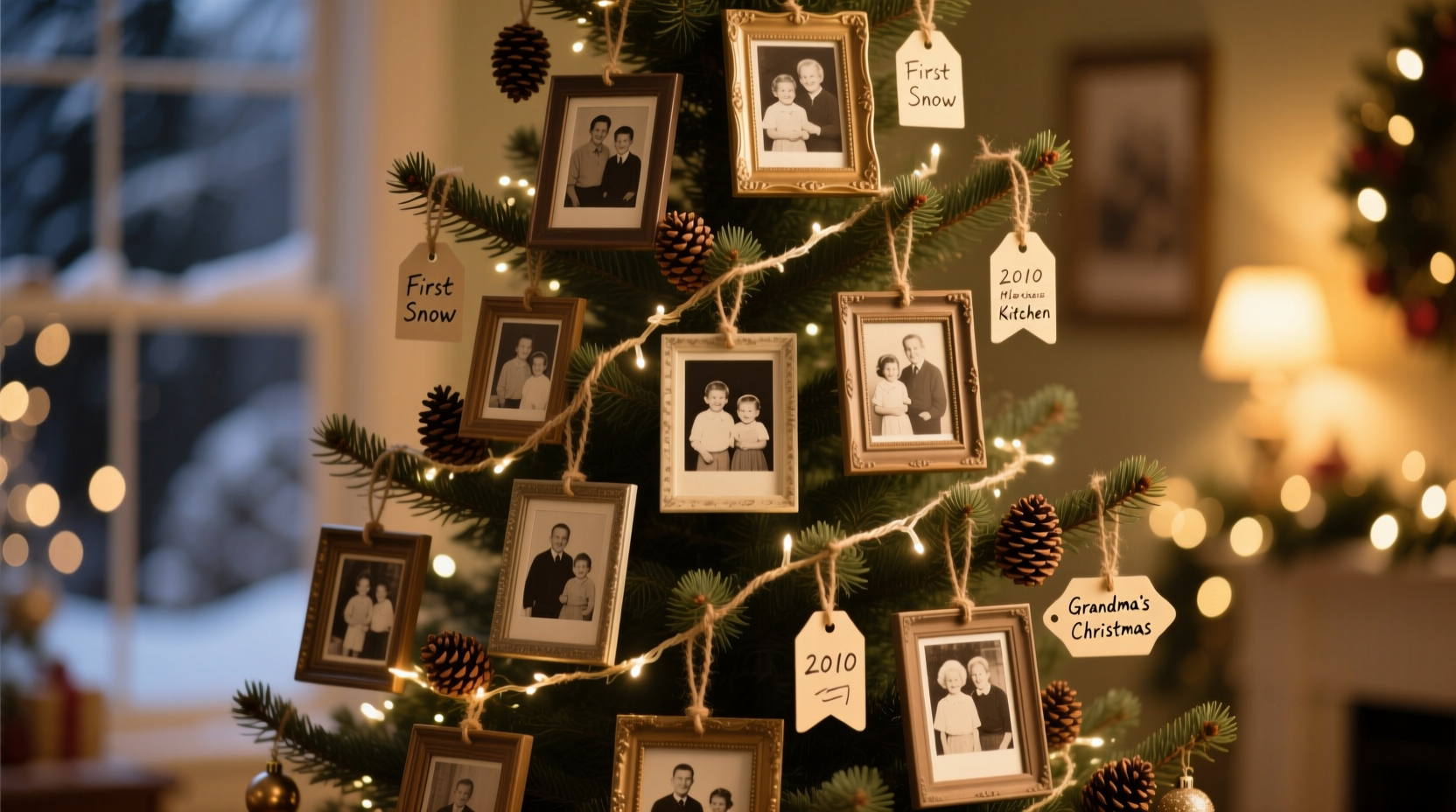
In an era of fleeting digital feeds and algorithmically curated memories, the physicality of printed photos and hand-selected frames offers rare grounding. Psychologists note that multisensory engagement—touching a textured frame, adjusting a miniature hanger, reading a handwritten date on the back of a photo—strengthens autobiographical memory encoding. A 2023 study published in the Journal of Environmental Psychology found that households with personalized, story-based holiday displays reported 37% higher levels of perceived family cohesion during December. The Memory Lane tree meets a quiet cultural need: to slow down, to anchor celebration in authenticity rather than aesthetics alone.
“People don’t remember how many ornaments were on their tree—they remember who stood beside them while hanging the first one, or what Grandma whispered when she saw her wedding photo tucked among the branches. That’s where meaning lives.” — Dr. Lena Torres, Family Rituals Researcher, University of Vermont
Gathering & Preparing Your Photos: Quality Over Quantity
Start with curation—not accumulation. Resist the urge to print every digital photo from your phone gallery. Instead, identify moments that carry emotional weight: a child’s first snowfall, a graduation handshake, a backyard barbecue with grandparents now gone, a pet’s goofy portrait, a travel snapshot with faded ticket stub taped to the back. Aim for 25–40 images for a standard 6–7 foot tree—enough for visual rhythm without visual noise.
Print quality matters deeply. Glossy or matte photo paper (not inkjet printer paper) ensures longevity and color fidelity. For archival stability, choose acid-free, lignin-free prints—these resist yellowing and fading for decades. If sourcing older photos, scan at 600 dpi minimum and restore minor scratches or fading using free tools like GIMP or Photopea before printing. Crop tightly to focus on faces and key details; avoid wide backgrounds that shrink legibility at small scale.
Selecting & Preparing Tiny Frames: Function Meets Feeling
Frames are the silent narrators of your Memory Lane tree. They must be lightweight (to avoid branch sag), secure (no loose glass or hinges), and visually cohesive enough to unify diverse photos—but varied enough to reflect personality. Avoid heavy metal or thick wood frames; instead, prioritize materials that weigh under 15 grams per unit.
| Frame Type | Weight Range | Pros | Cons | Best For |
|---|---|---|---|---|
| Miniature wooden clip frames (1.75\" x 2.25\") | 8–12 g | Natural texture, easy to hang, no glass risk | Limited depth for thicker photos | Families with young children or pets |
| Acrylic magnetic mini-frames | 5–9 g | Ultra-light, shatterproof, strong hold on metal tree stands or garlands | Can scratch if stacked; limited vintage aesthetic | Modern homes, minimalist decor, renters |
| Vintage-style tin frames with wire hangers | 10–14 g | Warm patina, excellent photo visibility, classic holiday feel | May tarnish over time; requires gentle polishing | Traditional interiors, multi-generational homes |
| Fabric-wrapped cardboard frames | 4–7 g | Eco-friendly, customizable fabric, completely safe for kids | Less durable for annual reuse; best for single-season display | Temporary installations, classrooms, therapy settings |
Prep frames *before* adding photos: sand rough edges, tighten hinge screws, reinforce wire hangers with a drop of clear-drying craft glue, and wipe interiors with a microfiber cloth to prevent dust smudges. For extra security, apply a tiny dab of archival PVA glue to the photo backing—just enough to hold it flat without warping.
A Step-by-Step Assembly Timeline (90 Minutes Total)
Build your Memory Lane tree intentionally—not all at once, but in thoughtful phases. This timeline assumes a fresh-cut or high-quality artificial tree with sturdy, layered branches.
- Day 1 (30 min): Prep & Organize — Sort printed photos chronologically or thematically (e.g., “Summer,” “Milestones,” “Pets”). Label each with a soft pencil on the back: year + brief context (“Ava’s 1st day of school, 2021”). Insert photos into cleaned frames. Place finished frames in labeled bowls by section (lower third, middle, top).
- Day 2 (20 min): Base Structure — Hang 3–5 “anchor” frames on lower branches near the trunk—larger moments (weddings, births) or photos with warm tones (reds, golds) to ground the visual weight. Use thin, clear monofilament line (not ribbon) for near-invisibility and strength.
- Day 3 (25 min): Layered Storytelling — Work upward in horizontal bands. In the middle third, cluster related photos: three generations at a picnic, siblings at different ages, seasonal repeats (same porch, different Decembers). Vary frame orientation—some vertical, some horizontal—to create organic flow.
- Day 4 (15 min): Final Refinement — Step back. Remove any frame that visually “shouts” (oversaturated colors, jarring contrast). Add 2–3 non-photo elements: a tiny dried orange slice wrapped in twine, a sprig of preserved eucalyptus tucked behind a frame, or a handwritten tag with a family motto (“Rooted in Love”). These provide breathing room and sensory contrast.
Real Example: The Chen Family’s 7-Year Evolution
The Chen family in Portland began their Memory Lane tree in 2017—the year their daughter Mei was born. Her newborn photo, in a walnut clip frame, anchored the lowest branch. Each December since, they’ve added two to four new frames: Mei’s first tooth, her parents’ 15th anniversary dinner, Grandma Li’s 80th birthday surrounded by grandchildren, Mei’s kindergarten art project photo, the family’s pandemic-era “backyard campout” shot. What began as a sentimental gesture became structural: when Mei started asking, “What happened before I was born?” her parents pulled frames from earlier years—her parents’ college graduation, her uncle’s military deployment photo, even a black-and-white image of her great-grandfather’s immigration arrival. By year five, the tree included 62 frames. Last year, Mei designed three new frames herself—hand-painted ceramic miniatures holding photos of her friends. “It’s not just our history,” says Mei’s mother, Sarah. “It’s proof that we pay attention—to each other, to time, to what matters.”
Common Pitfalls & How to Avoid Them
- Overcrowding branches: More than 5–6 frames per major branch creates visual fatigue. Prioritize negative space—let the tree’s natural form show through.
- Ignoring light direction: Hang frames so faces face outward and slightly downward—this catches ambient light and avoids glare from overhead fixtures.
- Mixing incompatible photo styles: Don’t pair heavily filtered smartphone shots with sepia-toned vintage prints unless you deliberately unify them with consistent matting or frame color.
- Skipping documentation: Without notes, future generations won’t know who’s in the photos. Keep a simple binder or digital spreadsheet listing frame number, photo description, year, photographer, and location.
- Using adhesive-backed frames: These damage bark on real trees and leave residue on artificial ones. Always use looped wire, ribbon ties, or clips designed for tree hanging.
FAQ: Practical Questions Answered
How do I protect photos from fading near lights or windows?
Use UV-filtering acrylic inserts if your frames include glazing—or skip glass entirely in favor of open-back clip frames. Keep the tree at least 3 feet from direct sunlight and incandescent bulbs. LED string lights emit negligible UV and generate almost no heat, making them ideal companions for photo displays.
Can I incorporate non-photographic mementos?
Absolutely—and often meaningfully. Small, flat keepsakes work well: a pressed flower from a wedding bouquet, a child’s first lost tooth (in a sealed, clear acrylic capsule), a folded love note, a vintage postage stamp, or a swatch of fabric from a christening gown. Mount these on stiff cardstock first, then insert into frames as you would photos. Ensure all items are fully dry and acid-free to prevent deterioration.
What’s the best way to store frames and photos between seasons?
Store frames and photos separately in archival boxes lined with unbuffered tissue paper. Place frames upright (like books) to prevent hinge stress. Keep the box in a cool, dry, dark closet—never in attics or basements where humidity and temperature swing. Include silica gel packets to absorb ambient moisture. Review and reorganize contents every 2 years: replace brittle wire hangers, clean frames with lens-safe wipes, and reprint any faded photos.
Maintaining Meaning Across Years
A Memory Lane tree gains power with repetition. Year two isn’t about novelty—it’s about noticing growth: how Mei’s smile changed between ages 3 and 5, how Grandma’s hands look more fragile in last year’s photo, how the same kitchen counter appears in six different holiday breakfasts. Make it participatory: assign each family member one “memory slot” to curate annually. Rotate who documents the process—keeping a short video log or typed journal entry describing why each new photo was chosen. Over time, the tree becomes less a decoration and more a shared language: a shorthand for belonging, resilience, and quiet, persistent love.
This tradition asks little in materials but much in attention. It doesn’t require expensive supplies or design expertise—only willingness to pause, to select, to connect. Every frame you hang is a vote for memory over momentum, for people over perfection, for continuity in a world that rarely slows down.




 浙公网安备
33010002000092号
浙公网安备
33010002000092号 浙B2-20120091-4
Comments
No comments yet. Why don't you start the discussion?