
Christmas lights are more than festive decor—they’re powerful environmental cues that directly influence our circadian biology. When used without intention, twinkling LEDs after dusk can suppress melatonin, delay sleep onset, and fragment rest. But when thoughtfully designed, a holiday lighting routine can actually support healthy sleep—especially during the high-stress, low-light winter months. This isn’t about eliminating cheer; it’s about aligning light exposure with human physiology. Drawing on chronobiology research, clinical sleep medicine, and real-world behavioral adaptation, this guide details how to transform your seasonal lighting into a gentle, science-informed sleep aid.
The Circadian Science Behind Holiday Lights
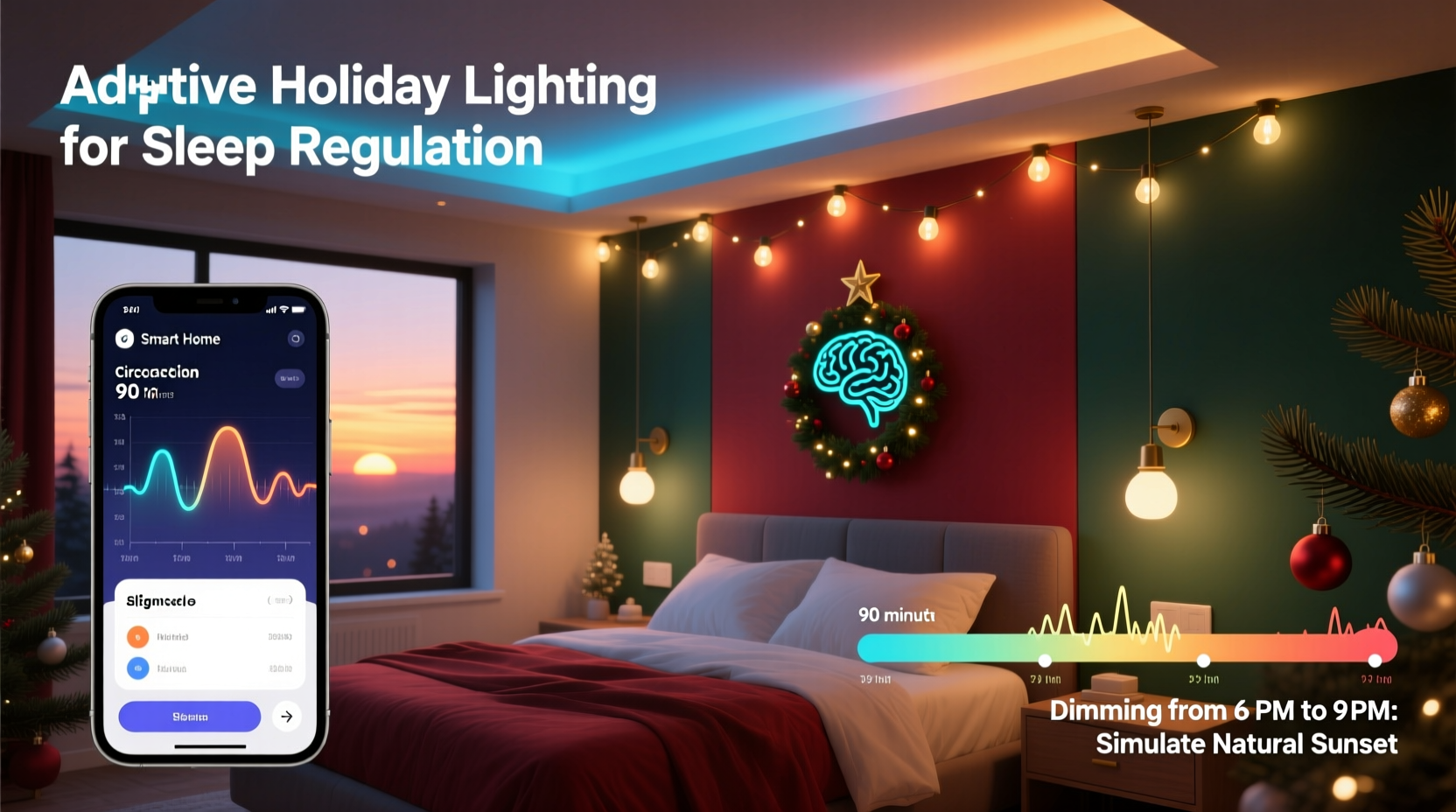
Our internal clock—the suprachiasmatic nucleus (SCN)—relies primarily on light intensity, spectrum, and timing to synchronize daily rhythms. Blue-enriched light (peaking around 480 nm) is especially potent at signaling “daytime” to the brain, even at low intensities. Most modern LED Christmas lights emit significant blue wavelengths—often unintentionally. A 2023 study in Chronobiology International found that participants exposed to standard white LED string lights for just 45 minutes between 8:00–9:30 p.m. experienced a 37% average reduction in evening melatonin levels compared to controls using amber-filtered lights.
This effect compounds during December, when natural daylight is shortest. Without conscious intervention, artificial light becomes the dominant zeitgeber—often at precisely the wrong time. The result? Later bedtimes, reduced slow-wave sleep, increased nocturnal awakenings, and next-day fatigue that many mistake for “holiday stress.” Adaptive lighting doesn’t mean dimming joy—it means honoring biological timing.
Building Your Adaptive Lighting Timeline
An effective adaptive routine follows a three-phase circadian arc: awakening support, evening transition, and sleep sanctuary. Each phase uses light intentionally—not as decoration alone, but as a non-pharmacological regulator. Below is a practical, weeknight-aligned timeline validated by sleep specialists at the Center for Circadian & Sleep Medicine at Northwestern University.
- 6:30–8:30 a.m.: Morning Activation — Illuminate outdoor trees and front-facing displays with full-spectrum, high-intensity white lights (5000K–6500K). Use timers to ensure consistency—even on weekends. This reinforces cortisol rhythm and sharpens daytime alertness.
- 4:00–6:30 p.m.: Warm Transition — Switch indoor lights to warm-white (2700K) or amber strings. Dim overhead fixtures by 40%. Begin lowering ambient brightness gradually—no abrupt shifts. This primes melatonin synthesis onset.
- 7:30–8:30 p.m.: Gentle Wind-Down — Reduce total lit surface area by 50%. Turn off non-essential strings (e.g., stair railings, ceiling garlands). Keep only one warm-light source active per room—ideally at eye level or below (not overhead).
- 8:30 p.m. onward: Sleep Sanctuary Mode — All decorative lighting powered down. Only essential, motion-activated nightlights (with red or amber LEDs ≤5 lux) remain active in hallways and bathrooms. No screens or bright task lighting permitted.
This sequence mirrors natural twilight progression—something our ancestors experienced daily. Modern life erodes that gradient; adaptive holiday lighting restores it, one evening at a time.
Do’s and Don’ts: Light Selection & Placement
Not all Christmas lights interact with biology the same way. Spectrum, intensity, location, and control method matter as much as timing. The table below summarizes evidence-based recommendations drawn from peer-reviewed studies and clinical sleep guidelines.
| Category | Do | Don’t |
|---|---|---|
| Spectrum | Use warm-white (2200K–2700K) or amber-only (≤590 nm peak) LEDs indoors after 5 p.m. | Install cool-white (5000K+) or RGB multicolor strings in bedrooms or living areas used after 7 p.m. |
| Intensity | Keep bedroom-adjacent lighting ≤10 lux (measurable with a smartphone lux meter app). Prioritize indirect illumination. | Mount bright strings directly above seating areas or beds—this creates glare and elevates retinal irradiance. |
| Control | Use programmable smart plugs or timers with sunrise/sunset sync. Integrate with voice assistants for manual override. | Rely solely on manual switches—human inconsistency undermines circadian consistency. |
| Placement | Position lights at foot-level (e.g., along baseboards) or behind furniture for soft, diffused glow. Use frosted bulbs or fabric diffusers. | String lights across mirrors, windows, or glossy surfaces—these amplify reflected brightness and spectral impact. |
Real-World Implementation: A Family Case Study
The Chen family of Portland, Oregon—parents Maya (42) and David (45), and children Leo (9) and Sofia (6)—struggled each December with escalating bedtime resistance, fragmented sleep, and morning irritability. Their home featured 17 strings of mixed LED lights, most activated at 4:30 p.m. and left on until midnight. After consulting a behavioral sleep specialist, they implemented a phased adaptive routine over three weeks:
- Week 1: Replaced all bedroom and hallway strings with 2200K amber LEDs. Installed smart timers limiting outdoor lights to 6:30–8:30 a.m. and 4:00–7:30 p.m.
- Week 2: Added a “light curfew” at 8:00 p.m.—all decorative indoor lights turned off except one warm string in the living room, dimmed to 30% brightness.
- Week 3: Introduced red-nightlight path lighting in hallways and bathrooms, eliminating all white light exposure post-8:30 p.m.
Within 12 days, average sleep onset shifted 28 minutes earlier. Parent-reported child nighttime awakenings dropped from 2.4 to 0.7 per night. Maya noted improved morning focus and reduced afternoon fatigue—a benefit she hadn’t anticipated. “We didn’t feel like we sacrificed celebration,” she shared. “The lights felt cozier, more intentional—and everyone slept like they hadn’t in months.”
Expert Insight: Why Timing Trumps Total Brightness
“The most common misconception is that ‘less light’ equals better sleep. In reality, it’s when and what kind of light matters far more than raw lumen output. A single 2700K bulb at 50 lux at 7 p.m. supports melatonin readiness far better than ten 6500K bulbs at 10 lux each scattered across a room at 9 p.m. Chronobiology is contextual—and adaptive lighting honors that context.”
— Dr. Lena Torres, PhD, Director of the Circadian Health Lab, University of Colorado Anschutz Medical Campus
Dr. Torres emphasizes that circadian responsiveness isn’t linear: sensitivity peaks in the two-hour window before habitual bedtime. That’s why the 7:30–8:30 p.m. wind-down phase carries disproportionate weight. It’s also why consistency matters more than perfection—if you miss one night, resume the pattern the next evening without self-criticism. The system recalibrates rapidly with repetition.
Frequently Asked Questions
Can I use color-changing (RGB) lights adaptively?
Yes—but only with strict spectral discipline. Avoid blue, cyan, or white channels after 5 p.m. Stick exclusively to amber (590 nm), red (620–650 nm), or deep-warm-white (2200K) modes in the evening. Many smart lighting apps allow custom “circadian profiles” that auto-shift hue and intensity based on time of day—use those instead of manual color selection.
What if I work night shifts or have irregular hours?
Adapt your lighting schedule to your actual wake/sleep anchor—not the calendar. If you sleep from 8 a.m. to 4 p.m., then your “morning activation” light exposure should occur within 30 minutes of waking (8:00–8:30 a.m.), and your “evening transition” begins 3–4 hours before your target bedtime (12–1 p.m.). Consistency relative to your personal rhythm is what builds resilience—not alignment with solar time.
Do incandescent or vintage-style bulbs offer advantages?
Yes—incandescents naturally emit almost no blue light and peak in the infrared/red spectrum, making them inherently sleep-friendly. However, their energy inefficiency and heat output limit practicality for large displays. Modern warm-dim LEDs (which shift from 2700K to 1800K as they dim) provide comparable spectral safety with 85% less energy use and no burn risk—making them the optimal upgrade path.
Putting It All Together: Your 7-Day Implementation Checklist
- ✅ Day 1: Audit all current lights: note color temperature (K), placement, and typical on/off times.
- ✅ Day 2: Purchase warm-white (2200K–2700K) or amber replacement strings for indoor use after 5 p.m.
- ✅ Day 3: Install programmable timers or smart plugs on outdoor and high-visibility indoor circuits.
- ✅ Day 4: Set morning activation (6:30–8:30 a.m.) and evening transition (4:00–7:30 p.m.) windows.
- ✅ Day 5: Designate one “wind-down zone” light—dimmable, warm, and positioned low—to remain on until 8:30 p.m.
- ✅ Day 6: Remove or cover all cool-white/RGB strings in bedrooms, hallways, and primary living areas used after 7 p.m.
- ✅ Day 7: Test the full sequence for one evening. Note subjective effects (ease of falling asleep, morning alertness) and adjust timing by ±15 minutes if needed.
Remember: this isn’t a rigid protocol—it’s a responsive framework. Observe how your body responds. If you feel drowsy earlier, shift the wind-down phase forward. If mornings feel sluggish, extend morning activation by 15 minutes. Your biology is your best feedback loop.
Conclusion: Light as Care, Not Just Decoration
Holiday lighting doesn’t have to be a trade-off between tradition and tranquility. When grounded in circadian science and applied with thoughtful intention, it becomes a quiet act of self-care—one that honors both the spirit of the season and the sanctity of rest. You don’t need to dismantle your display or forfeit sparkle. You simply redirect its purpose: from ambient spectacle to rhythmic support. As winter darkness deepens, your lights can do more than illuminate space—they can gently guide your nervous system toward stillness, deepen your capacity for presence, and restore the restorative power of true sleep. Start tonight. Choose one string. Adjust one timer. Notice the difference in your breath, your shoulders, your ability to settle. Then build from there—not toward perfection, but toward attunement.




 浙公网安备
33010002000092号
浙公网安备
33010002000092号 浙B2-20120091-4
Comments
No comments yet. Why don't you start the discussion?