
Themed Christmas trees have evolved from traditional red-and-gold elegance to deeply personal expressions of identity—especially among Gen Z and millennial fans who grew up with anime as emotional touchstones. But enthusiasm can easily tip into excess: tangled strings of character ornaments, mismatched scales, clashing palettes, or narrative whiplash (imagine Naruto’s headband next to Sailor Moon’s crescent moon beside a grimacing Demon Slayer sword—all competing for attention). The goal isn’t to suppress fandom; it’s to curate it. A successful anime-themed tree feels intentional, harmonious, and *festive*—not like a merch dump disguised as holiday decor. It respects both the spirit of Christmas and the integrity of the characters you love.
1. Start with Narrative Cohesion, Not Character Count
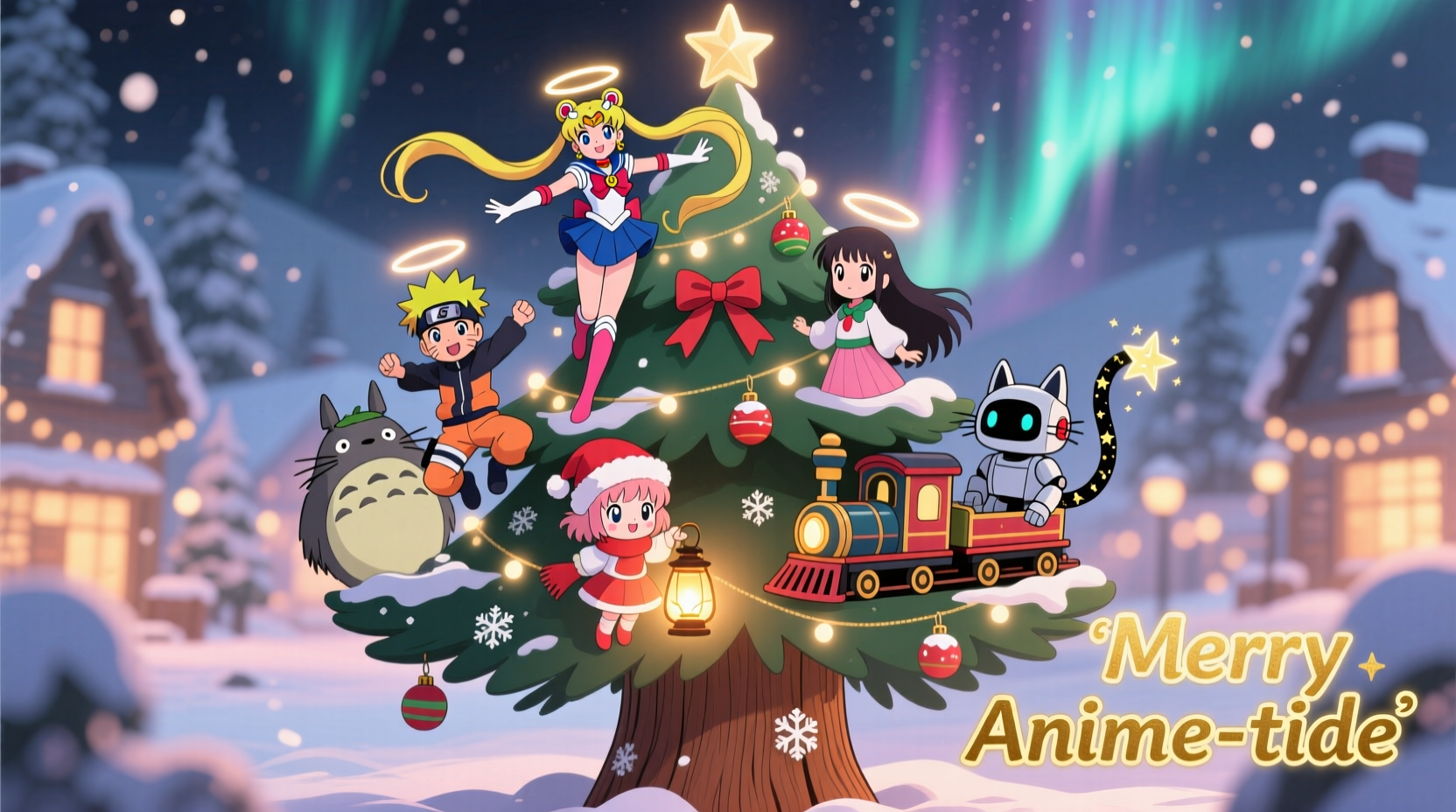
Most overdone anime trees fail at the foundational level: they treat “anime” as a monolithic genre rather than a vast, stylistically diverse medium. A tree that mixes shonen battle aesthetics with delicate shojo romance motifs—or throws in mecha, isekai, and magical girl elements without rhyme or reason—creates cognitive dissonance. Instead, anchor your tree in a single unifying idea: a shared theme, tone, color language, or even a specific story arc.
Consider these cohesive approaches:
- The “Winter Arc” Tree: Focus on series where snow, solitude, or quiet resilience define key moments—e.g., Clannad’s snow-covered shrine, Your Name’s comet-lit mountain, or My Hero Academia’s U.A. winter festival. Use cool-toned lights (soft white or pale blue), frosted pinecones, and minimalist ornaments shaped like train tickets, paper cranes, or frozen cherry blossoms.
- The “Studio Ghibli Reverie” Tree: Prioritize warmth, whimsy, and nature reverence. Avoid literal character busts; instead, use hand-painted wooden ornaments depicting soot sprites, Totoro’s umbrella, or Howl’s moving castle silhouette. Wrap the trunk in burlap dyed with natural indigo for earthiness.
- The “One Series, One Season” Tree: Dedicate the entire tree to a single beloved show—but only its *holiday-adjacent* moments. For Steins;Gate, use vintage-style clock gears, red LED “time leap” lights, and subtle lab-notebook tags. For K-On!, hang miniature guitars, tea cups, and music notes in pastel gradients—evoking their clubroom’s cozy energy, not just random band merch.
2. Curate Ornament Scale, Material, and Placement Strategically
Anime fandom thrives on detail—figures, plushies, keychains—but scale matters immensely on a tree. Oversized figurines overwhelm branches, obscure lights, and risk toppling. A 12-inch Naruto action figure may be perfect for a shelf but disastrous as a tree topper. Similarly, glossy plastic ornaments reflect light harshly, while matte ceramic or hand-blown glass diffuses it softly and feels more timeless.
Use this tiered ornament strategy for visual balance:
| Ornament Type | Recommended Size | Material Suggestions | Placement Principle |
|---|---|---|---|
| Character Focal Points | 2–4 inches tall | Ceramic, wood, felt, enamel | Max 5–7 pieces; spaced evenly across mid-to-lower third of tree |
| Symbolic Motifs | 1–2.5 inches | Wood, brass, linen-wrapped foam | Cluster 3–5 per branch; e.g., Sharingan eyes, Luffy’s straw hat, or Studio Ghibli’s soot sprite silhouettes |
| Textural & Ambient Elements | Variable (e.g., 4\" pinecone, 6\" ribbon) | Felt, wool, dried citrus, cinnamon sticks, burlap | Woven throughout—base layer for depth and tactile contrast |
| Lighting | N/A | Warm-white LED micro-fairy lights (non-blinking) | Wrapped tightly from trunk outward; avoid colored LEDs unless part of a deliberate palette (e.g., all soft pink for Sailor Moon) |
Remember: ornaments are punctuation—not the sentence. They should enhance the tree’s form, not fight it. A well-proportioned tree has visual breathing room. If you can’t see the branch structure beneath the ornaments, you’ve added too much.
3. Build a Refined Color Palette—Not a Merchandise Rainbow
It’s tempting to replicate every vibrant hue from your favorite anime opening—neon pinks, electric blues, acid greens. But Christmas trees thrive on tonal harmony. Unrestrained color saturation creates visual fatigue and undermines seasonal warmth. Instead, extract a *limited, elevated palette* from your chosen anime or theme.
For example:
- Haikyu!! fans might choose charcoal gray (for gym floors), deep navy (team uniforms), and warm amber (gym lighting)—not bright orange or fluorescent yellow.
- Fruits Basket enthusiasts could pull muted sage green (forest), dusty rose (Tohru’s scarf), and cream (paper scrolls)—avoiding cartoonish lime or bubblegum pink.
- A Death Note-inspired tree? Think charcoal black, parchment beige, and a single accent of deep blood red—used sparingly on ribbon or one ornate notebook tag—not full-on crimson overload.
Apply the 60-30-10 rule: 60% dominant base color (e.g., forest green branches + neutral ornaments), 30% secondary tone (e.g., cream ribbons or wood tones), 10% accent (one carefully chosen character motif or metallic finish). This preserves sophistication while honoring fandom.
4. Real-World Example: Maya’s “Quiet Ghibli Winter” Tree
Maya, a 28-year-old graphic designer and lifelong Ghibli fan, wanted a tree that felt like stepping into the bathhouse in Spirited Away—warm, layered, and quietly magical—not a retail display of merchandise. She began by rejecting all pre-made Ghibli ornaments, which she found overly literal and garish. Instead, she spent two weekends crafting her own:
- She cut 18 felt soot sprites (3” tall) in varying shades of charcoal, gray, and soft black—each with tiny embroidered eyes.
- She painted 12 wooden discs (2” diameter) with watercolor washes of misty lavender and seafoam green, then stamped each with a tiny, subtle No-Face symbol.
- She wrapped the trunk in undyed linen rope and draped hand-dyed silk ribbons in muted ochre and slate blue.
- She used only warm-white fairy lights—and strung them *before* adding any ornaments, ensuring even glow distribution.
The result wasn’t instantly recognizable as “Ghibli” to a casual observer—but longtime fans paused, smiled, and said, “It feels exactly like sitting in the boiler room with Kamaji.” Maya kept the tree up until early February, and visitors consistently described it as “calming,” “cozy,” and “surprisingly elegant.” Her secret? She treated the tree as interior design first, fandom second.
“Theming isn’t about how many characters you can fit—it’s about how deeply you can translate emotion into environment. A single, thoughtfully placed motif resonates more than twenty scattered ones.” — Kenji Tanaka, Tokyo-based set designer and anime exhibition curator
5. Step-by-Step Curation Timeline (4 Weeks Before Christmas)
Building a balanced anime tree is a process—not an impulse buy. Follow this timeline to avoid last-minute clutter and decision fatigue:
- Week 4: Define & Audit
Choose your unifying theme (e.g., “Studio Ghibli Winter,” “Shonen Friendship Arcs,” “Magical Girl Light”). Then inventory existing ornaments, ribbons, and lights. Discard or donate anything chipped, faded, or visually jarring—even if it’s “rare.” - Week 3: Source Mindfully
Purchase only what fills gaps in your palette and scale plan. Prioritize handmade, small-batch, or DIY options. Set a hard cap: no more than 1 ornament per foot of tree height (e.g., max 7 for a 7-foot tree). - Week 2: Prototype & Edit
Lay out all ornaments on a large sheet of neutral fabric. Arrange in rough thirds (top/mid/base). Step back. Remove the 3 items that feel loudest, most saturated, or least aligned with your adjectives. Repeat until composition feels calm. - Week 1: Assemble with Intention
Start with lights (wrapped tightly, trunk to tip). Add textural elements (ribbons, pinecones, dried citrus). Then place symbolic motifs. Finally, add character-focused ornaments—only where negative space invites focus. Stand back every 5 minutes. - Week 0: Refine & Reflect
View the tree at different times of day. Take a photo in black and white—if the composition still reads clearly, you’ve succeeded. If it looks like static, remove two more ornaments.
6. Do’s and Don’ts: The Balanced Decorator’s Checklist
Before finalizing your tree, run through this essential checklist:
- ✅ Do choose one primary anime universe or mood—not multiple franchises.
- ✅ Do limit character-based ornaments to 5–7 pieces maximum.
- ✅ Do use warm-white or soft-yellow lighting—not multicolor blinking LEDs.
- ✅ Do incorporate natural textures (wood, wool, dried citrus, cinnamon) to ground the theme.
- ✅ Do keep the tree topper simple: a woven star, origami crane, or minimalist crescent moon—never a character head.
- ❌ Don’t mix anime genres with wildly divergent art styles (e.g., Akira cyberpunk + Little Witch Academia whimsy).
- ❌ Don’t use glossy plastic ornaments—they cheapen the aesthetic and create glare.
- ❌ Don’t hang ornaments solely by fandom loyalty (“I love this character, so it must go on the tree”). Ask: “Does this support the mood?”
- ❌ Don’t overcrowd the lower third—this is where guests’ eyes naturally rest. Leave generous breathing room.
- ❌ Don’t forget the base: a simple linen or burlap tree skirt in a neutral tone completes the look far better than a character-print fabric.
7. FAQ: Practical Questions from Real Fans
Can I include anime quotes or lyrics on ornaments?
Yes—but sparingly and elegantly. Choose one line that embodies your theme’s essence (e.g., “Even the smallest person can change the course of the future” for a Lord of the Rings-adjacent fantasy anime tree), typeset in clean, serif font on matte cardstock. Avoid long passages, slang, or memes—they date quickly and distract from visual flow.
What if my favorite anime has dark or intense themes—like Attack on Titan or Berserk?
Respect the weight of those stories by translating their emotional core—not their violence—into decor. For Attack on Titan, consider minimalist 3D maneuver gear silhouettes in brushed steel, or ornamental walls made from stacked gray stone-textured clay. For Berserk, use deep burgundy ribbons, aged brass accents, and a single, weathered-looking Behelit pendant—hung low and solemnly, not as a cheerful bauble. Let gravity and restraint convey gravitas.
How do I explain my themed tree to family members unfamiliar with anime?
Lead with feeling, not fandom. Say, “This tree reflects the warmth and quiet magic I find in these stories—the same comfort I hope Christmas brings.” Show them how the colors, textures, and lighting align with classic holiday sensibilities. Most people respond to sincerity and beauty before they recognize a character. When they ask, “What’s that little black thing?”—that’s your invitation to share, not defend.
Conclusion: Your Tree Is a Story—Not a Showcase
A truly memorable anime-themed Christmas tree doesn’t shout its references. It whispers them—through the grain of hand-carved wood, the hush of matte-finish ceramics, the gentle glow of warm light catching the curve of a felt soot sprite. It honors the characters not by replicating their images, but by embodying the feelings they evoked: wonder, resilience, belonging, quiet joy. That kind of curation takes patience, discernment, and respect—for the season, for the art, and for your own evolving taste. You don’t need to prove your fandom. You only need to create a space where it breathes alongside tradition, not against it.
This year, resist the urge to fill every branch. Choose meaning over quantity. Prioritize harmony over hype. Let your tree be less a catalog of favorites and more a sanctuary built from what moves you—deeply, quietly, and authentically.




 浙公网安备
33010002000092号
浙公网安备
33010002000092号 浙B2-20120091-4
Comments
No comments yet. Why don't you start the discussion?