
Dicing an onion may seem like a simple task, but doing it properly affects the taste, texture, and appearance of countless dishes. Whether you're sautéing aromatics for a stew, building a sofrito base, or garnishing a salad, uniformly diced onions ensure even cooking and balanced flavor distribution. Yet, many home cooks struggle with tears, uneven pieces, or inefficient technique. Mastering the art of dicing an onion is not just about knife skills—it's about understanding structure, applying consistent pressure, and working safely and efficiently. This guide breaks down every phase of the process, from selecting the right onion and knife to executing clean, uniform cuts that elevate your everyday cooking.
Understanding the Onion: Structure and Culinary Role
The onion (Allium cepa) is a bulbous vegetable belonging to the lily family, closely related to garlic, leeks, and chives. It consists of layered, concentric rings protected by a papery outer skin, with a root cluster at one end and a dry stem cap at the other. When cut, enzymes within the cells react with air to produce sulfenic acid, which converts into a volatile gas—syn-propanethial-S-oxide—that irritates the eyes and causes tearing. Despite this inconvenience, onions are indispensable in global cuisines due to their ability to add depth, sweetness, and umami when cooked, and sharpness or brightness when raw.
In culinary terms, dicing—an evenly sized cube cut—ensures predictable cooking behavior. Unlike rough chopping or slicing, dicing allows onions to caramelize uniformly, dissolve smoothly into sauces, or distribute consistently through salsas and dressings. The standard dice sizes include:
- Large dice: ¾ inch (19 mm) – used in stews or stocks where texture is desired.
- Medium dice: ½ inch (12 mm) – ideal for soups, casseroles, and sautés.
- Small dice: ¼ inch (6 mm) – common in mirepoix, salsas, and fine relishes.
- Fine dice: ⅛ inch (3 mm) – used in tartare, garnishes, or compound butters.
For most applications, a medium to small dice offers the best balance between surface area for flavor release and structural integrity during cooking.
Key Characteristics of Onions
Not all onions behave the same way when diced. Their moisture content, pungency, and layer thickness influence both cutting ease and final result. Below is a summary of the most commonly used onion types and their traits:
| Type of Onion | Flavor Profile | Color/Form | Pungency Level | Culinary Function | Shelf Life (Unrefrigerated) |
|---|---|---|---|---|---|
| Yellow Onion | Sharp when raw, sweet when cooked | Brown papery skin, pale yellow flesh | High | Base for soups, stews, roasts, caramelization | 2–3 months |
| White Onion | Crisp, slightly more acidic | White skin and flesh | Moderate-high | Salsas, Mexican cuisine, pickling | 1–2 months |
| Red Onion | Mildly sweet with tangy finish | Purple-red skin and flesh | Low-moderate | Raw applications: salads, sandwiches, grilling | 3–4 weeks |
| Shallot | Delicate, garlicky, subtle sweetness | Gray-purple skin, pinkish flesh | Low | Vinaigrettes, sauces, fines herbes, reductions | 1 month |
Yellow onions are the default choice for dicing in cooked dishes due to their high sugar content and transformative browning capability. Red and white onions are preferred in raw preparations where color and bite matter. Shallots, though technically a separate species, are often substituted in refined applications requiring subtlety.
Essential Tools for Dicing an Onion
Proper equipment ensures control, consistency, and safety. The following tools are non-negotiable for efficient onion dicing:
- Sharp Chef’s Knife (8-inch): A sharp blade slices cleanly through layers without crushing cells, minimizing juice loss and reducing tear-inducing gas release. Dull knives require more force, increasing slip risk.
- Cutting Board (Stable, Non-Slip): Use wood or plastic with a damp towel underneath to prevent movement. Deep grooves can trap juices and bacteria.
- Bowl or Container: To collect diced onions immediately after cutting, preventing oxidation and keeping workspace clean.
Tip: Chill onions in the refrigerator for 15–30 minutes before cutting. Cold temperatures slow enzyme activity, reducing tear production. Avoid freezing, as ice crystals rupture cell walls and create mushiness.
Step-by-Step Guide: How to Dice an Onion
Follow these steps to achieve uniform, professional-quality diced onions. The method applies to all common globe onions unless otherwise noted.
- Prepare Your Workspace
Wash the onion under cool water to remove dirt. Dry it thoroughly. Place your cutting board on a stable surface. Have your bowl ready nearby. - Cut Off the Stem End
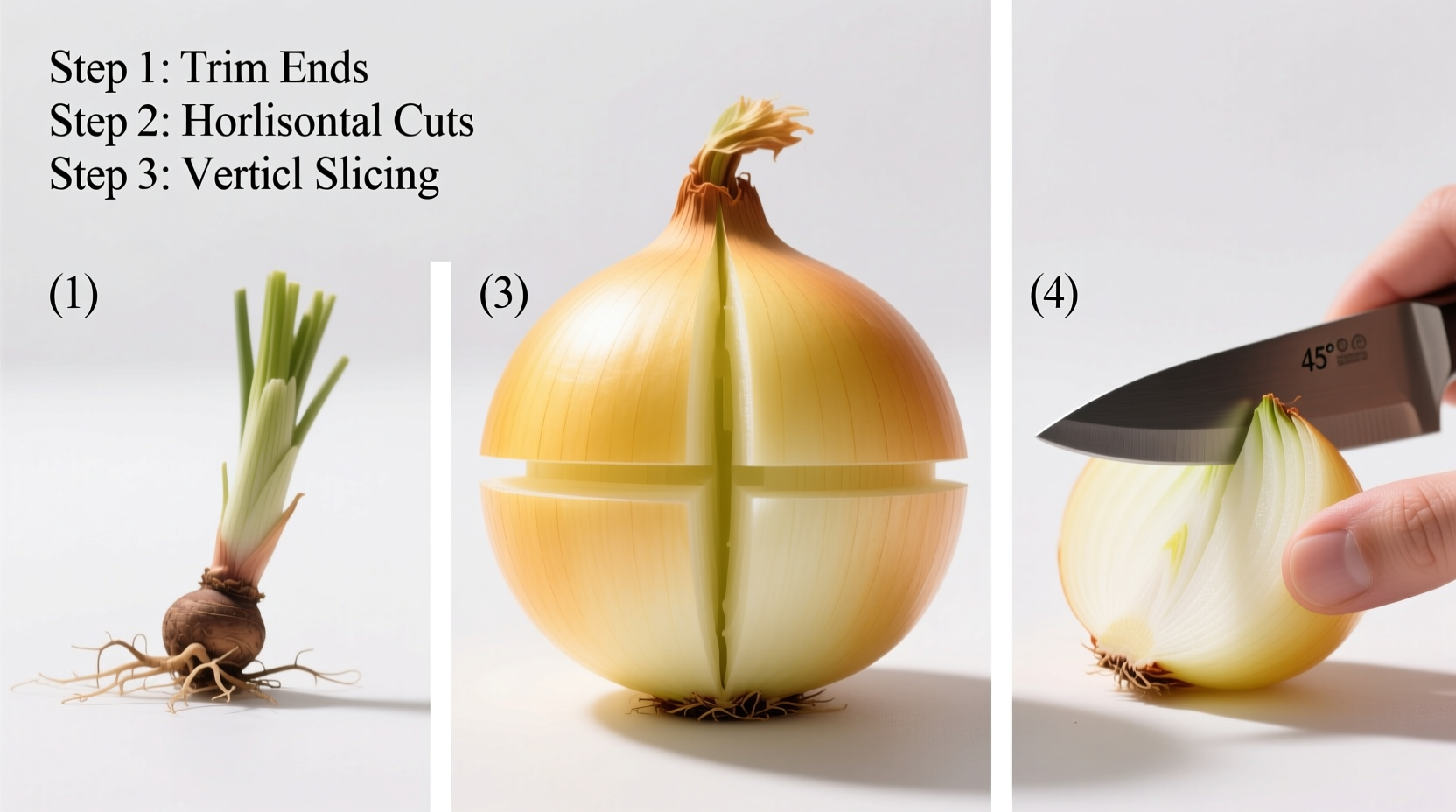
Position the onion vertically, root end down, stem end up. Using a chef’s knife, slice off approximately ½ inch from the top (stem end). Do not cut too deeply—preserve the root plate at the bottom, as it holds the layers together during subsequent cuts. - Peel the Onion
Remove the papery outer skin and any damaged outer layers. Depending on size, you may need to peel one or two layers. Discard skins into compost or trash. - Halve the Onion Through the Root
Keep the onion upright. Slice straight down through the center, passing through the root. You should now have two equal halves, each with half of the root intact. This maintains structural integrity during dicing. - Lay One Half Flat-Side Down
Take one half and place the freshly cut side down on the board. This creates a stable base and prevents rolling. - Make Vertical Cuts Toward the Root
Holding the knife handle with your dominant hand and curling your fingers of the opposite hand over the onion (using knuckles as a guide), make parallel vertical cuts from the stem end toward—but not through—the root end. Spacing determines dice size:- ¼ inch apart = small dice
- ½ inch apart = medium dice
- Make Horizontal Cuts (Optional for Finer Dice)
For smaller or more consistent cubes, especially in fine dicing, make one or two horizontal cuts parallel to the board, again stopping short of the root. These cuts go beneath the surface, creating internal segmentation. This step is optional for standard medium dices but recommended for restaurant-style precision. - Final Crosswise Slices
Rotate the onion 90 degrees. Now slice crosswise (perpendicular to the previous vertical cuts), moving from stem to root. As you cut, uniform cubes will fall away. Continue until only the root remnant remains. Discard the root portion. - Repeat with Second Half
Perform the same sequence on the remaining half. Transfer all diced pieces to a bowl promptly.
Professional Tip: Maintain a “claw grip” with your guiding hand—tuck fingertips inward, using knuckles to guide the blade. This protects your fingers while ensuring straight, controlled cuts. Never flatten your hand across the onion.
Variants and Specialized Dicing Techniques
While the standard dice suffices for most recipes, variations exist depending on cuisine, dish requirements, or presentation goals.
Julienne vs. Dice
A julienne cut produces thin matchsticks (typically ⅛ x ⅛ x 1 inch), often used as a precursor to fine dicing. To julienne: after halving and flattening, make close vertical cuts (⅛ inch apart), then stack strips and slice crosswise into small squares. This yields ultra-fine dice suitable for butter blends or garnishes.
Brunoise Cut (Fine Dice)
A brunoise is a 1/16-inch cube derived from julienned strips. It requires exceptional knife control and is typically reserved for consommés, clarified broths, or haute cuisine plating. Not recommended for beginners or high-volume prep.
French vs. English Method
- English Method: Involves peeling, halving, and dicing from flat side down—exactly as described above. Most common in American and British kitchens.
- French Method: Begins with peeling whole, then making radial cuts from pole to equator without separating halves, followed by horizontal and vertical slicing. Less stable and rarely used today due to inconsistency.
Comparison with Similar Ingredients
Onions are frequently confused with related alliums. Understanding differences helps avoid substitution errors.
| Ingredient | Texture When Diced | Flavor Intensity | Best Used In | Substitution Ratio |
|---|---|---|---|---|
| Garlic | Soft, pastes easily | Very strong, pungent | Sauces, marinades, stir-fries | 1 clove ≈ ½ tsp minced |
| Shallot | Firm, fine-grained | Milder, sweeter | Vinaigrettes, cream sauces | 1:1 for delicate dishes |
| Leek | Crunchy, fibrous | Mild, grassy | Soups, braises, gratins | 2:1 volume replacement |
| Green Onion (Scallion) | Crisp, tender | Light, fresh | Garnishes, Asian dishes, dips | Use whites only for base; greens as garnish |
Unlike garlic, which burns easily, diced onions can withstand prolonged heat. Leeks require thorough washing due to trapped soil between layers. Green onions offer color and freshness but lack the depth needed for foundational aromatics.
Practical Tips & FAQs
Why do onions make me cry, and how can I reduce tearing?
The act of cutting ruptures cells containing sulfoxides, which mix with enzymes to form a sulfur-based gas. To minimize exposure:
- Use a sharp knife to reduce cell damage.
- Cut near a running fan or vent hood to disperse gas.
- Work quickly and keep the root intact as long as possible—highest concentration of enzymes is near the root.
- Wear kitchen goggles (yes, seriously).
Can I dice onions in advance?
Yes, but store properly. Diced onions oxidize and degrade in flavor and texture over time. Refrigerate in an airtight container for up to 5 days. For longer storage, freeze—though texture becomes soft upon thawing, limiting use to cooked dishes only.
What’s the best way to clean my board and knife after dicing onions?
Rinse immediately with hot water and mild detergent. Wooden boards benefit from occasional mineral oil treatment. Residual odor can be neutralized by rubbing the board with lemon juice or baking soda paste.
Is there a safe alternative to dicing by hand?
While food processors yield inconsistent results and often over-process, a mandoline with a dicing attachment can work—but requires extreme caution. Hand dicing remains the gold standard for control and safety.
How much diced onion does one medium onion yield?
Approximately 1 cup (150g) of diced onion comes from one medium (8 oz / 225g) yellow onion. Adjust recipe quantities accordingly when scaling.
“The way you treat an onion reveals your respect for ingredients. A clean dice isn’t just about looks—it’s about honoring the chemistry of cooking.”
— Chef Thomas Keller, The French Laundry Cookbook
Summary & Key Takeaways
Dicing an onion is a fundamental skill that impacts nearly every savory dish. By mastering the proper technique, you gain consistency, efficiency, and safety in the kitchen. Key points to remember:
- Always start with a sharp knife and stable cutting board.
- Preserve the root end until the final cut to maintain structure.
- Use the claw grip to protect fingers and ensure straight cuts.
- Chill onions briefly to reduce eye irritation.
- Choose onion type based on application: yellow for cooking, red for raw, shallots for finesse.
- Store diced onions properly—refrigerate for short term, freeze only for cooked dishes.
- Practice regularly to build muscle memory and speed.
Like any foundational technique, dicing improves with repetition. Invest time in perfecting this skill, and you’ll notice immediate improvements in everything from scrambled eggs to coq au vin. The difference between a home cook and a confident kitchen artist often lies not in complexity, but in precision—and it starts with a single onion.




 浙公网安备
33010002000092号
浙公网安备
33010002000092号 浙B2-20120091-4
Comments
No comments yet. Why don't you start the discussion?