
Personality assessments like the Myers-Briggs Type Indicator or the Enneagram have become popular tools for self-understanding. While they offer valuable starting points, many people find that their results don’t fully resonate. Labels can feel limiting, and static test outcomes often fail to capture the complexity of who we are in different contexts. True self-knowledge goes beyond answering 50 multiple-choice questions—it requires observation, reflection, and courage.
Discovering your authentic personality type isn't about fitting into a box; it's about understanding your behavioral tendencies, emotional triggers, core motivations, and how you relate to the world across time and situations. This guide offers a structured yet flexible approach to uncovering your deeper self—one rooted in lived experience rather than algorithmic categorization.
Why Standard Tests Fall Short
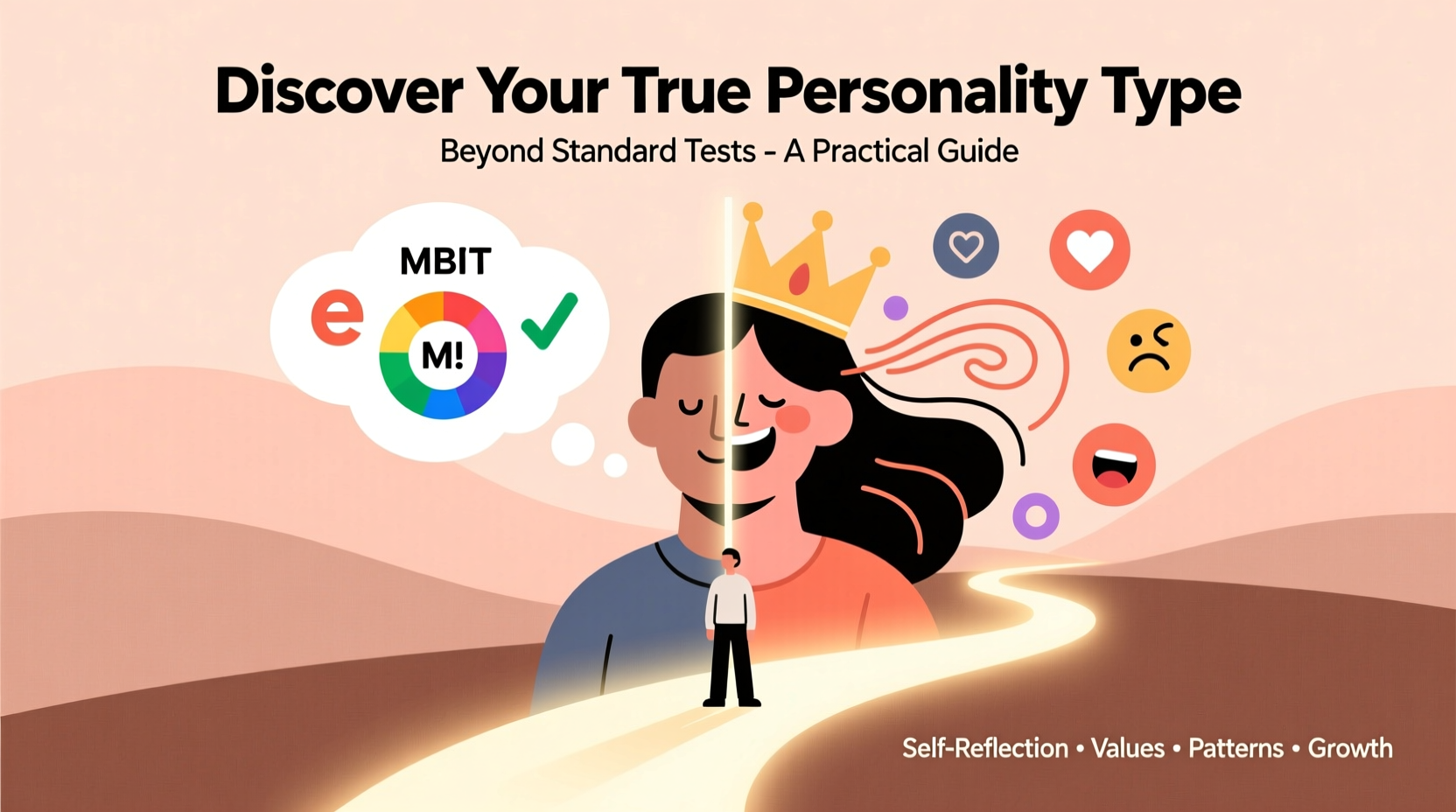
Standardized personality tests provide a snapshot, not a full portrait. They measure preferences at a single moment, often influenced by mood, environment, or social expectations. A person might score as an introvert one week and an extrovert the next—not because their personality changed, but because they were in a new job, under stress, or answering based on aspiration rather than reality.
Moreover, these tests rarely account for growth. We evolve through experiences, relationships, and challenges. The version of you from five years ago may no longer reflect your current values, coping mechanisms, or communication style.
“Personality is not a fixed trait but a dynamic system shaped by biology, environment, and conscious choice.” — Dr. Laura Chang, Clinical Psychologist and Behavioral Researcher
Relying solely on test results risks mistaking a temporary state for a permanent identity. To move beyond this limitation, we need more nuanced, reflective practices.
A Step-by-Step Guide to Uncovering Your True Personality
Self-discovery is a process, not an event. Follow this six-phase timeline to build a deeper, more accurate understanding of your personality over several weeks.
- Phase 1: Observe Without Judgment (Week 1–2)
Carry a small journal or use a notes app. For two weeks, record moments when you felt strongly—positive or negative. Note what triggered the emotion, how you responded, and how others reacted. - Phase 2: Identify Recurring Patterns (Week 3)
Review your entries. Look for common themes: Do you withdraw under pressure? Seek control in chaos? Feel energized after deep conversations? These patterns reveal underlying traits. - Phase 3: Map Your Energy Flow (Week 4)
Track where you gain and lose energy. Introversion and extroversion aren’t just about socializing—they’re about energy management. Did a team meeting drain you? Did solitary writing recharge you? Log daily energy shifts. - Phase 4: Explore Core Motivations (Week 5)
Ask yourself: What truly drives me? Is it security, recognition, autonomy, connection, or growth? Reflect on past decisions—what need were you trying to fulfill? - Phase 5: Test Your Insights (Week 6)
Use your observations to predict how you’ll respond in upcoming situations. Will conflict make you confrontational or avoidant? Will praise boost confidence or create pressure? Then observe whether your prediction holds. - Phase 6: Refine and Reassess (Ongoing)
Revisit your journal monthly. Update your self-profile. Personality isn’t static—your understanding of it should grow with you.
Key Dimensions of Authentic Personality
To organize your findings, consider evaluating yourself across five core dimensions. Unlike binary test categories, these exist on spectrums and can vary by context.
| Dimension | Description | Reflective Questions |
|---|---|---|
| Energy Source | Where do you recharge—through solitude or interaction? | After a long day, do you want to talk or be alone? |
| Decision Style | Do you prioritize logic, emotions, or values? | When choosing a job, is salary, culture, or purpose most important? |
| Stress Response | How do you behave under pressure? | Do you shut down, lash out, or seek solutions? |
| Social Role | What role do you naturally take in groups? | Are you the planner, listener, mediator, or initiator? |
| Growth Orientation | Are you motivated by mastery, safety, or contribution? | Do you seek new skills, stability, or meaningful impact? |
Rate yourself on each dimension using specific examples from your journal. Over time, clusters will form—these are the building blocks of your authentic type.
Real Example: From Test Confusion to Clarity
Sophie took the MBTI three times and received three different results: INFP, INFJ, and INTJ. Frustrated, she began tracking her behavior at work and home. She noticed that while she valued deep one-on-one conversations (a trait associated with Feeling types), she made tough decisions based on long-term strategy, not emotion. In meetings, she stayed quiet but later sent detailed follow-ups—indicating internal processing, not disengagement.
Through journaling, Sophie realized she wasn’t “indecisive”—she was context-dependent. At home, she was empathetic and expressive (Feeling-oriented). At work, she prioritized efficiency and structure (Thinking-oriented). Her true type wasn’t a letter code; it was a blend of adaptive strengths shaped by environment and responsibility.
This awareness helped her communicate better with her team and set boundaries without guilt. She stopped trying to “be” an INFP and started honoring her fluid, multifaceted nature.
Practical Checklist for Ongoing Self-Discovery
- Keep a weekly emotional journal noting reactions and triggers
- Identify at least three recurring behavioral patterns every month
- Discuss your self-observations with a trusted friend or therapist
- Notice how your responses differ across settings (work, family, friendships)
- Re-evaluate your self-summary every 90 days
- Use personality frameworks as reference points, not definitions
- Practice naming your needs in real time (“I need space,” “I need clarity”)
Frequently Asked Questions
Can my true personality type change over time?
While core temperament traits tend to remain stable, your expressed personality can evolve. Life experiences, trauma, growth, and intentional change all influence how you show up in the world. What changes isn’t your essence, but your strategies for navigating life. Reassessing your personality periodically ensures your self-understanding stays current.
I got conflicting results on personality tests. What should I do?
Conflicting results are common and often revealing. Instead of seeing them as errors, treat them as clues. Each result may reflect a different facet of you—your ideal self, your stressed self, or your social self. Use the discrepancies to explore which aspects feel authentic and which feel imposed.
Is it possible to have more than one personality type?
You have one integrated self, but it expresses itself differently depending on context. Think in terms of “modes” rather than “types.” For example, you might operate in a detail-oriented, structured mode at work and a spontaneous, playful mode with close friends. The goal isn’t to pick one label but to understand your range and what activates each aspect.
Conclusion: Own Your Narrative
Discovering your true personality type isn’t about finding a label that sticks—it’s about developing self-awareness that empowers better choices. When you understand your patterns, you can lean into your strengths, manage your vulnerabilities, and show up more intentionally in relationships, careers, and personal growth.
Forget the pressure to “be” a type. Start observing, reflecting, and refining. Your personality isn’t something to be tested—it’s something to be lived, understood, and honored. Begin today: open a notebook, ask yourself one honest question, and listen closely to the answer.




 浙公网安备
33010002000092号
浙公网安备
33010002000092号 浙B2-20120091-4
Comments
No comments yet. Why don't you start the discussion?