
Percentages are everywhere—in shopping discounts, tax calculations, test scores, and financial planning. Despite their everyday importance, many people still struggle with calculating percentages quickly and accurately. The good news? Finding the percentage of any number doesn’t require advanced math. With a few straightforward techniques, anyone can do it confidently—whether on paper, in their head, or using a calculator.
This guide breaks down the concept into manageable steps, offers practical strategies, and includes real-world examples so you can apply what you learn immediately. No jargon, no confusion—just clear, actionable methods that work every time.
Understanding What a Percentage Really Means
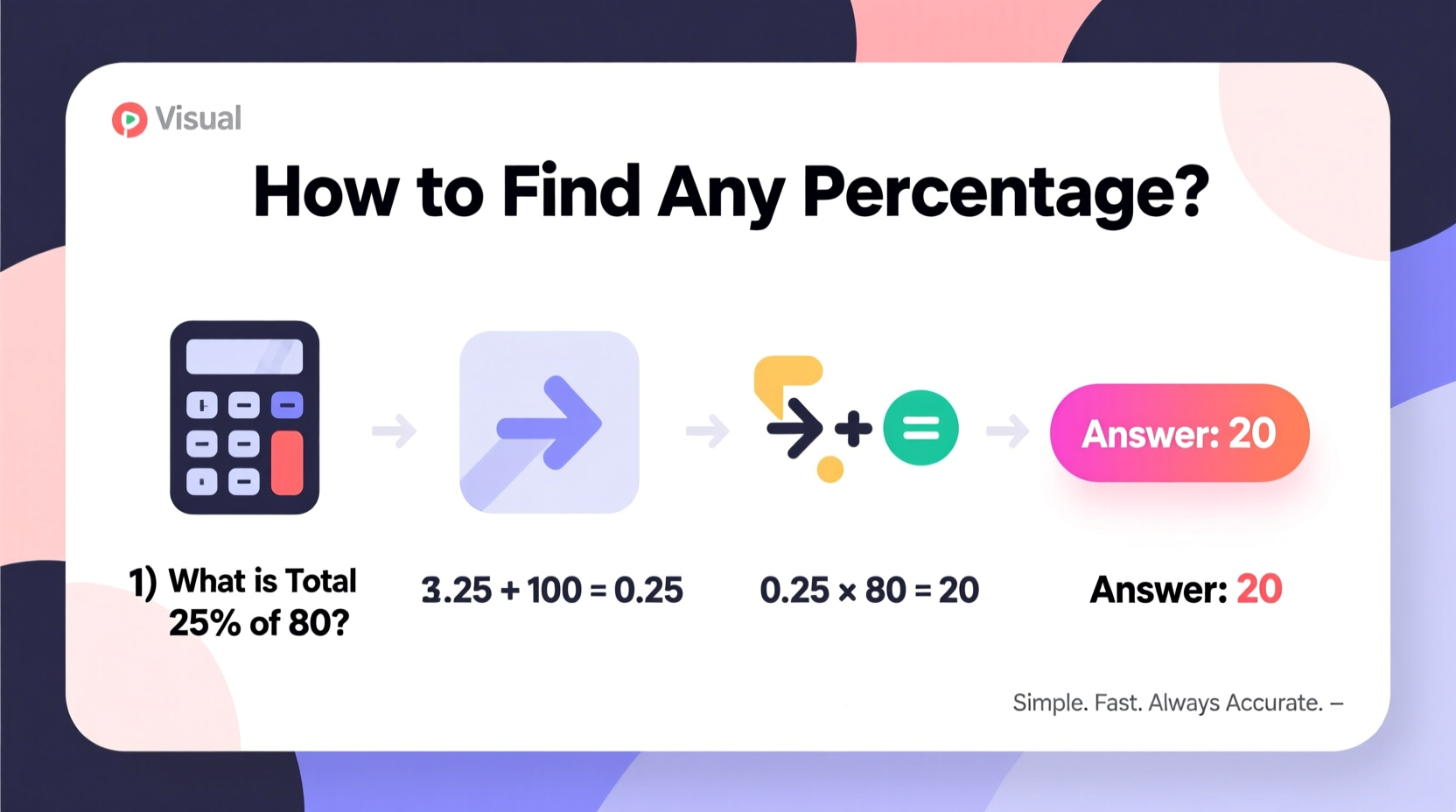
The word “percent” comes from the Latin *per centum*, meaning “by the hundred.” So when we say 25%, we’re literally saying “25 out of 100” or writing it as the fraction 25/100. This foundational idea is key: percentages are just fractions with a denominator of 100.
For example:
- 50% = 50/100 = 0.5
- 75% = 75/100 = 0.75
- 5% = 5/100 = 0.05
To find a percentage of a number, you're essentially asking: “What part of this number corresponds to X out of 100?” Once you understand this relationship, the actual calculation becomes much simpler.
Step-by-Step Guide to Calculating Any Percentage
Follow this five-step process to calculate the percentage of any number with confidence.
- Identify the total amount – This is the whole number you’re taking a percentage of. For example, if you want to know 20% of $80, the total is 80.
- Determine the percentage you need – Is it 10%, 15%, or 7%? Write it clearly.
- Convert the percentage to a decimal – Divide the percentage by 100. For instance, 20% becomes 0.20.
- Multiply the total by the decimal – Using our example: 80 × 0.20 = 16.
- Interpret the result – The answer is 16, so 20% of $80 is $16.
This method works for any percentage and any number, large or small. Whether you're calculating a tip, a discount, or interest, the process remains the same.
Real-Life Example: Restaurant Tip Calculation
Imagine you’ve just finished a meal at a restaurant. Your bill comes to $65, and you’d like to leave a 18% tip. How much should you add?
Let’s apply the steps:
- Total amount: $65
- Percentage: 18%
- Convert 18% to decimal: 18 ÷ 100 = 0.18
- Multiply: 65 × 0.18 = 11.7
- Result: $11.70
You should leave an $11.70 tip. This approach ensures fairness and accuracy without guesswork.
Quick Mental Math Tricks for Common Percentages
You don’t always need a calculator. For frequently used percentages, there are mental shortcuts that save time and build number sense.
| Percentage | Calculation Trick | Example (of 80) |
|---|---|---|
| 50% | Divide by 2 | 80 ÷ 2 = 40 |
| 25% | Divide by 4 | 80 ÷ 4 = 20 |
| 10% | Move decimal one place left | 80 → 8.0 |
| 5% | Half of 10% | Half of 8 = 4 |
| 15% | 10% + half of 10% | 8 + 4 = 12 |
| 20% | Double 10% | 8 × 2 = 16 |
Using these tricks, you can estimate tips, discounts, or commissions in seconds. For instance, to find 15% of $50:
- 10% of 50 = 5
- 5% of 50 = 2.5
- Add them: 5 + 2.5 = 7.5 → $7.50
Common Mistakes and How to Avoid Them
Even simple percentage problems can go wrong if you overlook small details. Here are frequent errors and how to fix them.
- Forgetting to convert percent to decimal – Multiplying 25 × 80 instead of 0.25 × 80 leads to wildly incorrect results.
- Misplacing the decimal point – Confusing 1% (0.01) with 10% (0.10) changes the outcome significantly.
- Confusing percentage of vs. percentage increase – Finding 10% of 200 is different from increasing 200 by 10%. Know which one you need.
- Rounding too early – Round only at the final step to maintain accuracy.
“More than 60% of adults make avoidable errors in basic percentage calculations—usually due to skipping the conversion step.” — Dr. Alan Reyes, Numeracy Research Institute
Practical Applications in Daily Life
Understanding percentages isn't just academic—it has real value in everyday decisions.
Sales and Discounts
A jacket priced at $120 is on sale for 30% off. How much will you save?
30% as a decimal is 0.30. Multiply: 120 × 0.30 = 36. You save $36, so the sale price is $84.
Sales Tax
If your state charges 8% sales tax on a $200 purchase, the tax amount is 200 × 0.08 = $16. Total cost: $216.
Grades and Test Scores
You scored 42 out of 50 on a quiz. What’s your percentage? Divide 42 by 50 = 0.84 → 84%. That’s a B or B+, depending on the scale.
Budgeting
If you earn $3,000 monthly and want to save 20%, multiply 3,000 × 0.20 = $600. Set aside $600 each month.
Checklist: How to Accurately Calculate Percentages Every Time
Print or bookmark this checklist for quick reference whenever you need to find a percentage.
- ☐ Identify the original number (the whole).
- ☐ Determine the percentage needed.
- ☐ Convert the percentage to a decimal (÷100).
- ☐ Multiply the number by the decimal.
- ☐ Double-check your decimal placement.
- ☐ Round appropriately if necessary.
- ☐ Verify with a mental estimate (e.g., is 10% around this value?).
Frequently Asked Questions
How do I find a percentage without a calculator?
Use mental math tricks. Start with 10% (move decimal left once), then build up. For example, 35% is 10% + 10% + 10% + 5%. Find 10%, triple it, add half of 10%, and sum them.
What’s the easiest way to calculate 15%?
Take 10% of the number, then add half of that amount. For $40: 10% is $4, half is $2, so $4 + $2 = $6. 15% of $40 is $6.
Can percentages be more than 100%?
Yes. A percentage over 100% means the part is larger than the whole. For example, 150% of 60 is 1.5 × 60 = 90. This often appears in growth comparisons or performance metrics.
Conclusion: Make Percentages Work for You
Calculating percentages is a fundamental skill that empowers smarter decisions—from tipping fairly to managing personal finances. By understanding the simple principle of converting percentages to decimals and applying consistent steps, you eliminate guesswork and gain confidence in everyday math.
Practice with real numbers around you: check your grocery receipt, analyze a salary raise, or calculate how much you’ll save during a seasonal sale. The more you use it, the more natural it becomes.




 浙公网安备
33010002000092号
浙公网安备
33010002000092号 浙B2-20120091-4
Comments
No comments yet. Why don't you start the discussion?